9 May 2026 · 3 min read
The Fossilised Lightning: The Fulgurites of Lake Lefroy
In the salt pans of Lake Lefroy, lightning strikes fuse desert sand into glass tubes that record the electrifying power of the Australian sky.
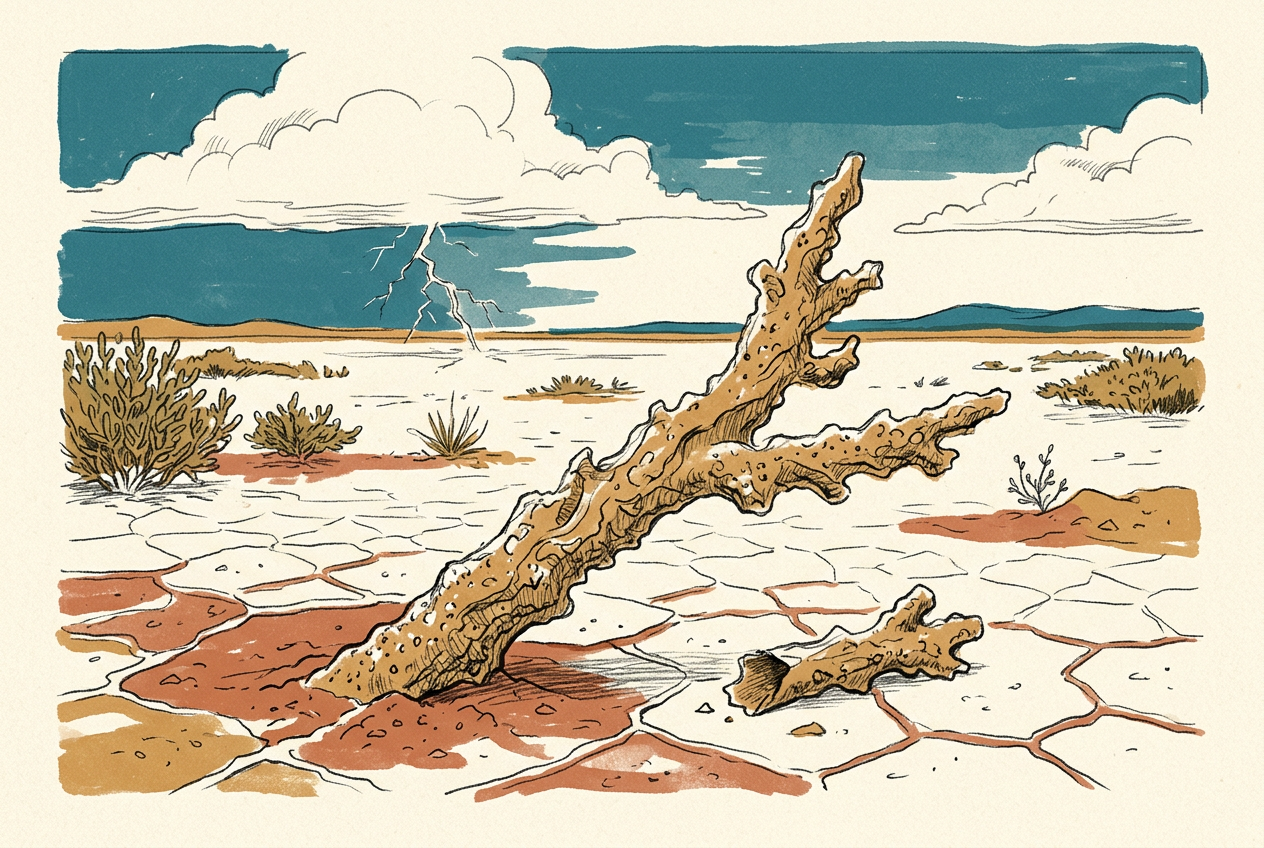
On the white salt crust of Lake Lefroy, near Kambalda in Western Australia, a lightning strike hits the ground at 30,000 degrees Celsius—five times hotter than the surface of the sun. In an instant, the quartz sand beneath the strike melts into a glassy tube, branching like root hairs through the sediment. These are fulgurites: fossilised lightning, frozen in silica.
The Instant of Creation
A fulgurite forms in less than a second. When lightning—a discharge of up to one billion volts—strikes dry sand, the intense heat vaporises moisture and fuses the surrounding quartz grains into a hollow glass tube. The outer surface is rough, coated with partially melted sand. The inner wall is smooth, vitrified, sometimes iridescent.
Lake Lefroy is a salt pan, a dry lakebed that floods only after rare rains. Its surface is a flat expanse of fine sand and evaporite minerals—ideal conditions for fulgurite formation. The salt crust conducts electricity more readily than dry sand, drawing strikes to the lakebed. Over thousands of years, the pan has accumulated a dense network of these glass tubes, some extending two metres or more into the sediment.
The fulgurites of Lake Lefroy are among the most extensive ever documented. In 2011, geologists mapping the area found tubes branching laterally for up to five metres, following moisture gradients and sedimentary layers. The largest specimens resemble the roots of a ghost tree.
A fulgurite is lightning's signature in stone—a single violent moment preserved as glass.
Reading the Record
Fulgurites are a form of mineralogical autobiography. They record not only the strike itself but the composition of the ground it struck. At Lake Lefroy, the sand is rich in quartz—silicon dioxide—which melts at around 1,700 degrees Celsius. But the salt crust introduces sodium and chlorine into the melt, lowering the melting point and altering the glass chemistry.
Under a microscope, Lake Lefroy fulgurites reveal a chaotic structure: lechatelierite (pure silica glass), bubbles from vaporised moisture, and tiny crystals of halite and gypsum that re-formed as the glass cooled. The walls are layered, like tree rings, each layer marking a pulse of cooling and contraction.
These structures matter. Fulgurites can tell geologists about past climates—whether the ground was wet or dry when the strike hit, what minerals were present, even the approximate energy of the strike itself. In the salt pans of Western Australia, they preserve a high-resolution record of a landscape shaped by aridity and electrical storms.
The Landscape That Makes Them
Lake Lefroy sits within the Yilgarn Craton, a 2.7-billion-year-old block of Archean granite and greenstone that forms the ancient core of southwestern Australia. The lake itself is young—a shallow depression carved by Pleistocene winds and occasional flooding. Its salt crust builds and dissolves with the seasons.
The same storms that bring rare rain to the lakebed also bring lightning. During the summer thunderstorm season, the sky above the salt pans turns electric. Cloud-to-ground strikes are frequent, and each one that hits the dry lakebed has the potential to create a fulgurite. Over millennia, these individual moments accumulate into a buried archive of storms.
Yet fulgurites are fragile. The same glass that preserves the strike is brittle and easily broken by wind, water, or the boots of prospectors. Most are discovered by accident—eroded from the sand by a rare flood, or exposed by the scraping of mining equipment. The Lake Lefroy area, home to gold and nickel operations, has yielded many of the best specimens.
The Unseen Archive
Fulgurites are not rare. Any sandy landscape with frequent lightning will produce them. But they are rarely noticed and rarely studied. They lie beneath the surface, invisible, until erosion or excavation reveals them. For every fulgurite collected, hundreds more remain buried.
Lake Lefroy's fulgurites are a reminder that the Australian landscape records its history in unexpected ways. Not only in the deep time of cratons and sedimentary basins, but in the instantaneous events—the strike, the flash, the melt—that leave their signature in glass. The sky above the salt pan writes its autobiography in sand, one bolt at a time.
More like this
- The 110-Million-Year-Old River That Runs Backwards UndergroundWestern Australia's 110-million-year-old dune system has been slowly dissolving into a labyrinth of caves where an ancient river still flows, carrying the taste of a Cretaceous desert.
- The 5,000-Year-Old Volcanoes That Still Smoke in the SouthIn Victoria's Newer Volcanics Province, 400 volcanic vents erupted as recently as 5,000 years ago—the youngest volcanic field in mainland Australia, where craters still hold blue lakes and scoria cone
- The 560-Million-Year-Old Garden That Never Saw a PredatorIn South Australia's Flinders Ranges, 560-million-year-old Ediacara surfaces preserve entire seafloor communities of fronds, discs, and quilts — a garden of soft-bodied life that flourished before pre