9 May 2026 · 3 min read
The Fossilised River: The Paleochannels of the Gawler Craton
Beneath the arid plains of South Australia, 40-million-year-old buried river channels preserve gold, uranium, and a record of a wetter continent.
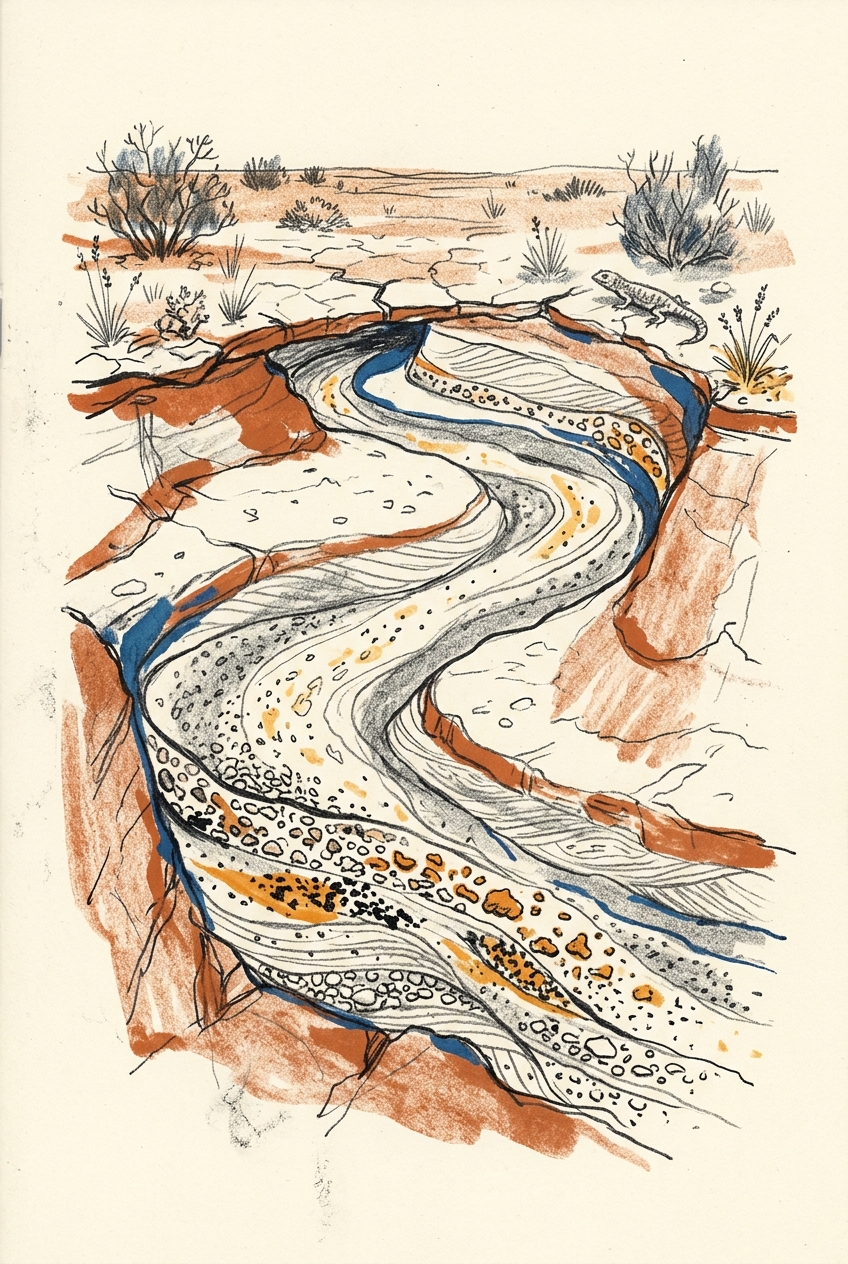
Northwest of Ceduna, the land flattens into a horizon of saltbush and red dirt. Nothing moves but the heat shimmer. But beneath this surface lies something unexpected: a network of ancient river channels, buried under thirty metres of sediment, that flowed across the Gawler Craton forty million years ago.
The paleochannels of the Gawler Craton are the ghosts of a wetter Australia. During the Eocene, when the continent was still attached to Antarctica and the climate was warm and humid, rivers carrying quartz sand and heavy minerals cut deep valleys into the Proterozoic basement. Then Australia drifted north, the continent dried, and the rivers were slowly buried by their own abandoned sediment.
The Buried Valleys
The channels are not visible from the air. They were discovered by drilling programs in the 1970s and 1980s, when geologists searching for uranium noticed that the water table beneath certain flat plains was unusually rich in dissolved minerals. The drill cores told the story: ancient valley floors, sometimes more than a kilometre wide, filled with Eocene sands and capped by clay-rich soils.
These paleochannels are preserved in remarkable detail. The original river gradients, the meander patterns, the point bars and floodplain deposits—all are intact beneath the modern surface. In places the channels follow the same fracture lines that guided Proterozoic mineralising fluids a billion and a half years earlier.
What the Water Carried
The paleochannels are economically significant for two reasons. First, they act as natural aquifers, storing groundwater that now sustains remote pastoral stations and mining operations across the Gawler Craton. Second, the ancient river gravels concentrated heavy minerals: gold, uranium, and iron oxide-copper-gold deposits that were eroded from the surrounding bedrock and deposited in the channel floors.
The most famous of these deposits is the Challenger gold mine, where gold particles weathered from a 1.7-billion-year-old lode were re-concentrated by Eocene river action. Miners extract the gold not from hard rock but from loosely consolidated gravel, the same way they would pan a modern stream. The river that deposited it has been gone for forty million years, but its work remains.
The river that deposited it has been gone for forty million years, but its work remains.
A Climate Archive
Beyond their mineral wealth, the paleochannels preserve a fine-grained record of environmental change. The sands and clays contain fossil pollen, leaves, and wood fragments that document the transition from the Eocene rainforests to the arid interior of the present day.
Pollen studies from the channel sediments show that the Gawler Craton once supported podocarp forests, Nothofagus beech, and tree ferns—vegetation now restricted to Tasmania and the highlands of New Guinea. The gradual disappearance of these species from the pollen record tracks Australia's northward drift and the onset of the modern aridity.
The Landscape Beneath the Landscape
The paleochannels remind us that the Australian continent is not a single surface but a stack of them, each buried beneath the next. What looks like a featureless plain is actually a palimpsest: the Eocene rivers cut into Proterozoic rock, the Miocene sediments filled them, and the Pleistocene dust covered everything.
Drill cores from the Tarcoola region sometimes bring up three distinct layers in a single metre: Archean granite at the base, Eocene river sand in the middle, and Pleistocene clay on top. Each layer represents a different Australia, a different climate, a different set of processes.
The channels also pose a practical question. As the Murray-Darling Basin dries and the Great Artesian Basin is drawn down, these ancient riverbeds are being tapped for groundwater at an increasing rate. They contain finite reserves—fossil water that has been stored for tens of thousands of years. Once pumped, it will not be replaced on any human timescale.
The Gawler paleochannels are a quiet archive: no cliffs, no gorges, no dramatic outcrops. Just a flat plain, a drill rig, and a core sample that holds the shape of a river that ran before humans existed.
More like this
- The 110-Million-Year-Old River That Runs Backwards UndergroundWestern Australia's 110-million-year-old dune system has been slowly dissolving into a labyrinth of caves where an ancient river still flows, carrying the taste of a Cretaceous desert.
- The 5,000-Year-Old Volcanoes That Still Smoke in the SouthIn Victoria's Newer Volcanics Province, 400 volcanic vents erupted as recently as 5,000 years ago—the youngest volcanic field in mainland Australia, where craters still hold blue lakes and scoria cone
- The 560-Million-Year-Old Garden That Never Saw a PredatorIn South Australia's Flinders Ranges, 560-million-year-old Ediacara surfaces preserve entire seafloor communities of fronds, discs, and quilts — a garden of soft-bodied life that flourished before pre