8 May 2026 · 3 min read
The Equatorial Ice: The Elatina Rhythmites
Explore the Elatina Formation in South Australia, where 635-million-year-old glacial rhythmites provide evidence for the 'Snowball Earth' phenomenon.
In the dry, undulating hills of the Flinders Ranges, the earth holds a silent record of a time when the entire planet was encased in ice. Here, within the Brachina Gorge, the Elatina Formation reveals layers of silt and stone that tell of a world frozen from pole to equator roughly 635 million years ago.
The Global Glaciation
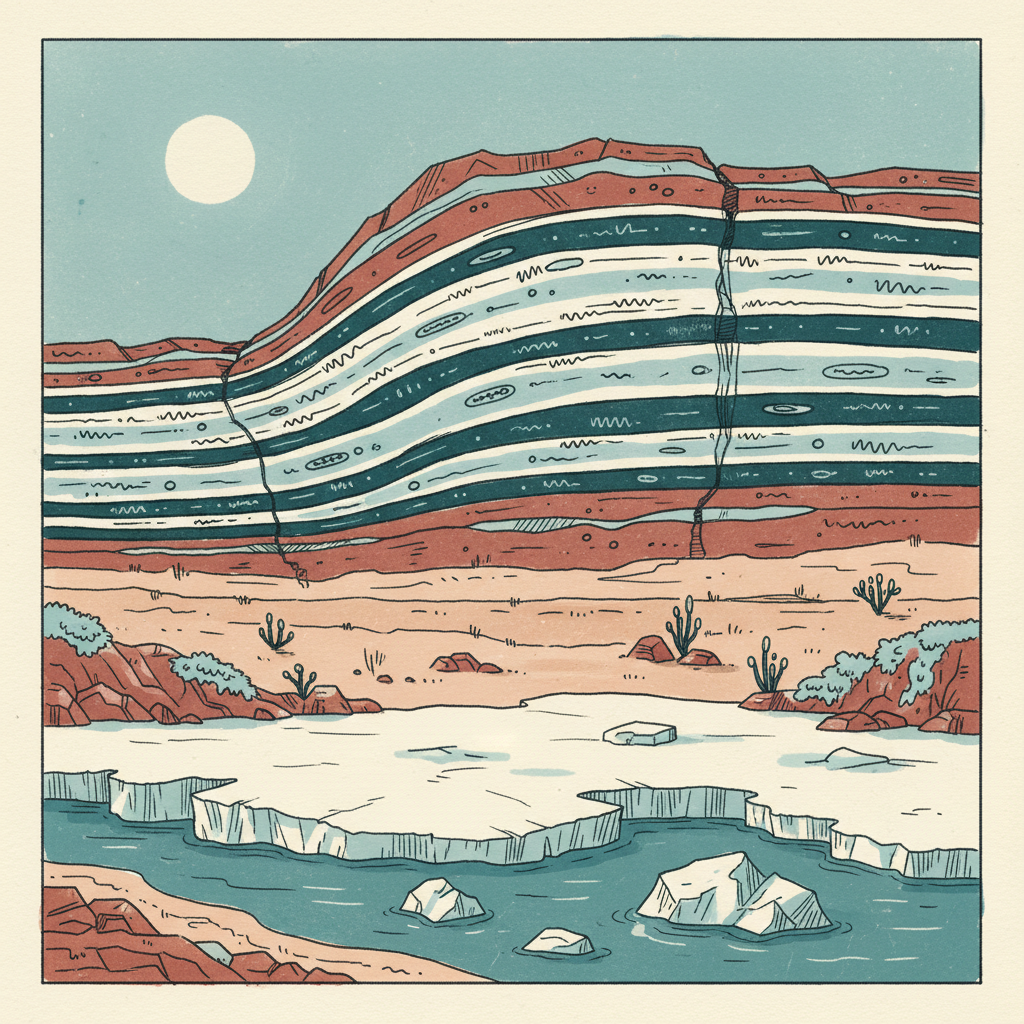
The Cryogenian period was defined by the Marinoan glaciation, a climatic extreme so severe it is commonly referred to as "Snowball Earth." During this era, the Australian continent sat near the equator, yet the geological evidence suggests it was choked by ice. The Elatina Formation, part of the Yerelina Subgroup, consists of rhythmites—repetitive layers of sediment deposited by tides and glacial melt.
These layers are remarkably thin, often no thicker than a fingernail, yet they represent a precise seasonal heartbeat. Geologists have used these laminations to track the lunar cycle and the Earth’s rotation from over half a billion years ago. The presence of dropstones—heavy boulders carried by icebergs and dropped into fine-grained sea-floor mud—confirms that glaciers were calving directly into the ocean at tropical latitudes.
The Rhythms of the Ice
What makes the Elatina Formation globally significant is its preservation of "tidal rhythmites." These are not merely glacial debris; they are a high-resolution recording of the ancient environment. By counting the thickness and frequency of these layers, researchers have reconstructed the orbital mechanics of the Neoproterozoic era.
The fine silts of the Elatina are a clock, ticking with the pull of a moon that was significantly closer to the Earth than it is today.
The formation suggests that even during a global freeze, the oceans remained dynamic. Tides ebbed and flowed beneath or alongside massive ice shelves, depositing sand and silt in a predictable, metronomic fashion. This contradicts the idea of a completely stagnant, solid-frozen ocean, suggesting instead a world of "slush" or seasonal openings in the ice.
The Great Unfreezing
The end of the Elatina glaciation was as dramatic as its onset. Above the glacial silts lies a distinct layer of "cap carbonates"—warm-water limestones that appear abruptly in the geological record. This transition represents one of the most violent climatic shifts in Earth's history.
As carbon dioxide from volcanic eruptions built up in the atmosphere, unable to be absorbed by a frozen ocean, it eventually triggered a runaway greenhouse effect. The ice melted with terrifying speed. The resulting chemical weathering of the continents flushed immense amounts of calcium and carbonate into the sea, creating the distinctive pinkish limestones that sit directly atop the glacial debris.
A Crucible for Life
While the Elatina Formation records a period of extreme hardship, it also marks the threshold of a biological revolution. The massive influx of nutrients into the oceans following the melt is thought to have paved the way for the rise of complex multicellular life.
The rocks of the Flinders Ranges do more than just document a freeze; they provide the context for the Ediacaran organisms that would follow. The "Snowball Earth" was the crucible. By stripping the oceans of competition and then flooding them with minerals, the planet inadvertently set the stage for the first great experiment in complex body plans. Throughout the Brachina Gorge, the red and grey bands of the Elatina stand as a testament to a planet that survived its own extinction.
More like this
- The 110-Million-Year-Old River That Runs Backwards UndergroundWestern Australia's 110-million-year-old dune system has been slowly dissolving into a labyrinth of caves where an ancient river still flows, carrying the taste of a Cretaceous desert.
- The 5,000-Year-Old Volcanoes That Still Smoke in the SouthIn Victoria's Newer Volcanics Province, 400 volcanic vents erupted as recently as 5,000 years ago—the youngest volcanic field in mainland Australia, where craters still hold blue lakes and scoria cone
- The 560-Million-Year-Old Garden That Never Saw a PredatorIn South Australia's Flinders Ranges, 560-million-year-old Ediacara surfaces preserve entire seafloor communities of fronds, discs, and quilts — a garden of soft-bodied life that flourished before pre