12 May 2026 · 3 min read
The Volcano That Built a Reef: Lord Howe Island's Eroded Shield
Lord Howe Island, a 7-million-year-old shield volcano remnant in the Tasman Sea, hosts the world's southernmost coral reef and records the slow collapse of a Pacific hot spot volcano.
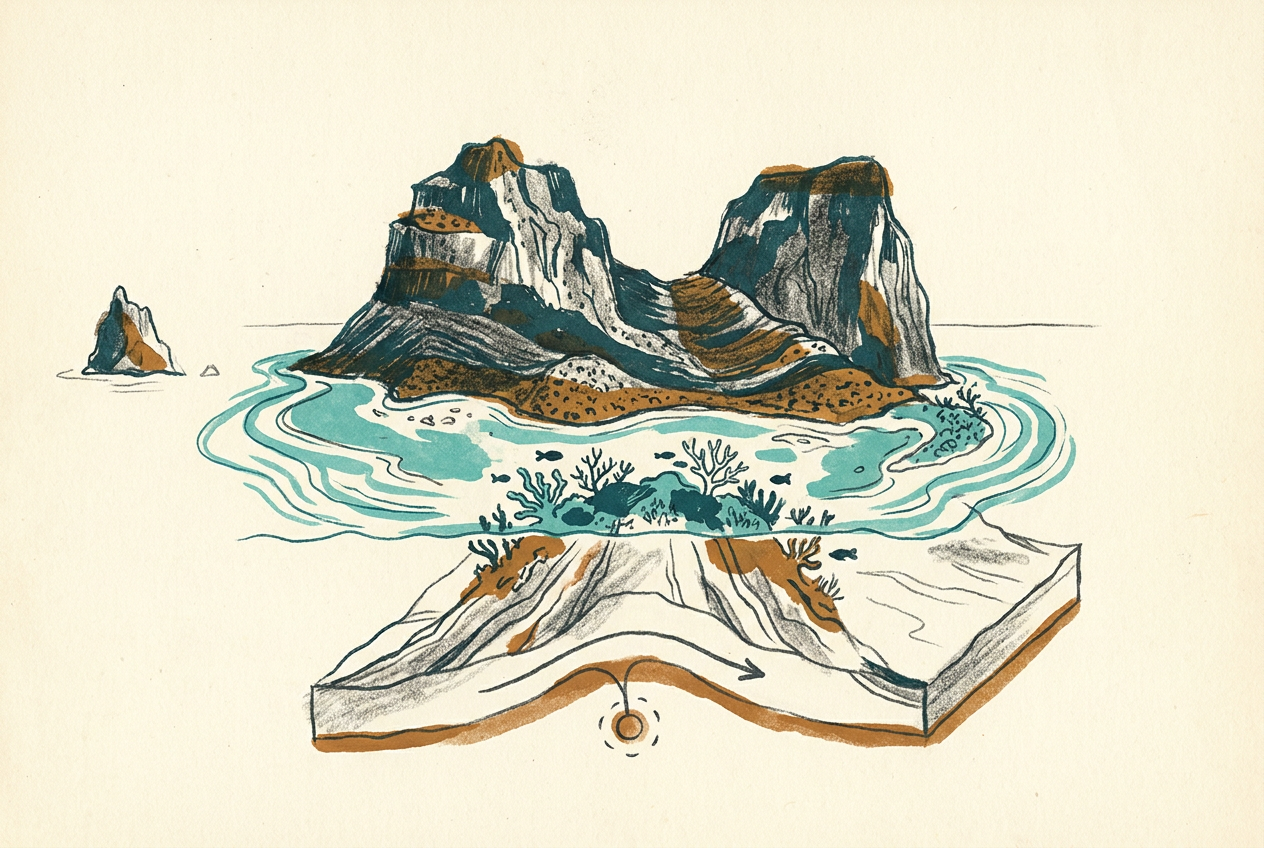
Seven million years ago, a shield volcano pushed above the Tasman Sea. Today, all that remains is a crescent of basalt and calcarenite, 11 kilometres long and shaped like a bent fishhook: Lord Howe Island.
The volcano that built this island was part of a hot spot chain—the same mantle plume that later created the seamounts of the Lord Howe Rise. As the Australian plate drifted north-east over a stationary thermal anomaly, magma punched through the seafloor, building a broad shield volcano perhaps 30 kilometres across. The island we see is its western rim, the collapsed eastern flank now submerged.
The Eroded Skeleton
Shield volcanoes are built by fluid basalt lavas that spread in thin, wide sheets. Lord Howe's original cone was likely symmetrical, like the Hawaiian shields. But once the hot spot moved on and volcanic activity ceased, the Pacific Ocean began dismantling it.
Wave action carved cliffs into the soft basalt. Reef-building corals colonised the shallow shelf. The central crater collapsed, and the sea flooded in. What survived was the western arc—Mount Lidgbird and Mount Gower, the island's twin peaks—rising 875 metres from the sea. These are not volcanic peaks in the active sense; they are the eroded roots of the old shield, the plumbing system laid bare.
The island's shape is not a volcano but a ghost of one: the skeleton of a mountain that no longer exists.
The Southernmost Coral Reef
Lord Howe Island sits at 31.5°S—near the thermal limit for coral reef growth. Here, the warm East Australian Current wraps around the island, keeping winter water temperatures above 18°C, just barely enough for reef-building corals to survive.
The reef that fringes the western shore is the world's southernmost true coral reef. It is young—perhaps 6,000 years old, having established itself after the last glacial maximum when sea levels stabilised. Unlike the Great Barrier Reef's vast carbonate factories, Lord Howe's reef is a thin veneer, a fringe of living coral clinging to the edge of a dead volcano.
The lagoon it encloses is shallow and clear. Beneath the surface, the transition is abrupt: living coral on the reef crest, then sand, then the dark basalt of the old shield. The reef is not growing on a carbonate platform but directly on volcanic rock—a reminder that every coral reef in the world began this way, as a tenant on borrowed stone.
A Record of Drift
The Lord Howe hot spot track extends north-west across the Tasman Sea, a chain of extinct volcanoes now submerged as seamounts. Each one marks a position of the mantle plume, frozen in time as the Australian plate crept north.
Lord Howe Island is the youngest subaerial expression of that track. The seamounts to its north-west are progressively older, their summits flattened by wave erosion and now sitting hundreds of metres below sea level, having cooled and subsided as the plate carried them away from the hot spot. This is the same process that built the Hawaiian-Emperor chain, but on a smaller, quieter scale.
The island's position also records the opening of the Tasman Sea. Around 85 million years ago, New Zealand rifted from eastern Australia, leaving a basin floored by basalt. The Lord Howe Rise—a submerged continental fragment—was left stranded in the middle. The hot spot that built Lord Howe Island punched through this stretched, thinned crust, not through a fresh oceanic plate.
So the island is a double record: of a mantle plume's passage, and of a continent's fragmentation. The basalt that forms Mount Gower's cliffs was once magma from deep within the mantle. The calcarenite dunes at the island's northern end are crushed shell and coral, the debris of a reef built on that basalt. Together, they tell the story of a volcano that rose, died, sank, and was briefly repopulated by life—before the sea takes it back entirely.
More like this
- The 110-Million-Year-Old River That Runs Backwards UndergroundWestern Australia's 110-million-year-old dune system has been slowly dissolving into a labyrinth of caves where an ancient river still flows, carrying the taste of a Cretaceous desert.
- The 5,000-Year-Old Volcanoes That Still Smoke in the SouthIn Victoria's Newer Volcanics Province, 400 volcanic vents erupted as recently as 5,000 years ago—the youngest volcanic field in mainland Australia, where craters still hold blue lakes and scoria cone
- The 300-Million-Year-Old Forest That Died Standing UpIn New South Wales, a 300-million-year-old fossil forest preserves dozens of trees buried upright by a Permian volcanic eruption—an entire ecosystem frozen in ash.