11 May 2026 · 3 min read
The Copper That Melted: The Olympic Dam Breccia Complex
Beneath the South Australian desert, the Olympic Dam deposit—the world's largest uranium and fourth-largest copper resource—formed 1.6 billion years ago when hydrothermal fluids explosively shattered
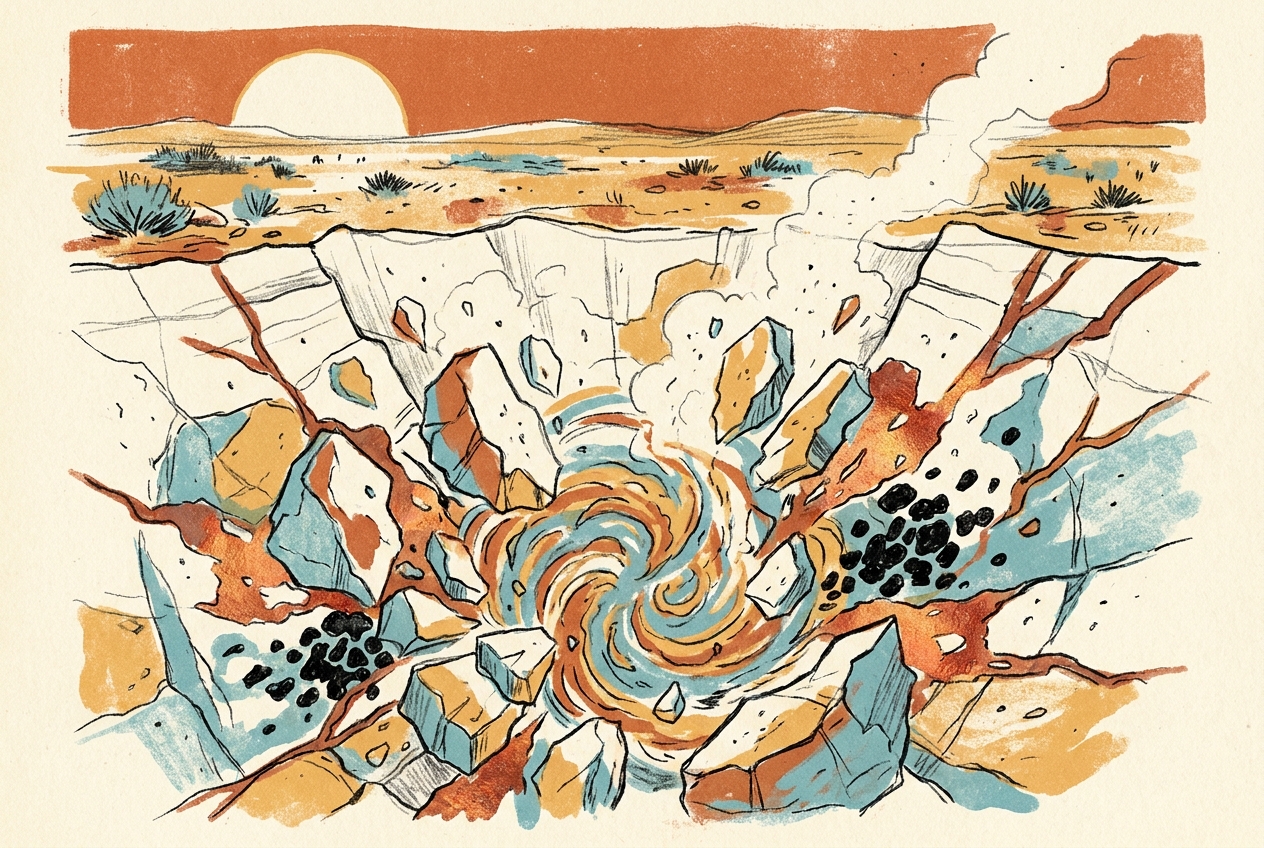
Four hundred metres below the South Australian desert, the largest known uranium deposit on Earth and the fourth-largest copper resource sit inside a single geological accident: a 7-kilometre-wide zone of shattered granite, its fractures laced with bornite, chalcopyrite, and uraninite.
The Broken Crust
Olympic Dam is not a vein, not a porphyry, not a stratiform layer. It is a breccia complex—a body of rock so thoroughly fractured that it resembles a jigsaw puzzle dropped from a height, the gaps between pieces filled with ore minerals. The host rock is a 1.6-billion-year-old granite, part of the Gawler Craton's Hiltaba Suite, which intruded during a period of intense magmatism that affected much of Proterozoic Australia.
What makes Olympic Dam unusual is not the granite itself but what happened after it cooled. A second pulse of hydrothermal activity—hot, metal-rich fluids rising from deeper magma chambers—did not simply flow through cracks. It exploded into the solid granite, brecciating it. The process repeated over hundreds of thousands of years, creating multiple generations of broken rock, each cemented by new mineral growth.
The resulting breccia pipes and lenses extend across an area roughly the size of the Sydney CBD, stacked in a vertical column that reaches from 300 metres depth down past 1,000 metres.
The Iron Oxide Connection
Olympic Dam belongs to a class of deposits called iron-oxide-copper-gold (IOCG) systems, a category that was barely recognised before its discovery in 1975. The defining minerals are hematite and magnetite—iron oxides that act as both host and cement for the copper and uranium sulphides.
In the deepest parts of the deposit, magnetite dominates, forming massive lenses of black iron ore that contain little copper. Higher up, hematite takes over, and with it comes bornite, chalcopyrite, chalcocite, and uraninite. The zoning is chemical, not accidental: it reflects the temperature and oxygen fugacity of the fluids as they rose and cooled through the breccia column.
The deposit was discovered not by drilling a visible outcrop but by interpreting a faint magnetic anomaly recorded by a government survey aircraft flying 150 metres above the red sand.
A Hidden Province
The discovery of Olympic Dam in 1975, after seven years of systematic exploration by Western Mining Corporation, transformed the understanding of Australian mineral wealth. Before it, the Gawler Craton was considered a barren shield—ancient, weathered, unlikely to host major deposits. The discovery team, led by geologist Roy Woodall, recognised that the subtle magnetic anomaly they had identified from airborne surveys might indicate buried iron-rich rocks. The first drillhole intersected 170 metres of copper mineralisation.
Olympic Dam now contains an estimated 7.7 billion tonnes of ore, grading 0.7 per cent copper, 0.03 per cent uranium oxide, and traces of gold, silver, and rare earth elements. The deposit remains open at depth.
The Unfinished Picture
No one has yet found another Olympic Dam. The same Hiltaba Suite granites extend across much of the Gawler Craton, and many carry the same iron-oxide alteration signatures, but the specific combination of processes—the right magma, the right fluid chemistry, the right fracturing regime—appears to have converged only once, 1.6 billion years ago, at this precise location.
That rarity is itself a geological lesson. The largest deposits are not simply the products of large-scale processes. They are the products of coincidence: a magma chamber that stayed hot long enough, a crust that fractured in just the right way, a fluid that carried exactly the right metals, and a chemical trap that precipitated them all in the same place.
Beneath the flat, dry plains of Roxby Downs, that coincidence is still there, waiting to be fully understood.
More like this
- The 5,000-Year-Old Volcanoes That Still Smoke in the SouthIn Victoria's Newer Volcanics Province, 400 volcanic vents erupted as recently as 5,000 years ago—the youngest volcanic field in mainland Australia, where craters still hold blue lakes and scoria cone
- The 1.85-Billion-Year-Old Caldera That Still Feeds the FurnaceIn South Australia's Middleback Ranges, a 1.85-billion-year-old volcanic caldera collapsed and later became one of the world's richest iron ore deposits.
- The 190,000-Year-Old Lava Tube That Still Holds a River of StoneIn Queensland's Undara volcano, 190,000-year-old lava tubes preserve the longest known flow on Earth—a frozen river of basalt that still shelters bats, ferns, and the memory of Pleistocene fire.