24 June 2026 · 3 min read
The Billion-Year Bombardment of the Gawler Craton
South Australia's Gawler Craton preserves a billion-year record of meteorite impacts, from the 580-million-year-old Acraman crater to the Nullarbor's modern meteorite finds, linking asteroid strikes t
On the Eyre Peninsula of South Australia, a farmer sinking a fence post in 1902 struck something that rang like metal. It was a block of iron—72 tonnes of it, lying just beneath the topsoil. The meteorite had fallen sometime in the last 10,000 years, but the landscape it landed on was far older: a 2.5-billion-year-old gneiss dome, scraped bare by ice and polished by wind. That single find—the largest meteorite ever discovered in Australia—opened a window into the deep time of a continent that has been quietly collecting the debris of the solar system for billions of years.
The 4.5-Billion-Year-Old Messenger
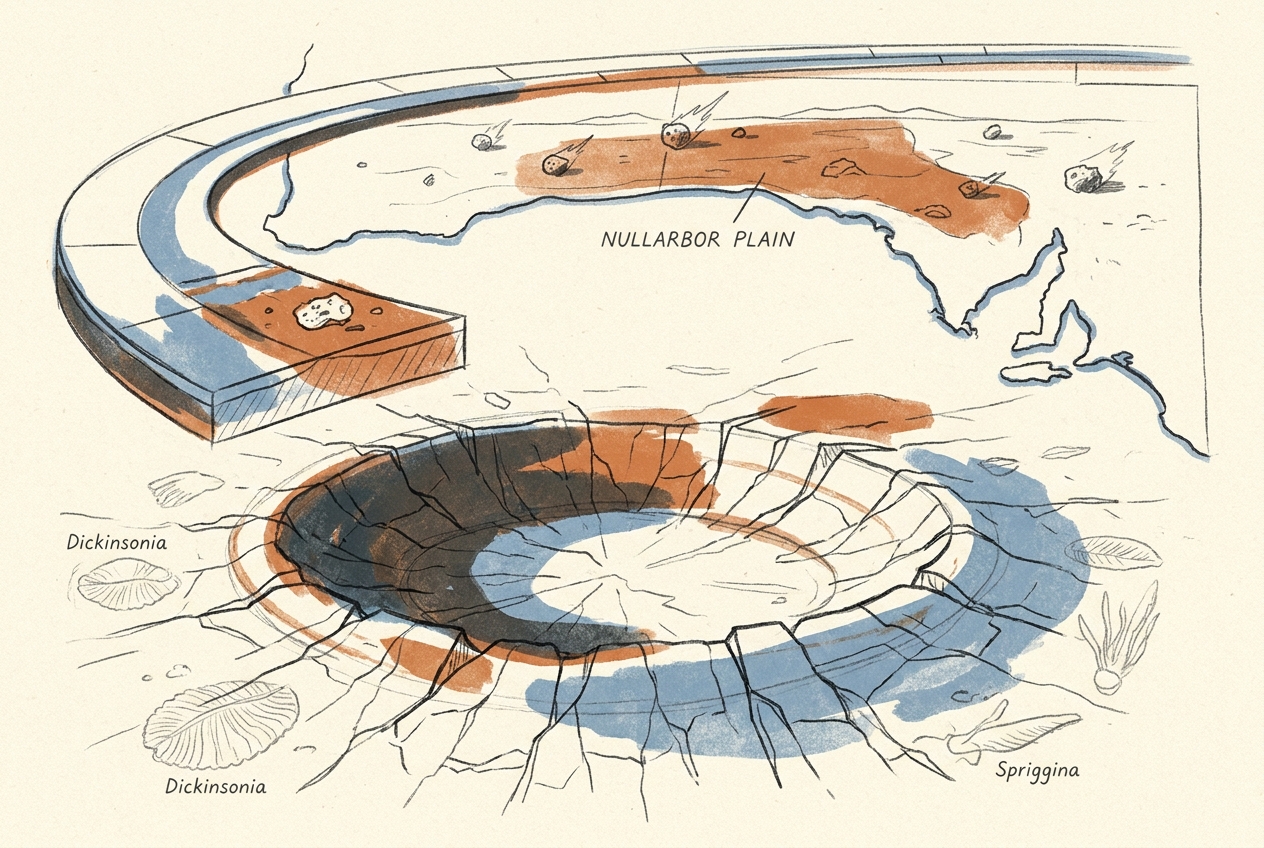
The meteorite now called the Mundrabilla iron was one of several large masses found scattered across the Nullarbor Plain. But the Nullarbor is a young surface—a limestone plateau laid down by a shallow sea only 15 million years ago. The real treasure lies to the east, in the Gawler Craton. This 2.5-billion-year-old block of ancient crust has been exposed at the surface for over a billion years. During that time, it has acted as a giant catcher's mitt for anything falling from the sky. The Hiltaba Suite granites that intruded the craton 1.6 billion years ago are studded with impact breccias—rocks shattered by meteorite strikes that happened long before complex life existed. The Gawler Ranges themselves may be the eroded remains of a 1.6-billion-year-old caldera system, but they also preserve the scars of at least four confirmed impact structures, including the 70-kilometre-wide Acraman crater, which formed 580 million years ago.
The Acraman Impact and the Ediacaran Sky
The Acraman event was one of the largest known impacts in Earth's history. A 4.8-kilometre-wide asteroid struck the Gawler Craton, ejecting debris across half a million square kilometres. The impact layer—a band of shattered rock and glassy spherules—is preserved today in the Flinders Ranges, interbedded with the same Ediacaran sediments that hold some of the oldest animal fossils on Earth. The timing was not coincidental. The Acraman impact has been proposed as a trigger for the Ediacaran diversification, the first major radiation of multicellular life. The reasoning is cautious but compelling: the impact would have injected vast quantities of phosphorus and iron into the shallow seas, fertilising the microbial communities that fed the earliest animals. The same layer of impact debris can be traced through the Bunyeroo Formation, where it sits directly beneath the beds that contain the iconic frond-like fossils of Dickinsonia and Spriggina.
The Acraman impact layer is the only known geological horizon that directly links a major asteroid strike with the dawn of animal life.
The Youngest Visitor
Not all of Australia's meteorites are ancient. The Nullarbor Plain, despite its young age, has yielded more meteorites per square kilometre than any other place on Earth. The reason is simple: the limestone surface is flat, dry, and virtually unchanging. Meteorites that fall here can lie undisturbed for tens of thousands of years, their dark fusion crusts standing out against the white calcrete. Since the 1960s, systematic searches have recovered over 1,000 meteorites from the Nullarbor, ranging from common chondrites to rare lunar and Martian specimens. One of them, a 4.5-billion-year-old chondrite called Camel Donga, contains tiny grains of presolar material—dust that formed in the atmospheres of other stars before the Sun was born. The Gawler Craton and the Nullarbor together span the entire history of the solar system. The oldest impact structures date from before the first bacteria; the youngest meteorite fragments fell within living memory. The continent has been recording the bombardment for over a billion years, and the record is still being read.
More like this
- The 560-Million-Year-Old Garden That Never Saw a PredatorIn South Australia's Flinders Ranges, 560-million-year-old Ediacara surfaces preserve entire seafloor communities of fronds, discs, and quilts — a garden of soft-bodied life that flourished before pre
- The 550-Million-Year-Old Frond That Died on PurposeA 550-million-year-old frond in the Flinders Ranges preserves the oldest known evidence of programmed cell death, recorded in the symmetrical decay pattern of Dickinsonia.
- The 825-Million-Year-Old Rift That Failed But Built a WorldA failed 825-million-year-old rift left a 650-kilometre volcanic chain and sedimentary basin in South Australia that preserved the Ediacaran fossils and still shapes the landscape today.