10 July 2026 · 3 min read
The 550-Million-Year-Old Frond That Died on Purpose
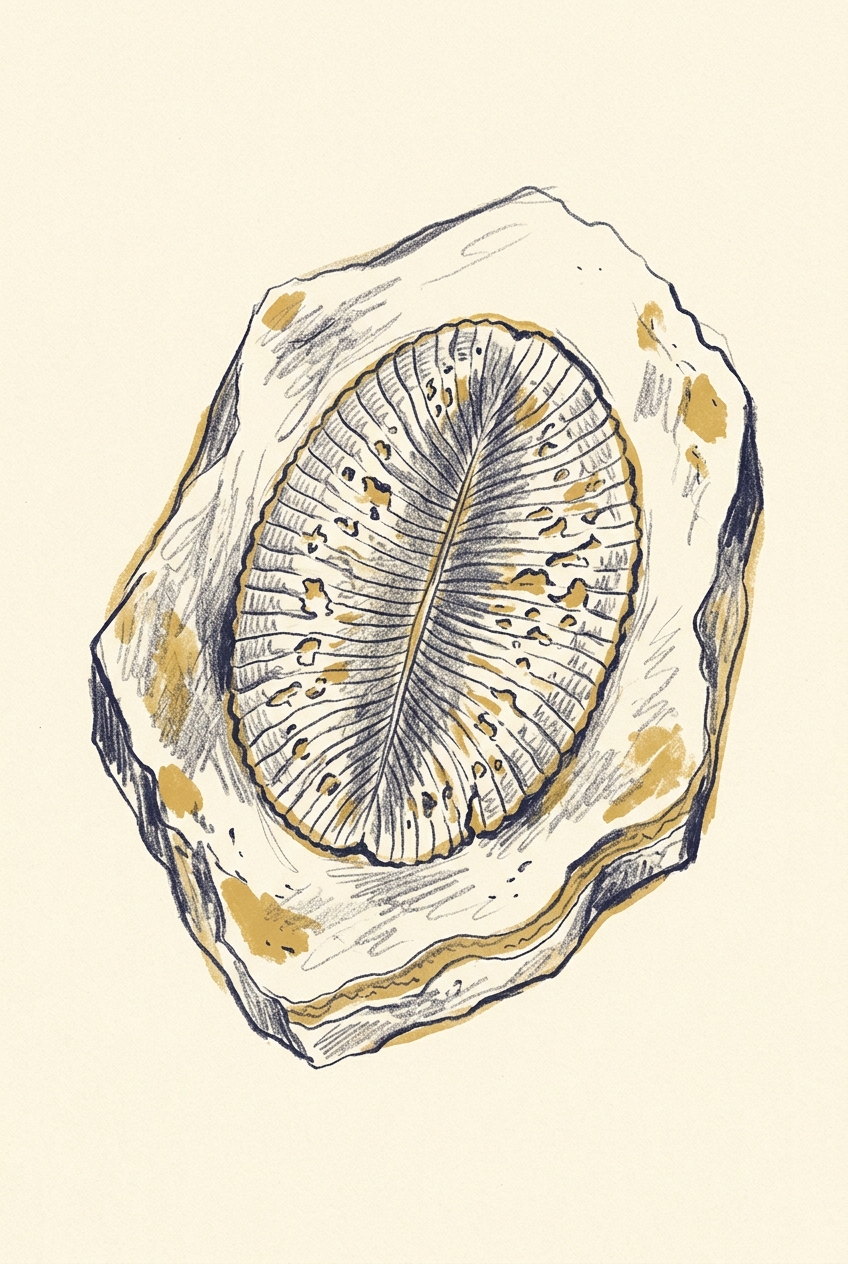
A 550-million-year-old frond in the Flinders Ranges preserves the oldest known evidence of programmed cell death, recorded in the symmetrical decay pattern of Dickinsonia.
In the Flinders Ranges of South Australia, a 550-million-year-old frond called Dickinsonia has left an imprint so precise that paleontologists can count how many hours it took to decay. The oldest known evidence of programmed cell death — apoptosis — is written not in bones or genes but in the slow collapse of a soft body on a microbial seafloor.
The Biology of Letting Go
Programmed cell death is essential to multicellular life. It prunes webbing between fingers, sheds the tail of a tadpole, and keeps cancerous cells from multiplying. Without it, complex organisms cannot develop or maintain themselves.
For decades, the earliest evidence of apoptosis came from animals with skeletons — Cambrian trilobites, Devonian fish. Soft-bodied Dickinsonia could not preserve cells, only shapes. But in 2022, researchers at the University of Oxford and the South Australian Museum realised that the decay pattern of Dickinsonia fossils contains a biological signature.
When a non-apoptotic organism dies, its tissues collapse randomly. The fossil looks wrinkled, shrunken, uneven. Dickinsonia specimens from the Flinders Ranges show something different: ordered shrinkage, with the body edge pulling inward symmetrically, as though the cells were programmed to release their contents in sequence.
“The frond didn’t just rot. It was dismantled.”
A Death That Preserved a Revolution
The Ediacaran seafloor was a microbial mat — a living carpet that held sediment together and prevented burrowing. Dickinsonia lay on top of this mat, absorbing nutrients through its underside. When it died, its body was quickly buried by episodic sandstorms that smothered the seafloor in thin layers.
The rate of burial mattered. Fast burial preserved the outer shape; slower burial captured the internal decay sequence. Fossils that took longer to be covered show the telltale signs of apoptosis — crisp, even edges that retreated uniformly, not the ragged collapse of passive decomposition.
This ordered dying is the hallmark of programmed cell death. It suggests that Dickinsonia had genetic machinery to control its own tissues, a prerequisite for the kind of development that would later produce eyes, limbs, and brains.
What It Means for the First Animals
Dickinsonia belonged to the Ediacaran biota, a group of soft-bodied organisms that lived between 575 and 541 million years ago. Their affinities remain debated: some researchers consider them early animals, others a failed experiment in multicellular life. The evidence of apoptosis pushes the argument toward animalhood.
Programmed cell death requires signalling proteins, enzymes called caspases, and the genetic instructions to build them. These are not trivial. They appear in all living animals — from sponges to humans — and their origin must lie deep in the Precambrian. Dickinsonia may not be our direct ancestor, but it shares a common tool kit with us.
The implication is striking. By 550 million years ago, organisms on the Ediacaran seafloor had already solved one of the hardest problems in biology: how to build a body and then, when the time came, take it apart cleanly.
A Fossil That Refused to Blur
Most soft-tissue fossils are ambiguous. A wrinkle might be a muscle; a stain might be an organ. The decay evidence is different. It is not an anatomical structure but a process — a sequence of events that can only happen if the cells are cooperating in their own destruction.
The Flinders Ranges fossils recorded that sequence in sandstone, grain by grain. As the Dickinsonia body broke down, the overlying sediment collapsed into the shrinking void, preserving the exact geometry of the retreat. That geometry matches what happens when lab-cultured cells undergo apoptosis.
Palaeontology rarely gets to watch cells die. In the Ediacaran, it was preserved for half a billion years.
More like this
- The 560-Million-Year-Old Garden That Never Saw a PredatorIn South Australia's Flinders Ranges, 560-million-year-old Ediacara surfaces preserve entire seafloor communities of fronds, discs, and quilts — a garden of soft-bodied life that flourished before pre
- The 300-Million-Year-Old Forest That Died Standing UpIn New South Wales, a 300-million-year-old fossil forest preserves dozens of trees buried upright by a Permian volcanic eruption—an entire ecosystem frozen in ash.
- The 1.75-Billion-Year-Old Reef That Outranks the BarrierA 1.75-billion-year-old microbial reef in the Kimberley is the largest biological structure ever built by a single species, preserving a world without predators.