24 June 2026 · 3 min read
The 1.7-Billion-Year-Old Storm That Froze in Stone: Western Australia's Bungle Bungle Range
How 1.7-billion-year-old sandstone in Western Australia's Bungle Bungle Range preserves the cross-bedded ripples of an ancient river delta, carved into orange-and-black domes by 20 million years of we
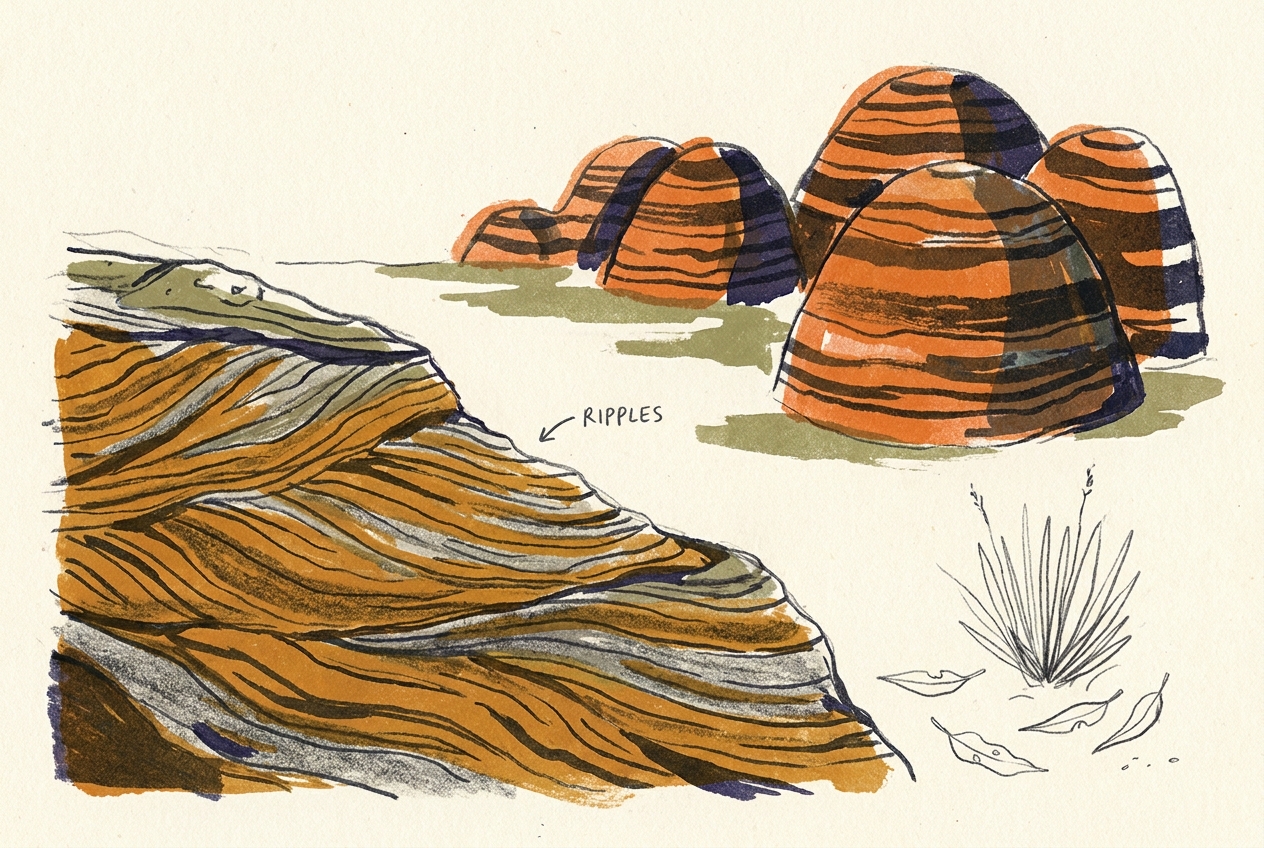
From a helicopter the Bungle Bungles look like a beehive the size of a city. The domes rise three hundred metres above the Kimberley savanna, striped in horizontal bands of orange and charcoal, so regular they appear painted. They are not painted. They are the cross-section of a river delta that poured into an inland sea 1.7 billion years ago, frozen in stone then carved by wind and water into one of the most alien landscapes on Earth.
The Delta That Became a Mountain
The rock is the Tonga Quartzite, a sandstone deposited during the Proterozoic when the Kimberley region was a vast coastal plain. Rivers carried sand from a rising mountain range to the north and dumped it into a shallow sea. Each flood season shifted the channels, and each shift left a sloping face of sand that later channels cut across. Those angled layers—cross-beds—are now preserved as the stripes on every dome.
The orange bands are iron oxide, precipitated from groundwater along permeable layers. The black bands are a crust of cyanobacteria that grows on the darker, moisture-retaining rock. The contrast is purely superficial: the dome beneath is the same quartzite throughout. The Bungle Bungles are not a stack of coloured sediments but a single formation scoured into thousands of identical knobs.
The Sculptor That Took 20 Million Years
The range sits inside Purnululu National Park, a name derived from the local Kija language meaning "sandstone." The domes formed not by uplift but by erosion. For roughly 20 million years the nearby Ord River has been cutting downward, and the exposed sandstone has weathered along a grid of vertical joints. Rain runs down the joint faces, undercutting the base until the pillars separate into rounded mounds.
The process is slow and precise. Each dome is roughly the same size because the joint spacing is uniform. The result is a landscape that looks artificial—a field of termite mounds built by a god with a plumb line.
The Bungle Bungles were unknown to most Australians until 1983, when a documentary crew flew over them during a fire survey. The footage caused a national sensation.
The Ripple That Survived a Billion Years
Look closely at the fallen slabs scattered among the domes. Many carry the impressions of ancient ripples—asymmetric ridges formed by water flowing in one direction. These are current ripples, identical to those you would find in a modern riverbed. They tell a story of depth and velocity: the water that deposited this sand was less than a metre deep and moving at about half a metre per second.
What is remarkable is not the ripples but their age. The sand that held them has been buried, compacted, cemented, uplifted, and stripped again. The ripples survived every transformation because quartzite is stubborn. It does not flow or recrystallise easily. The same grains that rolled across a Proterozoic riverbed are still touching one another, their surfaces still marked by the same current.
The Weather That Wins
The Bungle Bungles are eroding faster now than at any time in their history. The cyanobacteria that form the dark stripes protect the rock beneath, but the orange bands are soft and crumble easily. Rain dissolves the iron cement, and the grains fall away. A single storm can remove several centimetres of rock from a dome's flank.
This is not decay but revelation. The domes are disappearing, and as they go they expose the cross-beds more sharply. In another few million years the Bungle Bungles will be gone entirely—a flat plain dotted with quartz pebbles. But the cross-beds will survive somewhere, buried again, waiting for the next cycle of uplift and erosion to bring them back into the light.
More like this
- The 110-Million-Year-Old River That Runs Backwards UndergroundWestern Australia's 110-million-year-old dune system has been slowly dissolving into a labyrinth of caves where an ancient river still flows, carrying the taste of a Cretaceous desert.
- The 5,000-Year-Old Volcanoes That Still Smoke in the SouthIn Victoria's Newer Volcanics Province, 400 volcanic vents erupted as recently as 5,000 years ago—the youngest volcanic field in mainland Australia, where craters still hold blue lakes and scoria cone
- The 560-Million-Year-Old Garden That Never Saw a PredatorIn South Australia's Flinders Ranges, 560-million-year-old Ediacara surfaces preserve entire seafloor communities of fronds, discs, and quilts — a garden of soft-bodied life that flourished before pre