25 June 2026 · 3 min read
The 500-Million-Year-Old Volcano That Holds Australia's Rarest Blue Sapphires
How 500-million-year-old volcanic activity in New South Wales' New England region created sapphire crystals that still wash from deep weathering profiles today.
The blue of a New England sapphire is not quite like any other. It has a steeliness to it, a gunmetal undertone that sets it apart from the sugary blues of Sri Lanka or the cornflower of Kashmir. The colour comes from a volcano that erupted half a billion years ago, when the eastern edge of Australia was not a continent but an archipelago — a chain of volcanic islands adrift in the ancient Pacific.
The Lost Arc of the Lachlan Fold Belt
During the Cambrian and Ordovician periods, between 500 and 450 million years ago, a subduction zone ran along the eastern margin of what would become Australia. An oceanic plate slid beneath a scattering of island arcs, much like the modern Philippines or Indonesia. The volcanoes that rose from those arcs are long gone — eroded, buried, metamorphosed — but their roots remain.
The New England Orogen, a belt of deformed and intruded rock stretching from northern New South Wales into Queensland, preserves the deep plumbing of those ancient volcanoes. Magma chambers cooled slowly kilometres beneath the surface, and within those chambers, under intense heat and pressure, corundum — aluminium oxide — crystallised from aluminium-rich melts. Trace amounts of iron and titanium gave the crystals their distinctive blue.
Unlike most sapphires, which form in metamorphic rocks or basaltic lavas, the New England stones grew directly from a cooling silica-poor magma. They are igneous sapphires, born in the melt itself.
The Long Unroofing
A sapphire is hard — 9 on Mohs scale, second only to diamond — but it is not indestructible. It can survive the weathering and erosion that destroy the rocks around it. This is the key to how the New England sapphires reached the surface.
Over hundreds of millions of years, the volcanic mountains that once stood above the magma chambers were worn away. Rivers carried the debris to the sea. But the sapphires, dense and durable, did not travel far. They accumulated in ancient river gravels and alluvial fans, concentrated by the same processes that pan for gold.
The hardest mineral on Earth outlasts every mountain that held it.
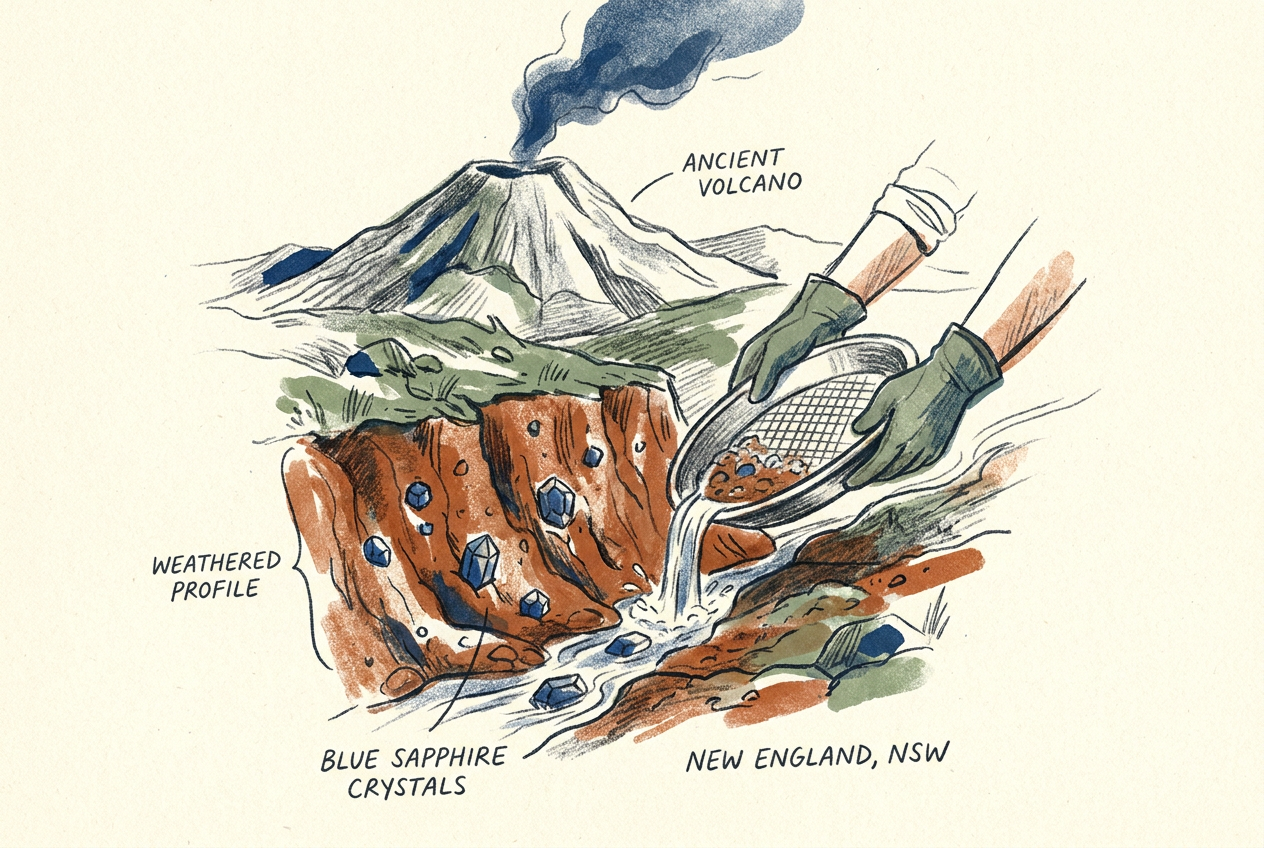
Today, the sapphires are found in deep weathering profiles — layers of decomposed rock that can extend tens of metres below the modern surface. These profiles formed during the Tertiary, when Australia was warmer and wetter, and chemical weathering ate deep into the old volcanic roots. The sapphires, along with zircons and spinels, were left behind as lag deposits.
The Inverell Field
The richest deposits lie around the towns of Inverell and Glen Innes on the New England Tableland. Miners work the pale, mottled clays of the weathered zone, washing the heavy concentrate through sieves and sluices. The sapphires come out as water-worn pebbles, their crystal faces rounded by transport. Most are small, a few carats at most. But the colour is exceptional.
Geologists call these deposits "basaltic sapphires" because the gemstones are often found in association with Cenozoic basalt flows — younger lavas that erupted 20 to 50 million years ago, covering the older rocks. The basalt did not create the sapphires; it simply provided a convenient host. The gems themselves are hundreds of millions of years older than the lava that entombs them.
This age gap — between the 500-million-year-old crystallisation and the 50-million-year-old basalt — means the sapphires have been through at least one full cycle of burial and exhumation. They formed in a Cambrian volcano, were eroded into Ordovician sediments, metamorphosed during the Carboniferous, and finally brought to the surface by Tertiary weathering. Few other minerals have survived such a journey.
A Stone That Remembers
Australian sapphires have never commanded the prices of their Burmese or Sri Lankan counterparts. They are often dark, sometimes almost inky, and they tend to be included — full of tiny rutile needles and healed fractures that testify to their violent origins. But for a gemmologist, they are among the most interesting stones on Earth.
Each crystal carries a record of the magma from which it grew: the trace elements that colour it, the inclusions that reveal its temperature and pressure history, the zoning that maps the changing chemistry of the cooling chamber. A New England sapphire is not just a gem. It is a grain of Cambrian magma, polished by half a billion years of geology, still holding the memory of the lost island arc that gave it birth.
More like this
- The 110-Million-Year-Old River That Runs Backwards UndergroundWestern Australia's 110-million-year-old dune system has been slowly dissolving into a labyrinth of caves where an ancient river still flows, carrying the taste of a Cretaceous desert.
- The 5,000-Year-Old Volcanoes That Still Smoke in the SouthIn Victoria's Newer Volcanics Province, 400 volcanic vents erupted as recently as 5,000 years ago—the youngest volcanic field in mainland Australia, where craters still hold blue lakes and scoria cone
- The 300-Million-Year-Old Forest That Died Standing UpIn New South Wales, a 300-million-year-old fossil forest preserves dozens of trees buried upright by a Permian volcanic eruption—an entire ecosystem frozen in ash.