17 May 2026 · 2 min read
The Ash That Made a Mountain: Victoria's Devonian Granite
Victoria's Mount Buffalo is a 370-million-year-old granite batholith that rose as molten magma but never erupted, later carved by glaciers into a landscape of tors and gorges.
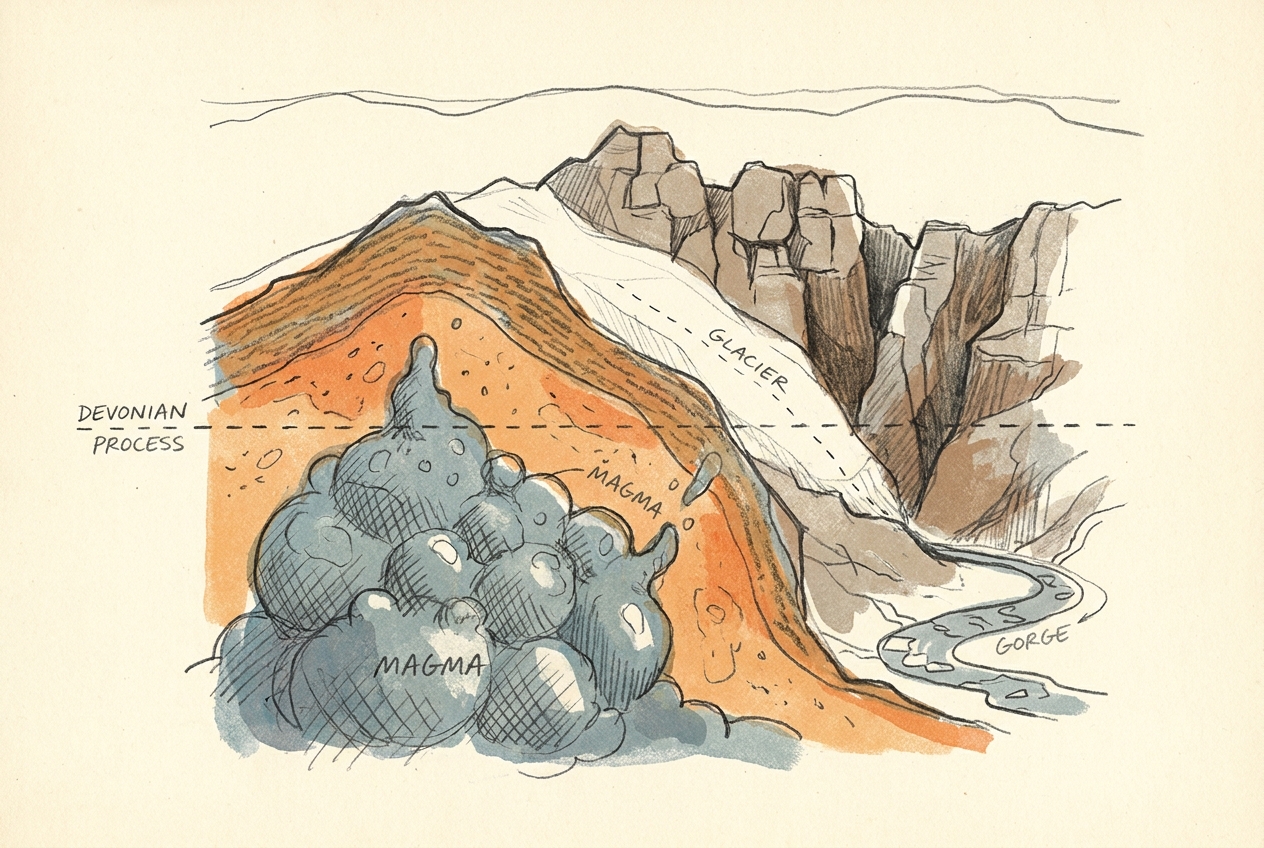
Mount Buffalo is not a volcano. It looks like one from a distance—a great hump of rock rising above the Victorian Alps—but its origins are deeper and quieter. The mountain is a single block of Devonian granite, 370 million years old, that cooled miles beneath the surface and only later, through the slow work of uplift and erosion, arrived at the daylight.
The Magma That Stopped
In the middle Devonian, eastern Australia was a volcanic arc. The Pacific Plate was subducting beneath Gondwana, melting the mantle and feeding a chain of volcanoes along the coast. Some of that magma never made it to the surface. It stalled in the crust, a body of molten rock perhaps 20 kilometres wide, and cooled so slowly that its minerals had time to grow into visible crystals.
The result was granite. Quartz, feldspar, mica—each mineral locked into a tight interlocking fabric that gives the rock its strength. The Mount Buffalo pluton is one of dozens of Devonian granites that stitch the high country of Victoria and New South Wales. They are the plumbing of a volcanic system that has long since eroded away.
The mountain is a fossil of heat. What we see is not what erupted, but what refused to erupt.
The Carving of a Batholith
Granite is hard, but not immune. For 300 million years after it cooled, the Mount Buffalo pluton sat buried under kilometres of overlying rock. Only in the last 10 million years did regional uplift and erosion strip that cover away. The granite emerged as a domed mass, its rounded shape inherited from the way the original magma body had bulged upward.
Then came the ice. During the Pleistocene, glaciers formed on the Buffalo plateau—small, cold-based glaciers that scoured the granite surface. They plucked blocks from joint planes, leaving behind tors and boulder fields. They carved cirques into the northern face. They deepened existing fractures into gorges. The landscape we see today is a collaboration between Devonian heat and Pleistocene cold.
The Crystals That Tell Time
Walk across the summit plateau and you walk on a surface that has been exposed for perhaps 2 million years. The granite is weathered into shallow pits and runnels—solution pans that hold rainwater after storms. Lichens cling to the feldspar. In the crevices, alpine plants take root.
But the rock itself holds a deeper record. Uranium-bearing minerals in the granite allow radiometric dating of its crystallisation. The 370-million-year age is precise, pinned to the Devonian period when fish dominated the seas and the first forests were spreading across the continents. Mount Buffalo is not a volcano. It is something rarer: a moment of arrested ascent, frozen in stone, then slowly unveiled by the same forces that build and unbuild all mountains.
More like this
- The 110-Million-Year-Old River That Runs Backwards UndergroundWestern Australia's 110-million-year-old dune system has been slowly dissolving into a labyrinth of caves where an ancient river still flows, carrying the taste of a Cretaceous desert.
- The 5,000-Year-Old Volcanoes That Still Smoke in the SouthIn Victoria's Newer Volcanics Province, 400 volcanic vents erupted as recently as 5,000 years ago—the youngest volcanic field in mainland Australia, where craters still hold blue lakes and scoria cone
- The 1.75-Billion-Year-Old Reef That Outranks the BarrierA 1.75-billion-year-old microbial reef in the Kimberley is the largest biological structure ever built by a single species, preserving a world without predators.