17 May 2026 · 3 min read
The Volcano That Drowned in a Lake: Queensland's Tweed Shield Volcano
Queensland's Tweed Volcano, active 23 million years ago, erupted basalt across 6,000 square kilometres, but its caldera later filled with a lake whose sediments preserved a unique record of Miocene Au
Twenty-three million years ago, a shield volcano the size of a small country rose above northern New South Wales and southern Queensland. Today, almost nothing of it remains above ground — but what was lost to erosion became something stranger: a lake that preserved a lost world in layers of silt.
The Mountain That Inverted Itself
The Tweed Volcano was one of Australia's largest Cenozoic volcanoes, erupting basalt across at least 6,000 square kilometres from a central vent near what is now Mount Warning. At its peak, the volcano likely stood more than 2,000 metres high — comparable to Mount Fuji. But unlike Fuji's steep andesite cone, Tweed was a broad shield built from runny basalt lava that flowed in all directions.
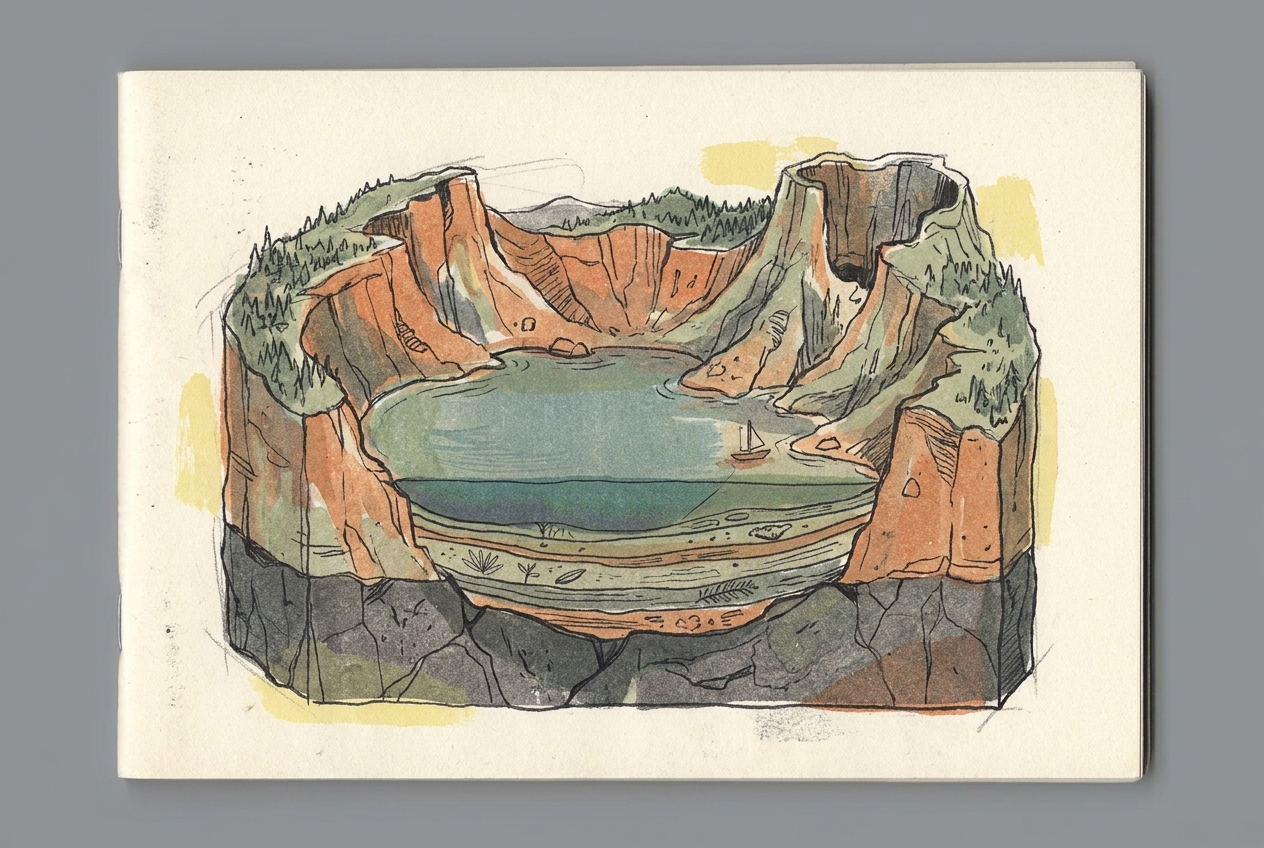
The eruptions ended around 20 million years ago. What followed was a slow collapse. The volcano's summit, undercut by its own weight and by the withdrawal of magma below, subsided into a caldera — a basin roughly 30 kilometres across. Erosion stripped away the original cone entirely. The result is what geologists call a "volcanic inversion": where the mountain once stood, only a depression remained.
The Caldera That Became a Lake
That depression filled with water, forming a lake that persisted for millions of years. Today, only fragments of this lake bed survive, preserved as the Lamington and Neranleigh-Fernvale groups — sedimentary rocks sandwiched between basalt flows. At places like the Numinbah Valley and along the McPherson Range, these lake deposits contain something remarkable: the fossils of a Miocene rainforest.
The lake was not deep, but it was calm. Fine clays and silts settled on its floor, burying leaves, flowers, seeds, and insects that fell from the surrounding forest. In some layers, the preservation is exquisite — individual leaf veins and insect wing venation remain visible. These are not the compressed coalified smears found in many fossil beds, but impressions in fine-grained sediment that capture the surface texture of every cell.
The lake's quiet waters did what the volcano's fire could not: they kept a record of the world the lava destroyed.
The Forest That Survives on Paper
The fossils reveal a forest unlike any in Australia today. The dominant trees were southern beeches (Nothofagus), now confined to Tasmania and South America, alongside conifers like Podocarpus and Agathis (the ancestors of today's kauri pines). Ferns, cycads, and palms filled the understorey. This was a cool, wet temperate rainforest — the kind that once stretched across a green Antarctica to connect Australia with South America.
The lake sediments also record the volcano's own decay. Interbedded with the fossil layers are thin bands of volcanic ash, washed in from eroding slopes on the caldera rim. Each ash layer marks a pulse of erosion after a storm or a minor seismic event. Together, the ash and the fossils tell a story of slow collapse: the volcano did not die in a single cataclysm but subsided incrementally over millions of years, its slopes sliding into the lake that had replaced its summit.
What Remains
The lake eventually drained or filled. The basalt flows that once capped the volcano now form the hard rims of the Border Ranges and the Lamington Plateau — protective caps that have preserved the softer sedimentary rocks beneath. Mount Warning itself, the volcano's eroded central plug, stands as a lone volcanic neck, the only piece of the original plumbing system still visible above ground.
The lake deposits are now found in road cuttings and creek beds, scattered across a landscape that bears no obvious resemblance to a volcano. No cone. No crater. Just a gentle, almost imperceptible basin in the hills, where road workers occasionally split open a slab of grey mudstone and find the ghost of a leaf that fell into still water when Australia was still attached to Antarctica.
More like this
- The 110-Million-Year-Old River That Runs Backwards UndergroundWestern Australia's 110-million-year-old dune system has been slowly dissolving into a labyrinth of caves where an ancient river still flows, carrying the taste of a Cretaceous desert.
- The 5,000-Year-Old Volcanoes That Still Smoke in the SouthIn Victoria's Newer Volcanics Province, 400 volcanic vents erupted as recently as 5,000 years ago—the youngest volcanic field in mainland Australia, where craters still hold blue lakes and scoria cone
- The 560-Million-Year-Old Garden That Never Saw a PredatorIn South Australia's Flinders Ranges, 560-million-year-old Ediacara surfaces preserve entire seafloor communities of fronds, discs, and quilts — a garden of soft-bodied life that flourished before pre