17 May 2026 · 3 min read
The Lava That Preserved a Lake: South Australia's Eromanga Sea Volcanoes
In South Australia, 120-million-year-old volcanoes erupted through the Eromanga Sea, creating islands that later became opal-bearing sedimentary rocks — a story of fire meeting water in the Cretaceous
In South Australia's far north, a chain of low hills rises from the red desert near the town of Andamooka. These are not ordinary hills. They are the throats of 120-million-year-old volcanoes that erupted through a shallow sea, building islands that later became some of the world's richest opal fields.
The Sea That Covered a Continent
During the Early Cretaceous, between 120 and 100 million years ago, much of inland Australia lay beneath a vast, shallow sea called the Eromanga Sea. It stretched from what is now the Gulf of Carpentaria down to the southern coast, covering nearly a third of the continent. The water was warm, perhaps 15 to 20 metres deep, and thick with microscopic marine life.
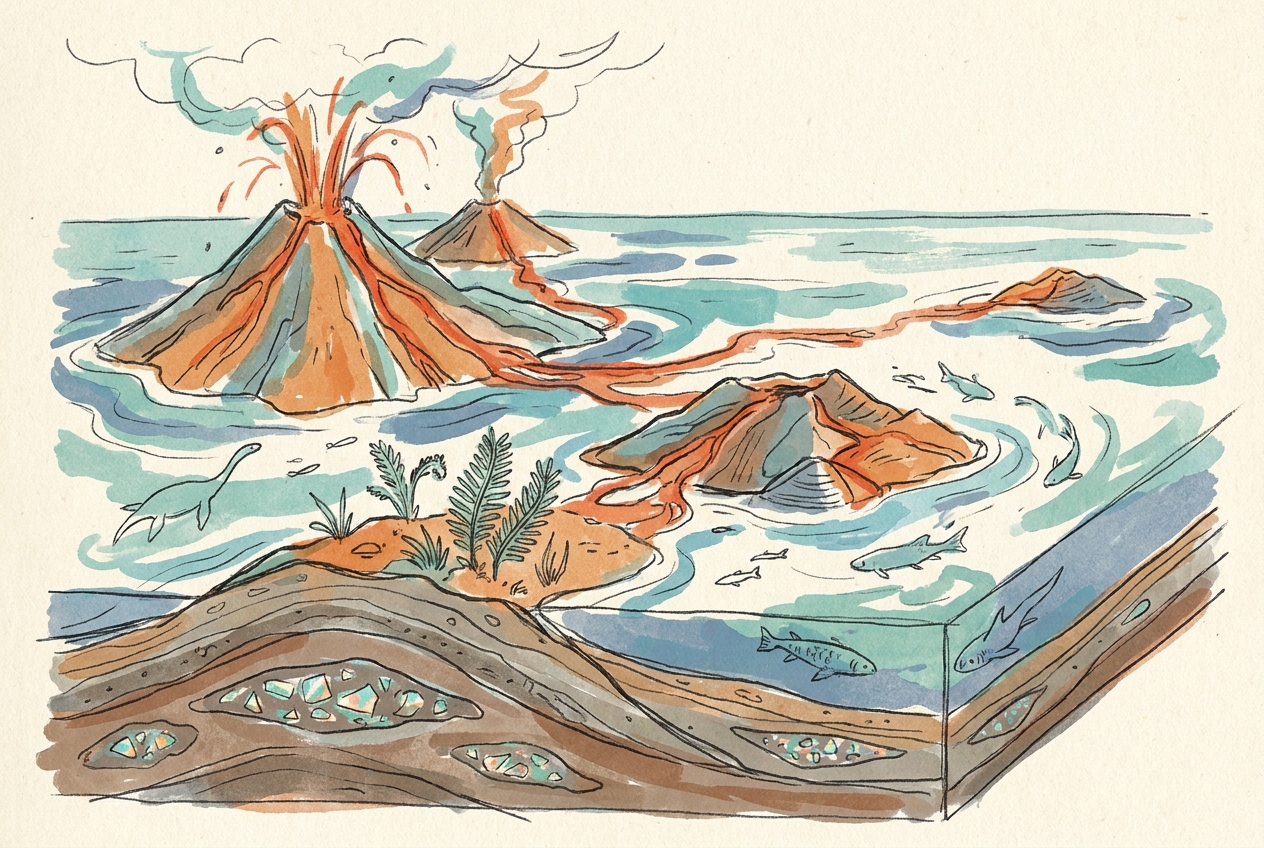
Along the sea's western margin, near present-day Andamooka and Coober Pedy, a series of volcanic vents punched through the sea floor. These were not violent eruptions of the kind that build towering cones. They were phreatomagmatic — explosions caused when rising magma met waterlogged sediment and seawater. Each eruption blasted a crater into the seabed, then built a low tuff ring of ash and shattered rock.
Over time, some of these rings grew into small islands, perhaps a kilometre across and a few tens of metres high. They were temporary landmarks in a shallow sea that had no other high ground.
When Fire Met Water
The evidence for these submerged volcanoes is preserved in the rocks of the Andamooka Ranges. Geologists have mapped more than a dozen separate vents, each marked by a sequence of volcaniclastic sediments — layers of ash, lapilli, and volcanic bombs that were deposited underwater and then reworked by currents.
What makes these eruptions unusual is what happened next. The volcanic islands weathered and eroded, releasing silica-rich fluids into the surrounding seabed sediments. Those sediments — fine-grained marine muds and silts — were already rich in the dissolved silica from countless microscopic organisms. When the volcanic silica mixed with this existing reservoir, it created the perfect chemical conditions for opal formation.
The opal at Andamooka is not found in the volcanic rocks themselves. It formed in the sedimentary layers adjacent to the volcanoes, where silica-rich groundwater percolated through cracks and pore spaces in the Cretaceous mudstone. Over millions of years, the silica precipitated as microscopic spheres, arranged in the regular lattice that produces opal's characteristic play-of-colour.
The volcanoes did not make the opal directly. They created the chemical engine that drove its formation.
The Desert That Kept a Secret
Today, the Eromanga Sea is gone, replaced by the stony deserts of South Australia. The volcanic islands have been eroded to low rises, their tuff rings barely visible against the horizon. But the opal they helped create lies buried in the ancient seabed sediments, protected by a cap of hard silcrete that formed during the Miocene.
Miners at Andamooka have worked these deposits since the early twentieth century. Unlike the famous black opal of Lightning Ridge, Andamooka's opal is typically lighter, with a milky or crystal base and bright flashes of colour. The most prized material is the "Andamooka matrix opal," in which the precious opal infills the pore spaces of the host rock, creating a stone that is part opal, part ironstone.
The link between the Cretaceous volcanoes and the opal was not understood until the 1980s, when detailed geological mapping revealed the extent of the volcanic vents. Before that, miners had simply followed the opal seams, unaware that they were walking on the eroded remnants of islands that had stood in a vanished sea.
A Vanished World
The Andamooka volcanoes are part of a larger pattern of Cretaceous volcanism across Australia. Along the eastern margin of the continent, the Whitsunday volcanic province erupted an estimated 2.5 million cubic kilometres of lava and ash between 132 and 95 million years ago, as Australia began to rift from Antarctica and Zealandia. The Andamooka vents were a smaller, western expression of this same tectonic event.
What survived is a rare geological archive: a record of how volcanic islands interact with marine sedimentation, and how those interactions can create conditions for gemstone formation. The opal fields of South Australia are not simply a story of silica-rich groundwater. They are a story of volcanoes that built islands in a Cretaceous sea, weathered into silica, and fed the chemical reactions that produced some of the world's most beautiful stones.
The low hills near Andamooka look unremarkable from a distance. Up close, they reveal a different history — one of fire, water, and the slow chemistry that turns volcanic ash into light.
More like this
- The 5,000-Year-Old Volcanoes That Still Smoke in the SouthIn Victoria's Newer Volcanics Province, 400 volcanic vents erupted as recently as 5,000 years ago—the youngest volcanic field in mainland Australia, where craters still hold blue lakes and scoria cone
- The 560-Million-Year-Old Garden That Never Saw a PredatorIn South Australia's Flinders Ranges, 560-million-year-old Ediacara surfaces preserve entire seafloor communities of fronds, discs, and quilts — a garden of soft-bodied life that flourished before pre
- The 300-Million-Year-Old Forest That Died Standing UpIn New South Wales, a 300-million-year-old fossil forest preserves dozens of trees buried upright by a Permian volcanic eruption—an entire ecosystem frozen in ash.