17 May 2026 · 3 min read
The Lava That Built a Diamond Mine: Western Australia's Argyle Pipe
How a 1.2-billion-year-old volcanic pipe in the East Kimberley produced rare pink diamonds from ancient carbon deep beneath the Australian continent.
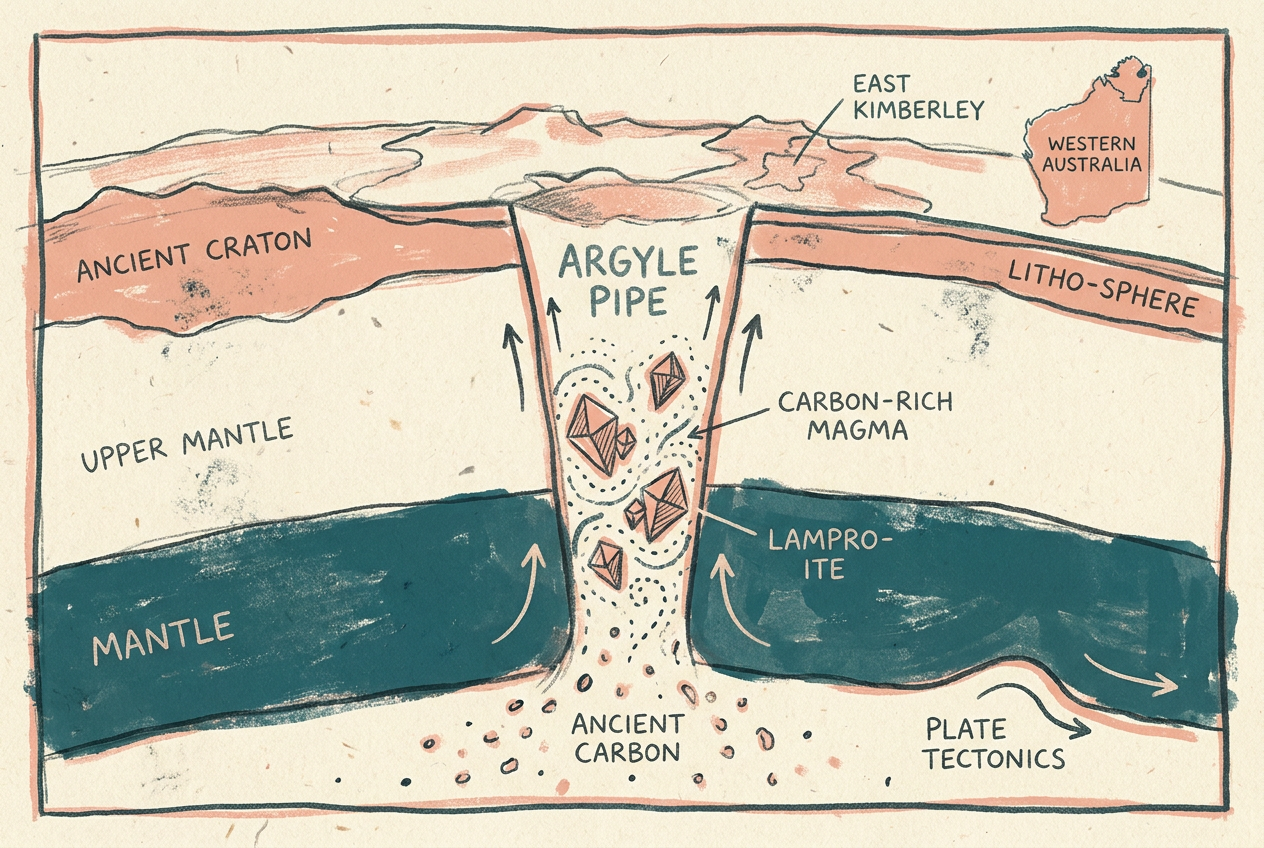
At 1.2 billion years old, the Argyle diamond pipe in Western Australia's East Kimberley region is not the oldest diamond deposit on Earth. It is, however, the only known source of pink diamonds at commercial scale — and it formed in a way that defied the rules of diamond geology.
The Wrong Kind of Rock
Most diamonds arrive at the surface through kimberlite pipes, volcanic conduits that punch through ancient continental crust from depths of 150 kilometres or more. Kimberlites carry diamonds from the stable roots of cratons — the thick, cold keels of Precambrian continents that have sat unmoved for billions of years.
Argyle is different. Its host rock is lamproite, a rarer volcanic rock with a different mineral chemistry. And the pipe did not erupt through a stable craton. It erupted through the Halls Creek Orogen, a mobile belt where crustal blocks had collided and sheared against each other during the Proterozoic.
The lamproite magma rose not through the thick, cold lithosphere that typically preserves diamonds, but through a zone that had been repeatedly deformed. Geologists initially doubted that diamonds could survive such a setting.
A Continent's Collision
The story begins 1.8 billion years ago, when two chunks of continental crust — the Kimberley Craton and the North Australian Craton — collided along what is now the Halls Creek Fault Zone. The collision squeezed and heated the rocks, folding them into mountain belts that later eroded.
More than 500 million years later, the same zone began to stretch and crack. Deep fractures opened. Lamproite magma, generated at great depth, shot upward along these weaknesses at speeds that may have reached 300 metres per second.
The magma carried fragments of carbon that had been transformed into diamond deep in the mantle. Exactly how old those diamonds are remains uncertain, but they likely formed between 1.5 and 2.5 billion years ago — older than the pipe that brought them up.
The Chemistry of Colour
Most diamonds are colourless because their carbon lattice is pure. Pink diamonds get their colour from something else: deformation.
When the Argyle lamproite erupted, the diamonds inside it experienced intense pressure and shear as the magma forced its way through the crust. This stress distorted the crystal lattice, creating tiny structural defects called "plastic deformation bands." These bands absorb green light and transmit red, producing the pink hue.
The same deformation that made the diamonds pink also made them brittle. Argyle diamonds are small — most under one carat — and many contain inclusions or internal fractures. They are rarely the flawless gems of jewellery advertisements. But their colour is unique.
"Argyle's diamonds are the product of violence — a continent colliding, magma rising, and crystals bending under forces that would shatter most rocks."
A Dying Pipe
Argyle was discovered in 1979 and began commercial production in 1983. For nearly 40 years, it was the world's largest source of natural diamonds by volume, producing about 20 million carats annually at its peak. It was also the only significant source of pink diamonds, supplying more than 90 percent of the global total.
The mine closed in November 2020. The volcanic pipe itself is not exhausted — the deeper portions remain unexplored — but the economics of extraction shifted. The open pit had reached its planned depth, and the cost of underground mining exceeded the value of what remained.
The pipe now sits open to the sky, a 1.5-kilometre-wide crater in the red earth of the East Kimberley. The lamproite that once rose from the mantle is being slowly weathered back to clay.
What the Pipe Reveals
Argyle changed how geologists think about diamonds. Before its discovery, the consensus held that diamonds could only be found in kimberlites on ancient cratons. Argyle proved that lamproites in deformed orogenic belts could also host economic deposits.
The pipe also records a specific moment in plate tectonic history: the collision and later extension of two Australian cratons, events separated by more than a billion years. Without that collision, the fractures that allowed the lamproite to rise would never have formed.
The pink diamonds themselves are a byproduct of that violence — crystals bent by forces that would shatter most rocks, preserved by the accident of a volcanic eruption that happened at exactly the right time and place.
In the Argyle pipe, a billion-year-old continent collision, a volcanic eruption, and a crystal's response to stress combined to produce something that exists nowhere else on Earth.
More like this
- The 5,000-Year-Old Volcanoes That Still Smoke in the SouthIn Victoria's Newer Volcanics Province, 400 volcanic vents erupted as recently as 5,000 years ago—the youngest volcanic field in mainland Australia, where craters still hold blue lakes and scoria cone
- The 300-Million-Year-Old Forest That Died Standing UpIn New South Wales, a 300-million-year-old fossil forest preserves dozens of trees buried upright by a Permian volcanic eruption—an entire ecosystem frozen in ash.
- The 1.85-Billion-Year-Old Caldera That Still Feeds the FurnaceIn South Australia's Middleback Ranges, a 1.85-billion-year-old volcanic caldera collapsed and later became one of the world's richest iron ore deposits.