9 July 2026 · 3 min read
The 790,000-Year-Old Scar That Still Holds Shrapnel
On the Nullarbor Plain, a 790,000-year-old meteorite left a 24-metre-wide crater that preserves fragments of the iron projectile itself—a rare survival among Earth's impact structures.
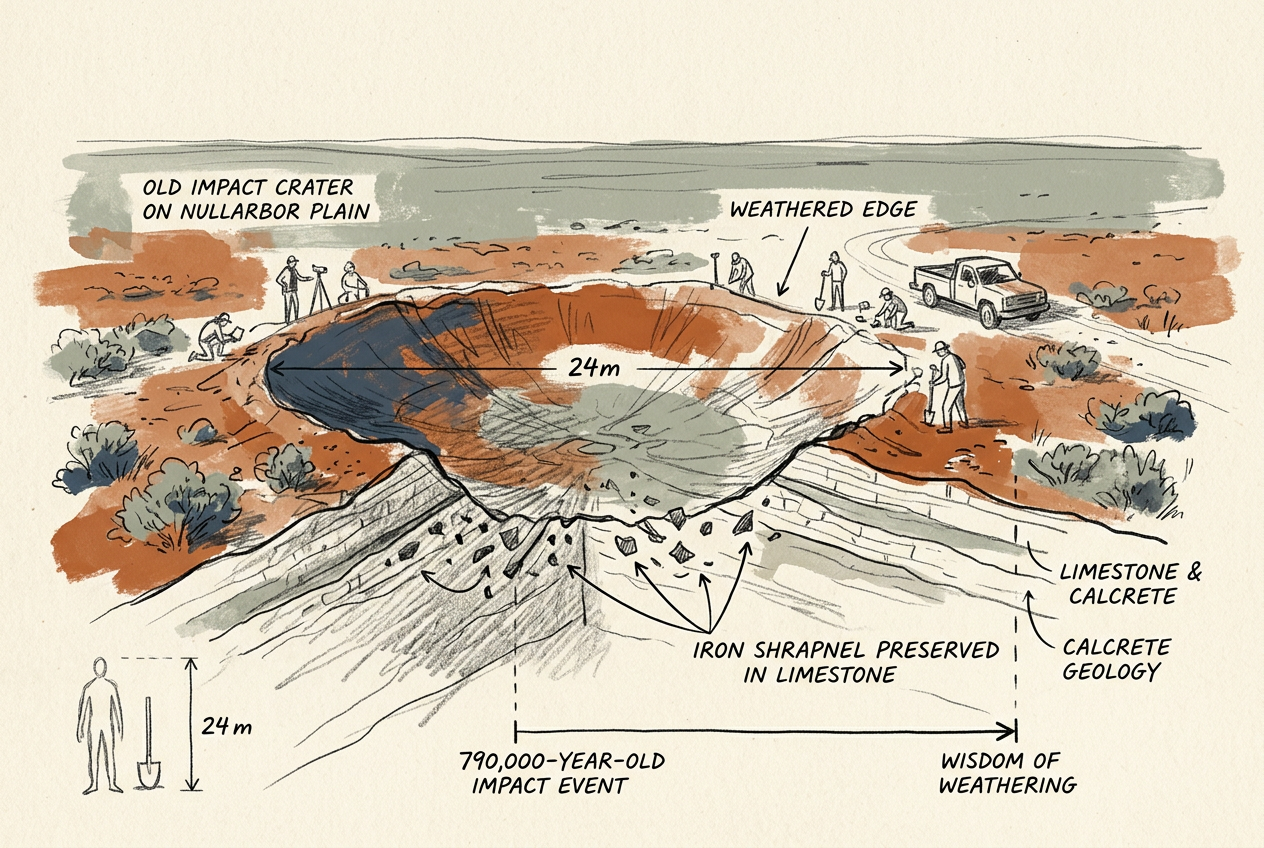
On the remote Nullarbor Plain, a 790,000-year-old meteorite left a crater so perfectly circular that for decades geologists mistook it for a volcanic maar. It is neither. Dalgaranga—a 24-metre-wide scar in Western Australia's outback—was carved by an iron meteorite that struck at an oblique angle, and it remains the only confirmed impact crater in Australia to preserve fragments of the projectile itself.
The Blast That Left No Trace
Most of Earth's impact craters are erased within a few million years—buried, eroded, or subducted. Australia, with its ancient, tectonically quiet crust, preserves a disproportionate share. Yet even here, craters are rare. The continent hosts only seven confirmed impact structures, scattered across its vast interior like faint scars on a weathered face. Dalgaranga, discovered in 1921 by a prospector searching for gold, is the smallest of them.
What makes Dalgaranga exceptional is not its size but its preservation. The crater sits in Archean granite, a hard, unyielding substrate that has resisted erosion for nearly a million years. Its rim rises just two metres above the plain, but its shape remains crisp—a bowl 24 metres across and 6 metres deep. When geologists first examined it in the 1930s, they found fragments of nickel-rich iron scattered across the surrounding limestone. Chemical analysis confirmed what the shape suggested: the impactor was a medium-octahedrite meteorite, a rare class of iron body that originated in the core of a differentiated asteroid.
A Meteorite's Fingerprint
The iron shrapnel at Dalgaranga tells a precise story. The meteorite struck from the north-east at an angle of roughly 30 degrees, travelling at speeds exceeding 15 kilometres per second. On impact, it vaporised—but not entirely. Small fragments, some weighing less than a gram, were preserved in the ejecta blanket, their surfaces still bearing the thumbprint-like regmaglypts characteristic of atmospheric passage.
The shrapnel is the crater's memory: without it, Dalgaranga would be just another circular depression in the scrub.
This is vanishingly rare. Of Earth's 200-odd confirmed impact craters, fewer than a dozen have yielded meteorite fragments. Most impactors are completely destroyed by the violence of their arrival. Dalgaranga's survival owes to its modest size—smaller impactors experience lower peak pressures, allowing some material to remain unmelted.
The Crater That Hides in Plain Sight
For decades, Dalgaranga's remote location protected it from disturbance. The nearest settlement, Mount Magnet, lies 150 kilometres to the south-west. The crater sits within a sheep station, and for most of the 20th century it was visited only by the occasional geologist or curious traveller. In 1962, an expedition led by the Western Australian Museum collected several kilograms of meteoritic material, securing the crater's status as a type locality for medium-octahedrite impacts.
Yet Dalgaranga remains little known beyond specialist circles. It lacks the dramatic scale of Wolfe Creek—another Australian impact crater, 880 metres across and 300,000 years younger—and it does not attract tourists. The crater is a subtle feature, easy to miss even when standing at its rim. But its modesty is precisely its scientific value. Dalgaranga is a pristine example of a small, simple impact structure, unaltered by tectonics or human intervention.
The Unfinished Catalogue
Australia's impact record is almost certainly incomplete. The continent's weathered surface hides craters beneath sand, soil, and vegetation. Airborne surveys and satellite imagery have revealed dozens of circular anomalies that await ground-truthing. Some will prove to be volcanic vents, sinkholes, or glacial features. Others may join Dalgaranga as confirmed impact sites.
For now, the 24-metre scar on the Nullarbor stands as a reminder that the Earth's surface is a palimpsest—a document written and rewritten by forces both internal and extraterrestrial. Most of the writing has faded. Dalgaranga is one of the few lines still legible.
More like this
- The 5-Million-Year-Old Cave Archive Beneath a Treeless PlainBeneath the treeless Nullarbor Plain, a labyrinth of limestone caves preserves five million years of Australian climate in sediment layers, fossil bones, and ancient air bubbles.
- The 1.7-Billion-Year-Old Life That Still Breathes from Black ShaleIn Western Australia's Kidson Sub-basin, 1.7-billion-year-old black shales preserve the molecular ghosts of the first oxygen-producing cyanobacteria.
- The 2.4-Billion-Year-Old Rust That Changed the PlanetIn Western Australia's Hamersley Range, 2.4-billion-year-old banded iron formations preserve the moment when photosynthetic bacteria filled the oceans with oxygen, rusting trillions of tonnes of iron