9 July 2026 · 3 min read
The 2.4-Billion-Year-Old Rust That Changed the Planet
In Western Australia's Hamersley Range, 2.4-billion-year-old banded iron formations preserve the moment when photosynthetic bacteria filled the oceans with oxygen, rusting trillions of tonnes of iron
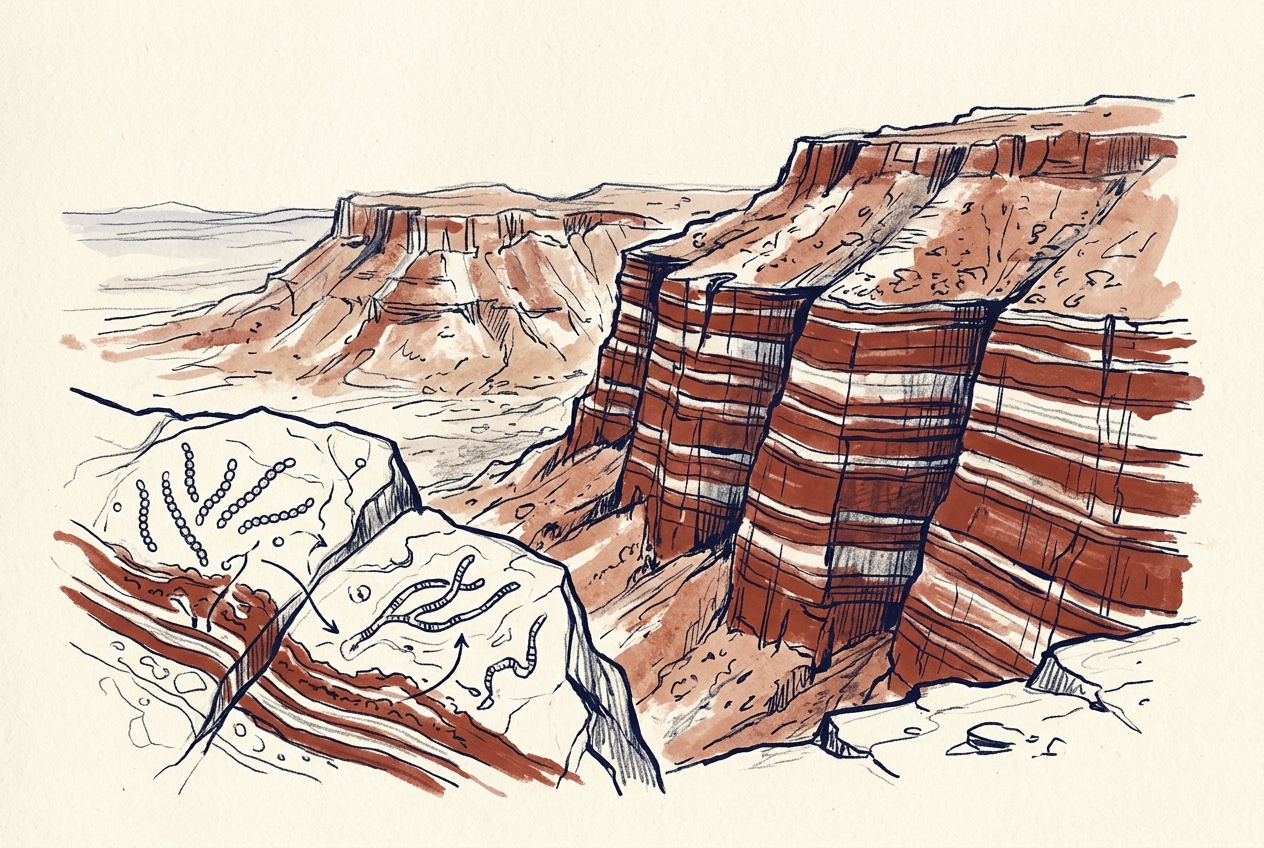
Somewhere between Wittenoom and Newman, the Hamersley Range rises like a rust-red fortress from the red dirt of Western Australia. Its ridges are layered in bands of steel-grey and deep ochre, hundreds of metres thick, stretching for kilometres. These are the banded iron formations—the single largest repository of iron ore on Earth. And they are the fossilised breath of the planet's first atmosphere.
The Oxygen Catastrophe
Two and a half billion years ago, Earth had almost no free oxygen. The atmosphere was a mix of methane, ammonia, and volcanic gases. Then, somewhere in the shallow seas of the Archean, a cyanobacterium learned to split water molecules using sunlight. It released oxygen as a waste product.
At first, this poison dissolved into the ocean, where it encountered dissolved iron—iron weathered from ancient continents, iron spewed from hydrothermal vents. Oxygen and iron reacted instantly, precipitating as rust-coloured particles that drifted to the seafloor like autumn leaves. Layer after layer, year after year, for hundreds of millions of years, the iron fell. The Hamersley Group alone contains over 300 separate bands, each one a pulse of photosynthetic activity.
By 2.4 billion years ago, the ocean's iron was exhausted. Free oxygen began escaping into the atmosphere. The Great Oxidation Event had begun.
A Cathedral of Bands
The Hamersley Range is not one formation but a stack of them: the Marra Mamba Iron Formation at the base, the Brockman Iron Formation above, and the Weeli Wolli Formation capping the sequence. Each is a record of environmental conditions—the ratio of iron to silica, the presence of volcanic ash, the depth of the basin.
The red bands are hematite, the grey bands are chert and jasper. The alternating stripes, some just millimetres thick, reflect seasonal cycles: wet-season blooms of cyanobacteria followed by dry-season silica deposition. A single metre of banded iron represents tens of thousands of years of accumulation. The entire Hamersley sequence is over 2,500 metres thick and spans roughly 200 million years of Earth history.
The rust that built Australia's iron mountains is the same rust that painted the sky blue.
The Mines and What They Took
Today, the Hamersley Range is a landscape of open-pit mines. At Mount Whaleback, the largest single iron ore mine in Australia, the pit descends more than 300 metres below the original summit. Trucks the size of houses haul ore to crushers that feed a 400-kilometre railway to Port Hedland.
The ore is not the banded iron itself but a weathered concentrate. Over billions of years, groundwater dissolved the silica, leaving behind enriched hematite and goethite—ore that assays at over 60 per cent iron. This natural beneficiation required deep weathering, a stable continent, and time beyond comprehension.
Australia exports roughly 900 million tonnes of iron ore each year, the vast majority from these formations. The steel in every city, every bridge, every railway line carries atoms that were first fixed by bacteria 2.4 billion years ago.
What the Rust Remembers
The banded iron formations of the Hamersley Range tell a story no other rock can. Before they formed, the oceans were green with dissolved iron. After they formed, the oceans were clear, the atmosphere was breathable, and the stage was set for complex life.
The formations stopped accumulating because the cyanobacteria had run out of iron to oxidise. In a sense, they mined themselves out of existence. What remains is a monument to the planet's most consequential biological innovation—a rust-coloured archive of the moment life changed the chemistry of an entire world.
More like this
- The 560-Million-Year-Old Garden That Never Saw a PredatorIn South Australia's Flinders Ranges, 560-million-year-old Ediacara surfaces preserve entire seafloor communities of fronds, discs, and quilts — a garden of soft-bodied life that flourished before pre
- The 1.75-Billion-Year-Old Reef That Outranks the BarrierA 1.75-billion-year-old microbial reef in the Kimberley is the largest biological structure ever built by a single species, preserving a world without predators.
- The 1.85-Billion-Year-Old Caldera That Still Feeds the FurnaceIn South Australia's Middleback Ranges, a 1.85-billion-year-old volcanic caldera collapsed and later became one of the world's richest iron ore deposits.