9 July 2026 · 3 min read
The 540-Million-Year-Old Teeth That Still Graze the Seafloor
In South Australia's Flinders Ranges, 540-million-year-old Kimberella fossils preserve the oldest known grazing marks—scratches left by a mollusk-like animal that fed on microbial mats before the Camb
In the Ediacara Hills of South Australia, a 540-million-year-old scratch mark curves across a slab of quartzite. It is the width of a fingernail, the depth of a knife score. And it is the oldest known evidence of an animal eating.
The Grazer
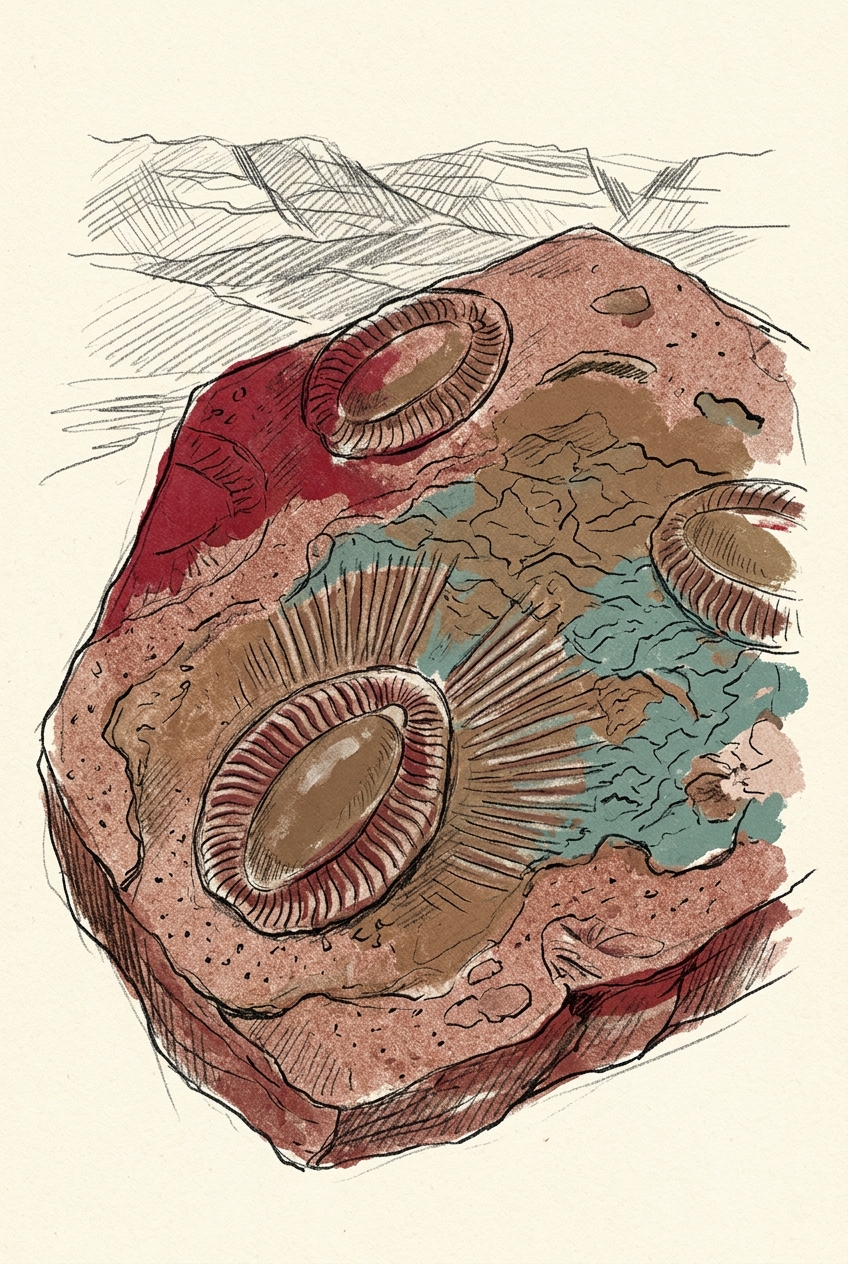
The creature that made it was Kimberella — a bilaterally symmetrical organism shaped like a teardrop, about the size of a walnut. It lived on the seafloor of the Ediacaran period, during the final 20 million years before the Cambrian explosion. Hundreds of Kimberella fossils have been found in the Flinders Ranges, preserved as impressions in fine-grained sandstone. But the most revealing fossils are not the bodies themselves. They are the traces.
Alongside the body fossils, paleontologists have found parallel sets of fan-shaped scratch marks — grooves radiating outward from a central point. The marks are arranged in overlapping arcs, as if a single organism had repeatedly reached out with a feeding organ, raked the surface, and pulled the food back toward its mouth.
The pattern is unmistakable. It is the same grazing trace left by modern chitons and limpets — mollusks that use a radula, a tongue-like ribbon studded with microscopic teeth, to scrape algae and microbial mats off rock.
What the Scratches Reveal
The Kimberella grazing marks tell us three things that body fossils alone cannot.
First, that the animal had a muscular foot and a distinct front and back — directed locomotion, not passive drifting. Second, that it possessed a specialized feeding organ capable of coordinated, repeated motion. Third, that it could sense its environment well enough to reposition itself between feeding bouts, overlapping its grazing arcs in a systematic pattern.
These are not the behaviors of a sponge or a cnidarian. They are the behaviors of a bilaterian — an animal with two symmetrical sides, a gut, and a mouth. For decades, the Cambrian explosion was thought to mark the sudden appearance of such complexity. Kimberella pushes that origin back by at least 10 million years.
The scratches are older than the earliest known trilobite. Older than the first brachiopod. Older than almost every shelly fossil in the Cambrian record.
The World They Grazed
The seafloor that Kimberella fed upon looked nothing like the seafloors of today. It was covered in thick microbial mats — living carpets of cyanobacteria and other microbes that bound the sediment into a firm, leathery surface. No animals burrowed into it. No predators tore through it. The Ediacaran seafloor was a pastoral world, and Kimberella was its first known grazer.
The mats themselves are preserved in the same sandstone, wrinkled into patterns called "elephant skin" texture. In some slabs, you can see the pristine mat surface, the Kimberella body impression, and the grazing marks all in the same frame — the animal, its food, and its feeding trace, frozen in a single instant.
The End of the Mat World
Kimberella did not survive the Ediacaran-Cambrian transition. Its grazing may have contributed to its own demise. By scratching through the microbial mats, these early grazers broke the cohesion of the seafloor, opening patches for burrowing animals to colonize. Within a few million years, the mat world collapsed entirely, replaced by a bioturbated seafloor full of tunnels, tracks, and trails.
The Ediacara Hills remain one of the few places on Earth where the old world is still visible — its last grazers still frozen in the act of their final meal.
More like this
- The 560-Million-Year-Old Garden That Never Saw a PredatorIn South Australia's Flinders Ranges, 560-million-year-old Ediacara surfaces preserve entire seafloor communities of fronds, discs, and quilts — a garden of soft-bodied life that flourished before pre
- The 300-Million-Year-Old Forest That Died Standing UpIn New South Wales, a 300-million-year-old fossil forest preserves dozens of trees buried upright by a Permian volcanic eruption—an entire ecosystem frozen in ash.
- The 1.75-Billion-Year-Old Reef That Outranks the BarrierA 1.75-billion-year-old microbial reef in the Kimberley is the largest biological structure ever built by a single species, preserving a world without predators.