9 July 2026 · 2 min read
The 1.7-Billion-Year-Old Life That Still Breathes from Black Shale
In Western Australia's Kidson Sub-basin, 1.7-billion-year-old black shales preserve the molecular ghosts of the first oxygen-producing cyanobacteria.
The rusty reds and deep purples of southeast Australia's Kidson Sub-basin were not always colour. Two billion years ago, they were teeming with life—simple, single-celled life that learned a new trick: to make oxygen by splitting water. When those cyanobacteria died, their molecular skins fell like silent rain into black mud, and there they stayed.
The Breath in Black Mud
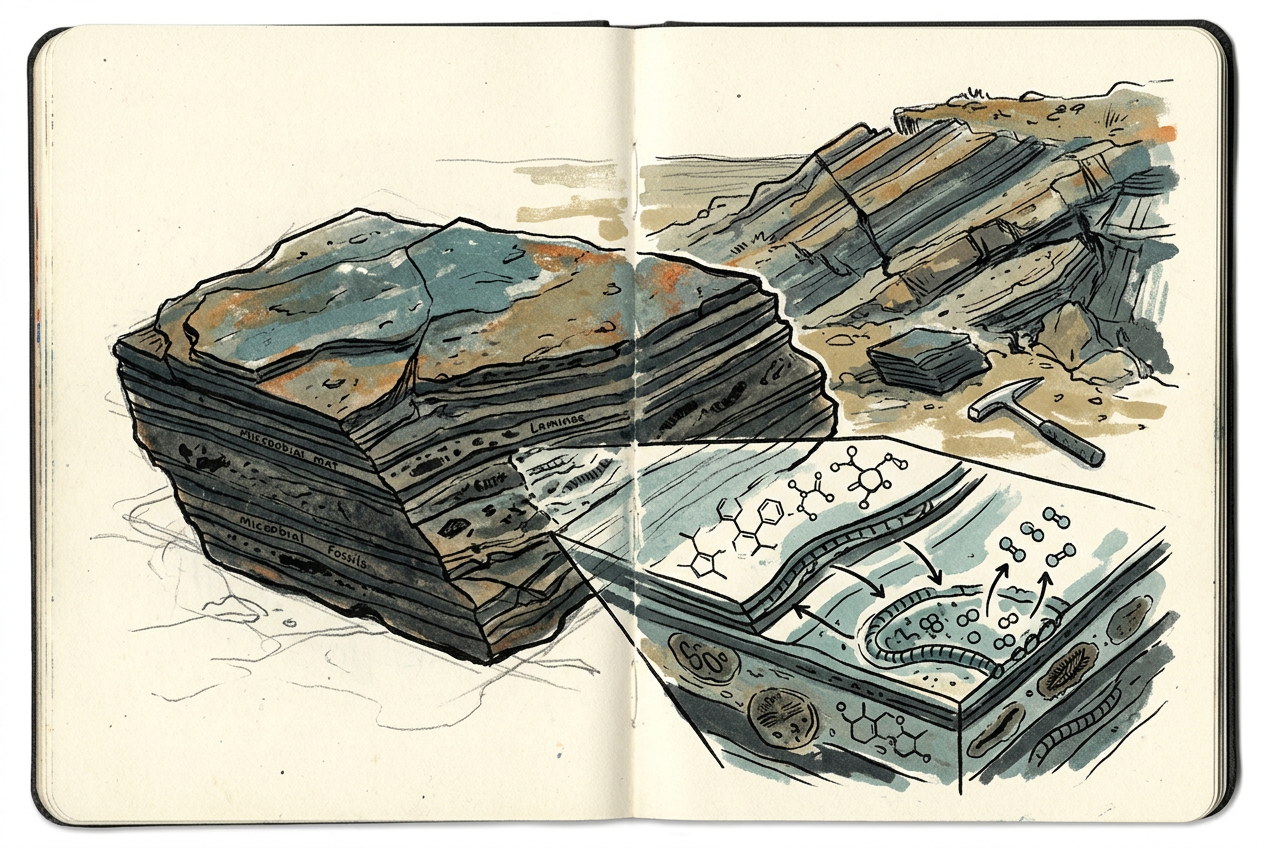
In the 1960s, geologists drilling through the Proterozoic Barney Creek Formation in the McArthur Basin kept pulling up cores of black shale. The rock was unprepossessing—fine-grained, dark, faintly oily—and it smelled, when freshly broken, of old swamps. But under a microscope, the shale revealed tiny golden-brown specks: the chemical fossils of ancient cyanobacteria, preserved as crystalline hydrocarbons called carotenoids.
These molecules are the direct descendants of photosynthetic pigments. They tell a precise story: here, 1.7 billion years ago, cyanobacteria were already splitting water and releasing oxygen. The shale itself is the waste product—the dead cells and their molecular ghosts, settled into an anoxic basin where nothing rotted them away.
The Kidson Sub-basin, near the border of Western Australia and the Northern Territory, holds one of the thickest shale deposits on Earth—a sequence of black muds deposited over tens of millions of years, each metre representing thousands of years of biological rain.
A Two-Billion-Year-Old Oil Source
Because the shale is rich in organic matter, it is also a source rock for hydrocarbons. Small pockets of gas and oil have been found in the Kidson basin, generated by the slow cooking of those ancient cyanobacterial skins under the weight of overlying sediment. The hydrocarbons are the breath of those old cells, compressed and heated into a new form.
The oil that seeps from the Kidson shale is made of the same carbon atoms that once floated in the sunlight of a Proterozoic sea.
But the basin has never been thoroughly explored. Its remote location—hundreds of kilometres from the nearest town—and the depth of its shale sequence have kept most drill rigs away. Only a few deep cores exist, each one a time capsule of a world that breathed oxygen into the atmosphere for the first time.
What the Sediment Also Preserves
The same black shales that trapped the cyanobacterial remains also caught other debris: volcanic ash beds, trace metals, and the subtle shifts in carbon isotopes that record ancient climate changes. Geochemists now use these layers to map the rise of oxygen across the Proterozoic, precisely because the Kidson basin was so quiet and so deep—a perfect archive, sealed in mud, for two billion years.
More like this
- The 560-Million-Year-Old Garden That Never Saw a PredatorIn South Australia's Flinders Ranges, 560-million-year-old Ediacara surfaces preserve entire seafloor communities of fronds, discs, and quilts — a garden of soft-bodied life that flourished before pre
- The 300-Million-Year-Old Forest That Died Standing UpIn New South Wales, a 300-million-year-old fossil forest preserves dozens of trees buried upright by a Permian volcanic eruption—an entire ecosystem frozen in ash.
- The 1.75-Billion-Year-Old Reef That Outranks the BarrierA 1.75-billion-year-old microbial reef in the Kimberley is the largest biological structure ever built by a single species, preserving a world without predators.