26 June 2026 · 3 min read
The 650-Million-Year-Old Volcano That Woke the Ediacaran
How 650-million-year-old volcanic ash in South Australia's Flinders Ranges may have fertilised the oceans and triggered the dawn of complex animal life.
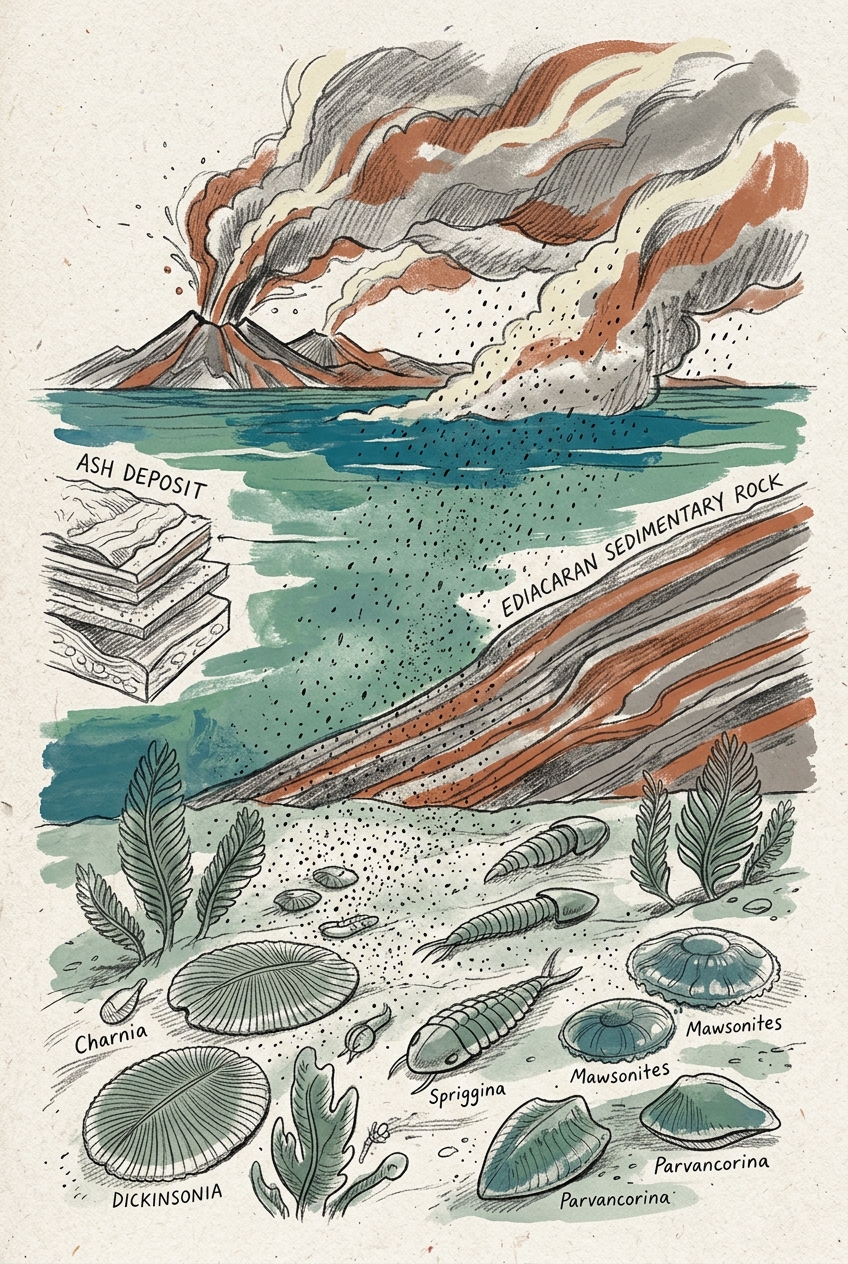
In the Flinders Ranges of South Australia, a layer of green clay runs through the rock like a seam of mould. It is barely a handspan thick, but it marks a turning point in the history of life. This is the Gifford Creek ash bed—a 650-million-year-old volcanic eruption that may have helped wake the Ediacaran world.
A Blast from the Cryogenian
The Gifford Creek ash bed sits within the Brachina Formation, a sequence of sedimentary rocks laid down during the Cryogenian Period, when Earth was locked in the Sturtian glaciation—one of the most severe ice ages the planet has ever known. The ash is fine-grained, almost chalky, and it is the only known volcanic layer in this entire section of the Adelaide Rift Complex.
Geologists who have analysed the ash estimate the eruption occurred roughly 660 to 640 million years ago. The volcano itself is long gone—eroded, buried, or subducted—but its ash drifted across the shallow sea that covered what is now the Flinders Ranges. The fall of ash was brief, perhaps weeks or months, but it left a chemical calling card.
That calling card is phosphorus.
The Fertiliser That Changed the World
Volcanic ash is rich in phosphorus, a nutrient that limits biological productivity in most oceans. When the Gifford Creek volcano erupted, it dumped a layer of ash into a sea that had been starved of nutrients for millions of years. The ice above was melting. The glaciers were retreating. And suddenly, the water was full of food.
Phytoplankton bloomed. Then the organisms that ate them. Then the organisms that ate those. The ash bed sits directly below the first appearance of Ediacaran fossils in the Flinders Ranges—the frond-like Rangea, the quilted Dickinsonia, the mysterious Spriggina. The timing is too precise to ignore.
The green clay layer is less than a metre thick. Below it: glacial rubble and barren siltstone. Above it: the first explosion of complex life on Earth.
It is not that the volcano created the Ediacaran biota. Life had been evolving for billions of years. But the ash fertilised a starving ocean, and that pulse of nutrients may have enabled the leap from simple microbial mats to the first large, mobile, multicellular organisms.
A Fingerprint in the Clay
The ash bed itself is unremarkable to the naked eye—a greenish band in a cliff of red and brown sediment. Under a microscope, it contains tiny crystals of zircon and apatite, minerals that resist weathering. The zircons have been dated using uranium-lead radiometric methods, giving the ash its precise age.
But the ash also contains something more telling: shards of volcanic glass, now altered to clay, that preserve the original chemical composition of the magma. Geochemists have matched these shards to a type of volcano called an intraplate rift eruption—similar to the volcanoes that today shape the East African Rift. The Gifford Creek volcano was not a giant. It was probably a modest cone, perhaps a few hundred metres high, that erupted briefly and then fell silent.
Yet its ash travelled hundreds of kilometres, settling across a continental shelf that stretched from the Flinders Ranges to the present-day Amadeus Basin in Central Australia. The same green layer appears in drill cores across the continent, a time-stamped fingerprint of a single event.
The Unseen Engine of Evolution
Volcanoes are usually cast as agents of destruction. Pompeii. Krakatoa. The end-Permian extinction. But the Gifford Creek ash bed suggests a gentler role. A volcano that fed the ocean, not poisoned it.
The Ediacaran biota did not appear from nothing. It emerged from a world that was, in a sense, fertilised by fire. The ash layer is a reminder that evolution does not happen in a vacuum. It happens in a world of volcanoes, ice ages, and shifting continents—a world where a single eruption can change the course of life.
The green clay seam in the Flinders Ranges is easy to miss. Most visitors drive past it. But it may be the most important volcanic deposit in Australian geology: the thin green line that separates a world of microbes from a world of animals.
More like this
- The 5,000-Year-Old Volcanoes That Still Smoke in the SouthIn Victoria's Newer Volcanics Province, 400 volcanic vents erupted as recently as 5,000 years ago—the youngest volcanic field in mainland Australia, where craters still hold blue lakes and scoria cone
- The 560-Million-Year-Old Garden That Never Saw a PredatorIn South Australia's Flinders Ranges, 560-million-year-old Ediacara surfaces preserve entire seafloor communities of fronds, discs, and quilts — a garden of soft-bodied life that flourished before pre
- The 300-Million-Year-Old Forest That Died Standing UpIn New South Wales, a 300-million-year-old fossil forest preserves dozens of trees buried upright by a Permian volcanic eruption—an entire ecosystem frozen in ash.