26 June 2026 · 3 min read
The 120-Million-Year-Old Volcano That Made the Kimberley's Black Rock
How a 120-million-year-old volcanic eruption in Western Australia's Kimberley region created the black basalt fields that preserved dinosaur footprints and hold a unique place in Aboriginal culture.
In the Kimberley, the ground is black not from age but from fire. The basalt plains that stretch across the peninsula's western edge are the remains of a volcanic province that erupted 120 million years ago, when Australia was still attached to India and Antarctica. The rock is young by the continent's standards—mere yesterday—but it preserves a world that no longer exists.
The Eruption That Split a Continent
In the early Cretaceous, the breakup of Gondwana was reaching its climax. As India rifted away from the northwestern margin of Australia, deep fractures opened in the crust. Basaltic magma rose through these fissures and flooded the landscape, layer after layer, building a volcanic province that once covered more than 200,000 square kilometres.
The eruptions were not explosive. They were effusive—great curtains of lava that poured from the ground and spread across the floodplains, each flow tens of metres thick. The rock that remains is tholeiitic basalt, rich in iron and magnesium, dark as charcoal, and hard enough to resist the tropical monsoon for a hundred million years.
Today, the flows are preserved as the King Leopold Sandstone and the basalt plains of the West Kimberley. The softer sedimentary rocks that once surrounded them have eroded away, leaving the black rock standing as low plateaus and mesas. The Bunuba people call it jilimirri—the country that holds the old stories.
The Tracks That Outlasted the Flesh
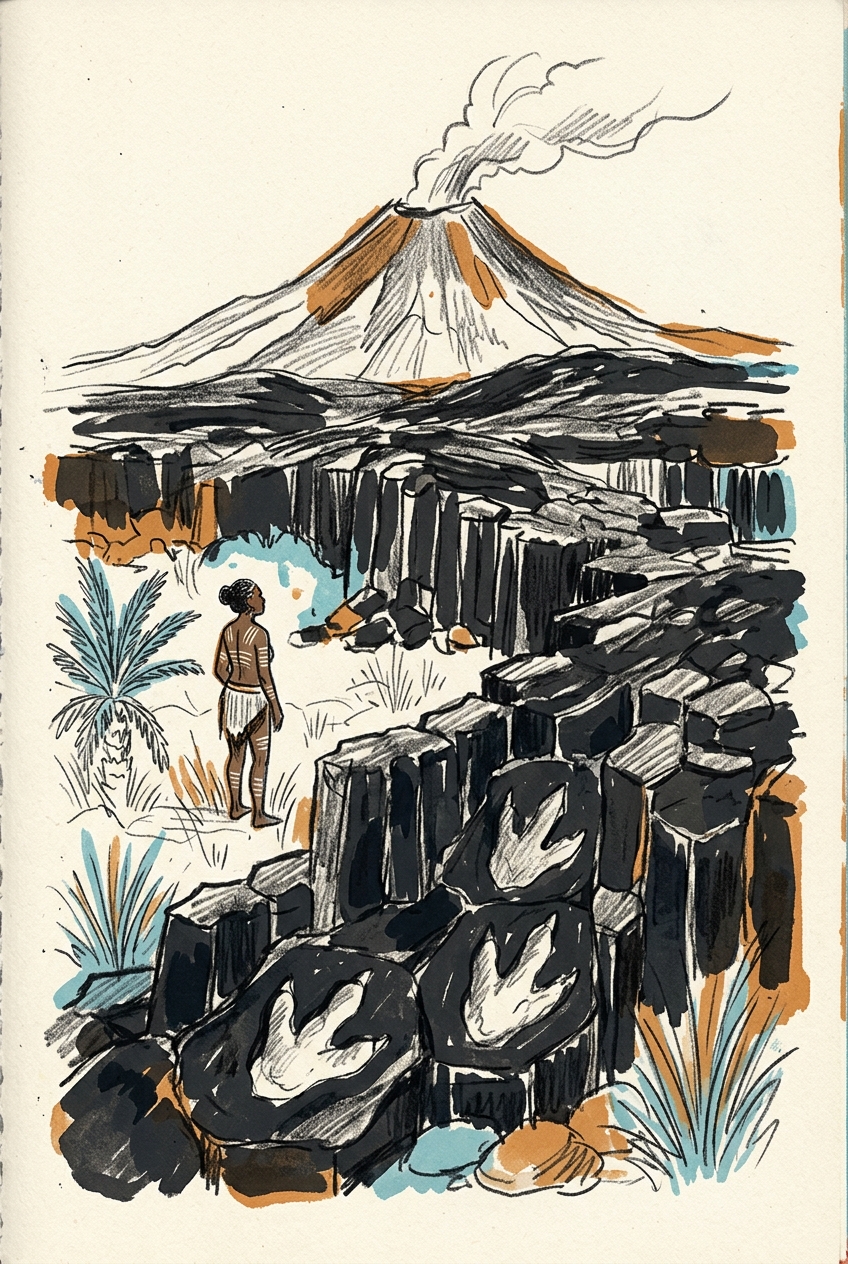
The basalt preserved something unexpected. In the early Cretaceous, the Kimberley was a coastal floodplain threaded with rivers and lakes. Dinosaurs walked along these shores, leaving footprints in the wet sand that later hardened into mudstone. When the lava flows covered the sediments, they baked and hardened them, sealing the tracks beneath a black lid.
More than 2,000 dinosaur footprints have been found in the Walmadany area—the Dampier Peninsula—preserved in sandstone that once sat beneath the basalt. The tracks include sauropods, theropods, and ornithopods, walking across a landscape that was then at 40 degrees south latitude. The basalt protected them from erosion for 120 million years.
The lava that destroyed the living forest became the roof that saved the dead animals' prints.
The Rock That Holds the Rain
The basalt's mineralogy gives it a second life. The rock weathers into a clay-rich soil that holds moisture through the Kimberley's long dry season. Black soil plains support grasslands and woodlands that would not grow on the surrounding sandstone. The cracks and joints in the basalt store groundwater, feeding springs that run year-round.
These springs are why the Kimberley's volcanic country has been inhabited for at least 40,000 years. The Bunuba and Ngarinyman peoples used the basalt to make stone tools—the rock's fine-grained texture produces sharp edges when struck. Grinding stones made from basalt have been found across the region, traded along routes that crossed the continent.
The flows also created natural shelters. Where lava tubes formed, they left caves that were used as shelter from the monsoon. Some of these caves contain rock art that depicts the volcanic eruptions themselves—red ochre paintings that may be the oldest known representations of geological events on Earth.
What the Black Rock Teaches
The Kimberley basalt is a reminder that volcanic rock is not always destructive. It preserves, it nourishes, it records. The same eruptions that buried the Cretaceous floodplains also created the conditions for life to persist through the ice ages and the long drying of the Australian interior.
The basalt is still there, black and unweathered on the surface, cracked and fertile beneath. It holds dinosaur footprints, freshwater springs, and the memory of a continent tearing itself apart. Not bad for a rock that is only 120 million years old.
More like this
- The 110-Million-Year-Old River That Runs Backwards UndergroundWestern Australia's 110-million-year-old dune system has been slowly dissolving into a labyrinth of caves where an ancient river still flows, carrying the taste of a Cretaceous desert.
- The 5,000-Year-Old Volcanoes That Still Smoke in the SouthIn Victoria's Newer Volcanics Province, 400 volcanic vents erupted as recently as 5,000 years ago—the youngest volcanic field in mainland Australia, where craters still hold blue lakes and scoria cone
- The 560-Million-Year-Old Garden That Never Saw a PredatorIn South Australia's Flinders Ranges, 560-million-year-old Ediacara surfaces preserve entire seafloor communities of fronds, discs, and quilts — a garden of soft-bodied life that flourished before pre