26 June 2026 · 3 min read
The 400-Million-Year-Old Reef That Became a Diamond Pipe
How a 400-million-year-old coral reef in Western Australia's Canning Basin was pierced by a 20-million-year-old volcanic eruption, creating the Argyle diamond pipe—and the world's richest source of pi
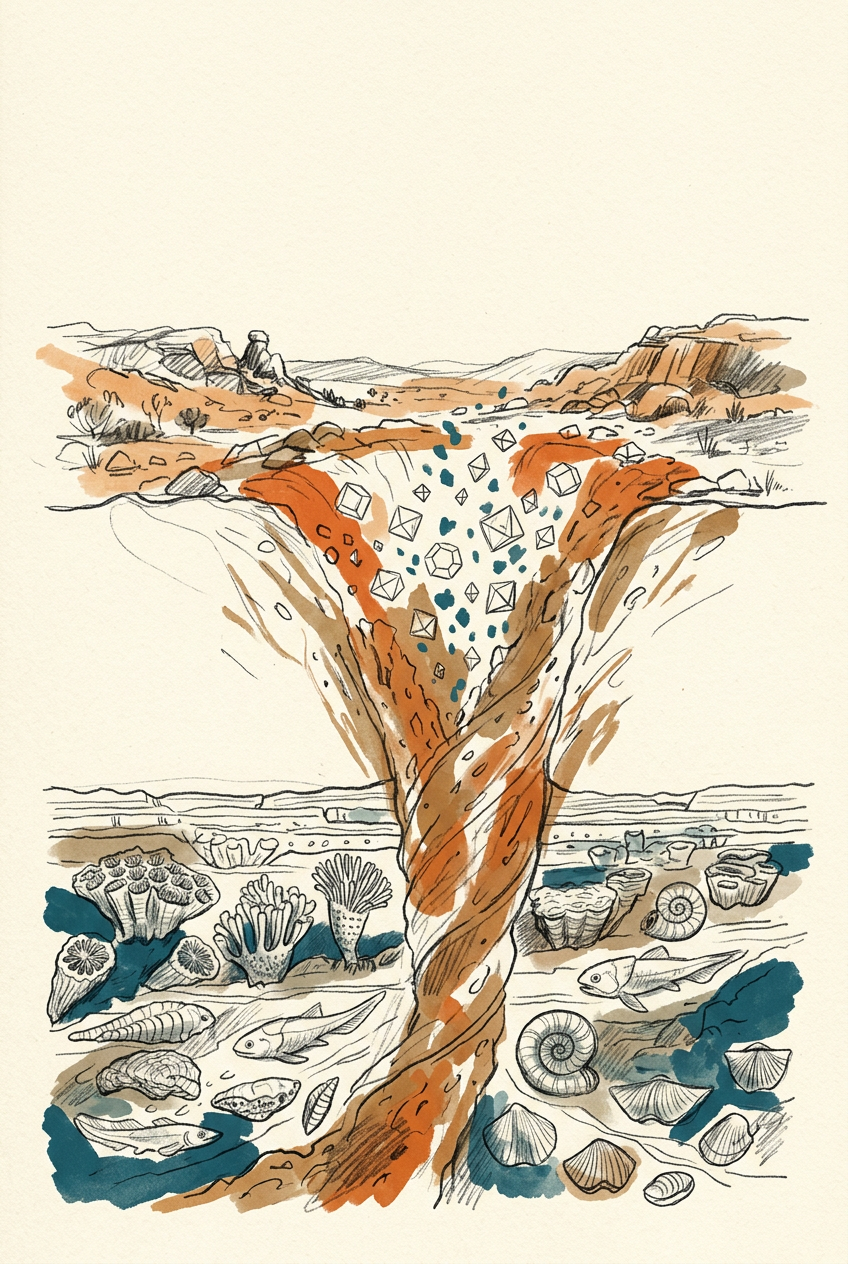
Deep beneath the eastern Kimberley, a 400-million-year-old coral reef meets a 20-million-year-old volcanic pipe. The collision produced something no one expected: the world's richest deposit of pink diamonds.
The Reef That Became a Trap
During the Devonian period, when fish ruled the seas and the first forests crept across land, a vast barrier reef stretched along the northern edge of the Australian continent. The reef system of the Canning Basin rivaled the Great Barrier Reef in scale—hundreds of kilometres of limestone built by corals, sponges, and stromatoporoids.
But this reef grew in a very different world. Australia sat near the equator, part of the supercontinent Gondwana. Warm, shallow seas teemed with life. Layer upon layer of calcium carbonate accumulated, compacted, and hardened into limestone. By 360 million years ago, the reef was dead, buried under younger sediments, locked away in the crust.
That limestone would wait 340 million years to serve a new purpose.
The Volcano That Pierced Through
Around 20 million years ago, in the Miocene, a plume of molten rock rose from deep within the Earth's mantle beneath the eastern Kimberley. This was no ordinary magma. It originated in the diamond stability field, more than 150 kilometres down, where immense pressure keeps carbon locked in the crystalline structure of diamond.
The magma—a rare type called kimberlite—surged upward at extraordinary speed, perhaps 10 to 30 metres per second. As it rose, it ripped fragments from every layer it passed through. Shale. Sandstone. And then, deep below, the Devonian limestone.
When the kimberlite reached the surface, it erupted with explosive violence, forming a carrot-shaped pipe that narrowed with depth. The eruption left behind a crater filled with volcanic breccia—a chaotic mix of kimberlite, shattered country rock, and diamonds.
The Colour That Made It Famous
Most kimberlite pipes produce white, yellow, or brown diamonds. Argyle produced pink ones. The cause is not entirely understood, but geologists believe the pink colour results from deformation—intense pressure within the Earth's crust that warps the diamond's crystal lattice, causing it to absorb light differently.
Somehow, the Argyle diamonds experienced a particular kind of plastic deformation during their journey to the surface, or during their long residence in the mantle. The result was a gemstone that auctions for more than a million dollars per carat.
The Argyle deposit produced more than 90 percent of the world's pink diamonds. Without a Devonian reef, they might never have been discovered.
The Reef's Final Gift
The limestone layer that once sheltered Devonian marine life did one more thing: it made the pipe detectable. Kimberlite weathers easily, forming a depression in the landscape. But the surrounding limestone resisted erosion, creating a subtle topographic ring that guided geologists to the deposit in 1979.
For 37 years, the Argyle mine produced an average of 8 million carats annually. When it closed in 2020, the pit had yielded more than 865 million carats of rough diamonds. The pink stones alone accounted for a fraction of that volume but the majority of its value.
The reef is gone, crushed and processed. But the limestone that once held the skeletons of Devonian corals still guards the pipe's deepest secrets—diamonds that formed a billion years before the reef itself, waiting in the dark for a volcano to bring them into the light.
More like this
- The 5,000-Year-Old Volcanoes That Still Smoke in the SouthIn Victoria's Newer Volcanics Province, 400 volcanic vents erupted as recently as 5,000 years ago—the youngest volcanic field in mainland Australia, where craters still hold blue lakes and scoria cone
- The 560-Million-Year-Old Garden That Never Saw a PredatorIn South Australia's Flinders Ranges, 560-million-year-old Ediacara surfaces preserve entire seafloor communities of fronds, discs, and quilts — a garden of soft-bodied life that flourished before pre
- The 300-Million-Year-Old Forest That Died Standing UpIn New South Wales, a 300-million-year-old fossil forest preserves dozens of trees buried upright by a Permian volcanic eruption—an entire ecosystem frozen in ash.