25 June 2026 · 3 min read
The 65-Million-Year-Old Volcanic Lake That Became Australia's Biggest Lithium Deposit
How 65-million-year-old volcanic activity in Western Australia's Yilgarn Craton created a lithium-rich clay deposit at Mount Marion, where ancient lakebeds concentrated rare metals from weathering gra
Near Kalgoorlie, Western Australia, a 65-million-year-old volcanic lakebed holds one of the world's largest lithium deposits. The metal did not arrive in molten rock. It washed in, grain by grain, from the slow breakdown of granite.
The Lake That Collected a Metal
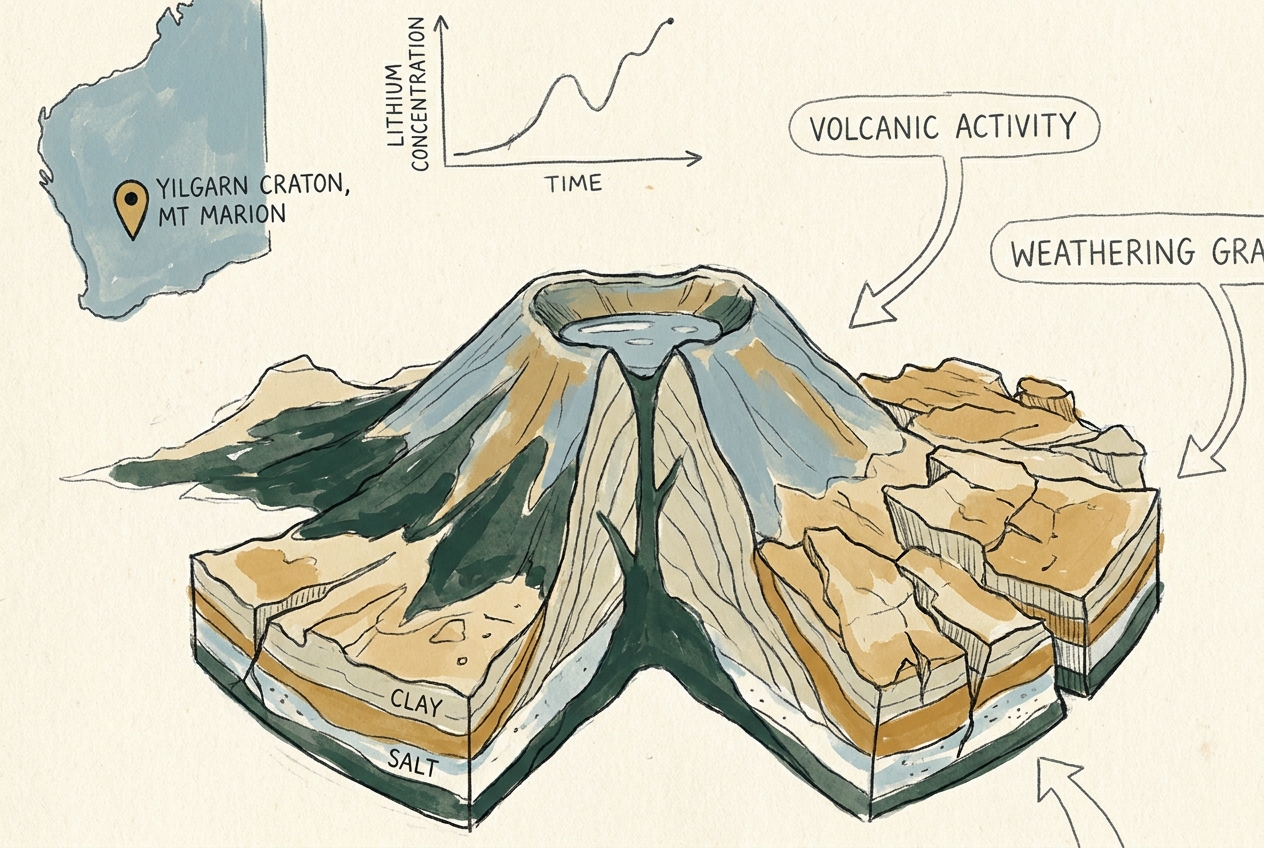
During the Paleogene, after the breakup of Gondwana, a broad shallow lake sat in what is now the Yilgarn Craton. Volcanic activity nearby deposited layers of ash and basalt. But the lithium came from the surrounding highlands—ancient granites rich in the mineral spodumene.
Rain and groundwater weathered those granites for millions of years. Lithium, a light and mobile element, dissolved out of the spodumene and flowed into the basin. There it was trapped by the clay minerals of the lake sediments, particularly a mineral called hectorite. The lake dried and refilled many times. Each cycle concentrated the metal further.
Today the Mount Marion deposit averages 1.4 percent lithium oxide—among the highest grades in the world. The ore is not hard rock but a soft, pale clay that can be dug with excavators.
The Volcanic Engine
A series of small eruptions built the volcanic field that surrounds the deposit. The lava was basaltic, low in silica, and it flowed across the ancient landscape between 65 and 50 million years ago. These flows sealed the lake sediments beneath them, protecting the lithium-rich clays from erosion.
The lithium did not arrive in molten rock. It washed in, grain by grain, from the slow breakdown of granite.
But the volcanism did more than cap the deposit. The heat and fluids from the intrusions altered the surrounding rocks, creating the clay minerals that would later trap the lithium. Without the right clay chemistry—magnesium-rich, layered, and reactive—the lithium would have simply washed out to sea.
The Green Energy Paradox
Lithium is the lightest metal on Earth. It does not occur in its native form. It must be concentrated by geological processes that are both rare and slow. Mount Marion took tens of millions of years to form. We will exhaust the deposit in decades.
The same story plays out across Western Australia. At Greenbushes, 200 kilometres south, lithium is mined from hard-rock pegmatites—the crystallised remnants of ancient magma. At Mount Marion, the process was gentler: weathering, transport, and chemical trapping in a quiet lake.
Both deposits owe their existence to the same tectonic event: the slow drift of Australia northward after Gondwana broke apart. That drift changed the climate, altered the drainage, and exposed fresh granite to the weather. The volcanic lakes were just the right kind of container.
The Invisible Concentration
Lithium is not rare in the Earth's crust—it is simply spread thin. A typical granite contains about 30 parts per million. To form an economic deposit, that concentration must increase by a factor of nearly 500. At Mount Marion, the process was entirely sedimentary: dissolution, transport, and adsorption onto clay.
The deposit was discovered only in the 1990s, when geologists drilling for gold found anomalous lithium in the lake sediments. For millions of years, the metal had sat unnoticed beneath the red soil and saltbush. Now it powers batteries for electric vehicles and grid storage.
What made the deposit work was the coincidence of several slow processes: a granite source, a volcanic basin, the right clay chemistry, and a dry climate that preserved the sediments. Geology rarely offers such neat combinations.
More like this
- The 110-Million-Year-Old River That Runs Backwards UndergroundWestern Australia's 110-million-year-old dune system has been slowly dissolving into a labyrinth of caves where an ancient river still flows, carrying the taste of a Cretaceous desert.
- The 5,000-Year-Old Volcanoes That Still Smoke in the SouthIn Victoria's Newer Volcanics Province, 400 volcanic vents erupted as recently as 5,000 years ago—the youngest volcanic field in mainland Australia, where craters still hold blue lakes and scoria cone
- The 300-Million-Year-Old Forest That Died Standing UpIn New South Wales, a 300-million-year-old fossil forest preserves dozens of trees buried upright by a Permian volcanic eruption—an entire ecosystem frozen in ash.