25 June 2026 · 2 min read
The 2.7-Billion-Year-Old Ocean That Left a Scar of Banded Iron: Western Australia's Hamersley Range
How 2.7-billion-year-old banded iron formations in Western Australia's Hamersley Range record the moment Earth's oceans first breathed oxygen—and why these rust-stained cliffs still hold the key to mo
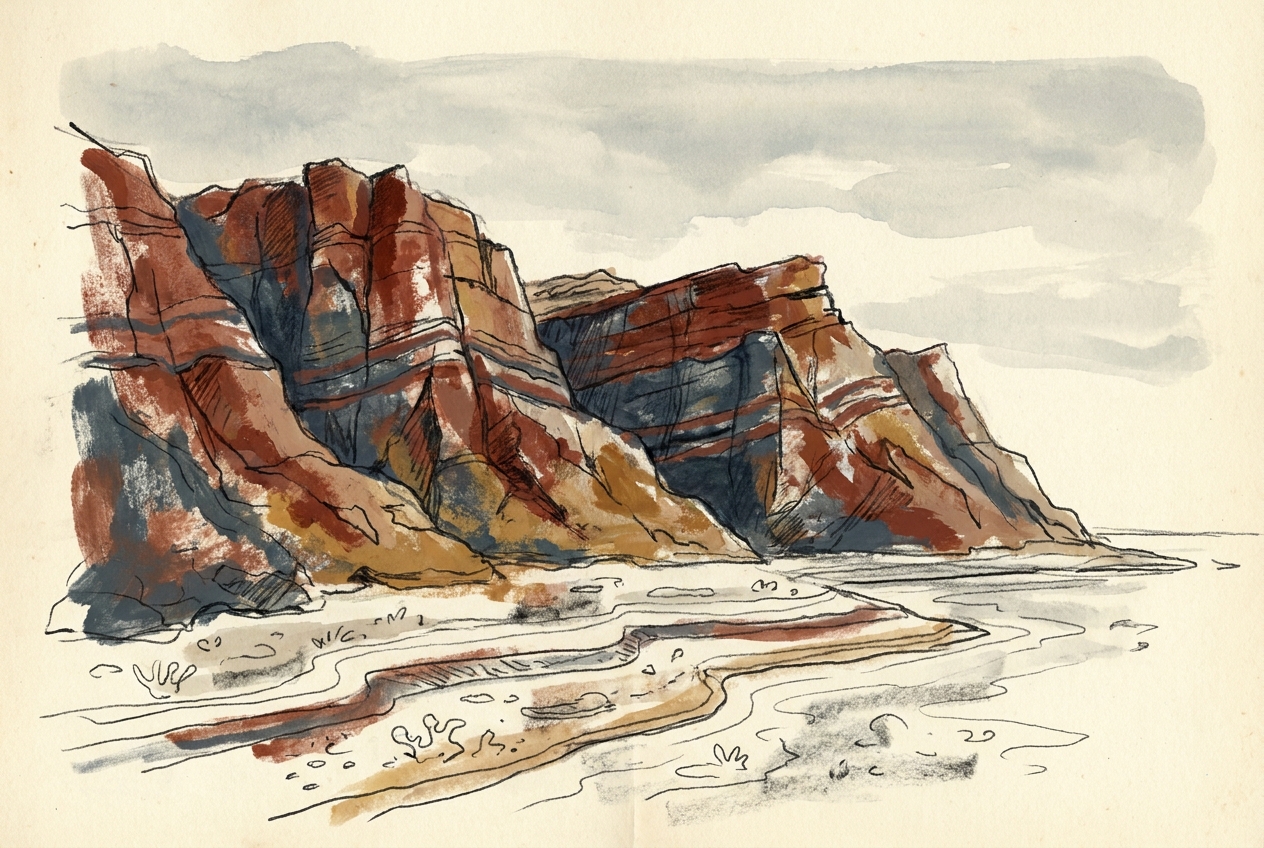
The Hamersley Range rises from the red dust of Western Australia's Pilbara as a 500-kilometre-long spine of rust and flint. Its cliffs are not sandstone or limestone but something stranger: banded iron formation, a rock that exists nowhere on Earth in such abundance. These are the fossilised breath of an ancient ocean.
The Iron Sea
Two and a half billion years ago, the Pilbara lay beneath a shallow sea. The water was rich in dissolved iron—not from rivers or vents but from the slow chemical weathering of the early Earth's crust. The atmosphere had almost no free oxygen. The iron simply stayed in solution, tinting the ocean green.
Then came the cyanobacteria. These microscopic organisms produced oxygen as a waste product. As oxygen levels rose, it reacted with the dissolved iron, causing it to precipitate as rust—layer after layer, year after year, for hundreds of millions of years.
The result was the banded iron formations of the Hamersley Range: alternating bands of red hematite and black chert, each pair representing a seasonal or climatic cycle. Some bands are paper-thin. Others are thick as a fist. Together they hold an estimated 80 billion tonnes of iron ore.
The Hamersley deposits contain more iron than any other single geological province on Earth.
The Transformation
The original rock was not rich enough to mine. It contained roughly 30 percent iron, bound with silica. What turned it into ore was time—and water.
Over two billion years, groundwater slowly dissolved the silica, leaving the iron behind. The process concentrated the metal to 60 percent or more. In places, the rock is almost pure hematite, black and heavy as a cannonball.
This secondary enrichment happened deep underground, along fractures and faults. The result is a landscape of flat-topped mesas and steep gorges where the ore bodies sit like dark seams in the striped walls. Tom Price, Mount Whaleback, Newman—these are not just mines but the remains of an entire ocean floor, inverted and exposed by erosion.
The Modern Quarry
Today the Hamersley Range is the world's largest iron ore province. The mines are vast: the Mount Whaleback pit alone is five kilometres long and half a kilometre deep. Trains 2.5 kilometres long haul the ore to Port Hedland, where ships carry it to steel mills in China, Japan, and Korea.
But the rock itself has not changed. The bands are still there—the same rhythmic stripes laid down when the Earth was half its current age. Miners call them "the barber's pole." Geologists call them the Brockman Iron Formation and the Marra Mamba Iron Formation, named for the Aboriginal words for the country that holds them.
The Last Witness
The Hamersley banded iron formations are not just an economic resource. They are a record of a planetary transformation that happened only once. When the oceans finally ran out of dissolved iron, the banded iron stopped forming. The atmosphere continued to accumulate oxygen, and life took its next great step.
Nothing since has produced rock quite like this. The Hamersley Range is the archive of that singular moment—a 2.5-billion-year-old ledger written in rust and silica, still standing in the Western Australian sun.
More like this
- The 110-Million-Year-Old River That Runs Backwards UndergroundWestern Australia's 110-million-year-old dune system has been slowly dissolving into a labyrinth of caves where an ancient river still flows, carrying the taste of a Cretaceous desert.
- The 560-Million-Year-Old Garden That Never Saw a PredatorIn South Australia's Flinders Ranges, 560-million-year-old Ediacara surfaces preserve entire seafloor communities of fronds, discs, and quilts — a garden of soft-bodied life that flourished before pre
- The 1.75-Billion-Year-Old Reef That Outranks the BarrierA 1.75-billion-year-old microbial reef in the Kimberley is the largest biological structure ever built by a single species, preserving a world without predators.