25 June 2026 · 3 min read
The 150-Million-Year-Old Volcano That Opened a Diamond Window: Western Australia's Argyle Pipe
How a 150-million-year-old volcanic eruption in Western Australia's Kimberley region brought diamonds to the surface through a rare lamproite pipe, creating the world's richest diamond deposit.
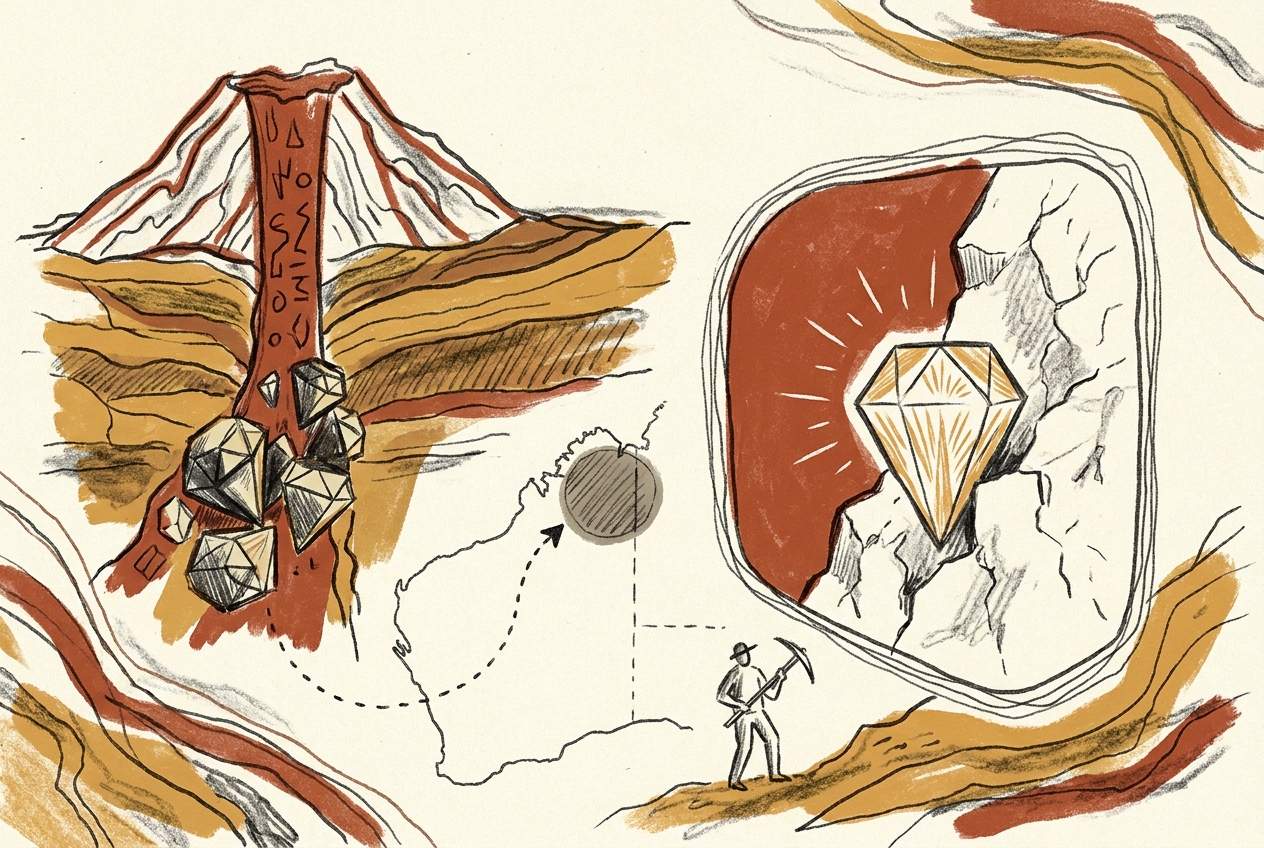
Deep beneath the Kimberley Plateau, a column of molten rock rose through the crust at nearly the speed of sound. When it broke the surface 150 million years ago, it carried cargo that had spent a billion years in the dark: diamonds from the base of the continent, where carbon had crystallised under crushing pressure in the ancient lithospheric keel.
The Lamproite Anomaly
Most diamonds arrive at the surface in kimberlite pipes, but the Argyle pipe is something rarer. It is a lamproite—a volcanic rock with a different chemical signature, richer in potassium and magnesium, poorer in carbon dioxide. Only a handful of lamproite pipes on Earth contain diamonds, and Argyle is by far the richest.
The pipe itself is a carrot-shaped vertical conduit, about 1.6 kilometres across at its widest, that punched through Proterozoic sandstone and basalt. The eruption that formed it was not the gentle welling of lava but a violent gas-driven blast—a volcanic jet that widened as it neared the surface, creating the bowl-shaped crater miners later dug into.
What made Argyle extraordinary was the quality of its diamonds. Most are small, less than a millimetre across. But a fraction—fewer than one in a thousand—are pink. The pink colour comes from plastic deformation: the diamond crystal lattice was twisted and bent during its violent ascent, and the resulting defects scatter light in a way that produces a soft rose hue. No other diamond deposit on Earth produces pink stones in such quantity.
A Billion Years in the Deep
The diamonds themselves are far older than the pipe that brought them up. They crystallised between 1.58 and 1.15 billion years ago, deep in the lithospheric root of the Kimberley Craton—a section of continental crust that has remained stable for over two billion years.
Diamonds are not born in volcanoes. They are passengers, hitchhiking from a depth where carbon exists as pure crystal, stable only under the weight of a continent.
The host rocks that yielded the diamonds are ancient eclogites—metamorphic rocks formed from basaltic oceanic crust that was subducted and then trapped beneath the craton. The carbon itself may have come from organic matter on a long-vanished seafloor, subducted deep enough to transform into diamond.
Argyle's diamond population is distinctive for another reason: it contains almost no large gem-quality stones. More than 90 percent of Argyle's diamonds are industrial grade, used for cutting and abrasives. But the tiny fraction that are pink, red, or violet command prices higher than almost any other coloured gemstone on Earth.
The End of an Era
For 37 years, from 1983 to 2020, the Argyle mine produced more diamonds by volume than any other deposit on Earth—over 860 million carats. The open pit, now a flooded lake 450 metres deep, is a human-made crater that dwarfs the original volcanic pipe.
The mine closed in November 2020, not because the diamonds ran out but because the economics shifted. The remaining ore is still rich, but extracting it from the underground tunnels that extend beneath the open pit became too expensive. The pink diamonds that once sold for over a million dollars per carat are now only found in the jewellery they were cut into.
What remains is a geological curiosity: a 150-million-year-old volcanic throat that punched through the Australian crust, sampling the deep lithosphere and bringing up a billion-year-old secret. No other lamproite pipe on the continent has yielded diamonds in commercial quantities. The conditions that created Argyle—an ancient craton, a specific mantle composition, and exactly the right kind of violent eruption—may never repeat.
More like this
- The 5,000-Year-Old Volcanoes That Still Smoke in the SouthIn Victoria's Newer Volcanics Province, 400 volcanic vents erupted as recently as 5,000 years ago—the youngest volcanic field in mainland Australia, where craters still hold blue lakes and scoria cone
- The 300-Million-Year-Old Forest That Died Standing UpIn New South Wales, a 300-million-year-old fossil forest preserves dozens of trees buried upright by a Permian volcanic eruption—an entire ecosystem frozen in ash.
- The 1.85-Billion-Year-Old Caldera That Still Feeds the FurnaceIn South Australia's Middleback Ranges, a 1.85-billion-year-old volcanic caldera collapsed and later became one of the world's richest iron ore deposits.