26 June 2026 · 3 min read
The 640-Million-Year-Old Volcano That Melted a Mountain of Copper
How a 640-million-year-old submarine volcanic arc in western Tasmania became the Mount Lyell copper-gold deposit—born from black smokers, hardened by metamorphism, and exposed by 100 million years of
Somewhere beneath western Tasmania, a mountain of pure copper has been waiting for 640 million years. The Mount Lyell deposit—one of the richest copper-gold systems on Earth—was born not in a single dramatic event but in a long, strange dance between volcanic islands, black smokers, and the slow crush of continents.
The Sea That Built a Mountain
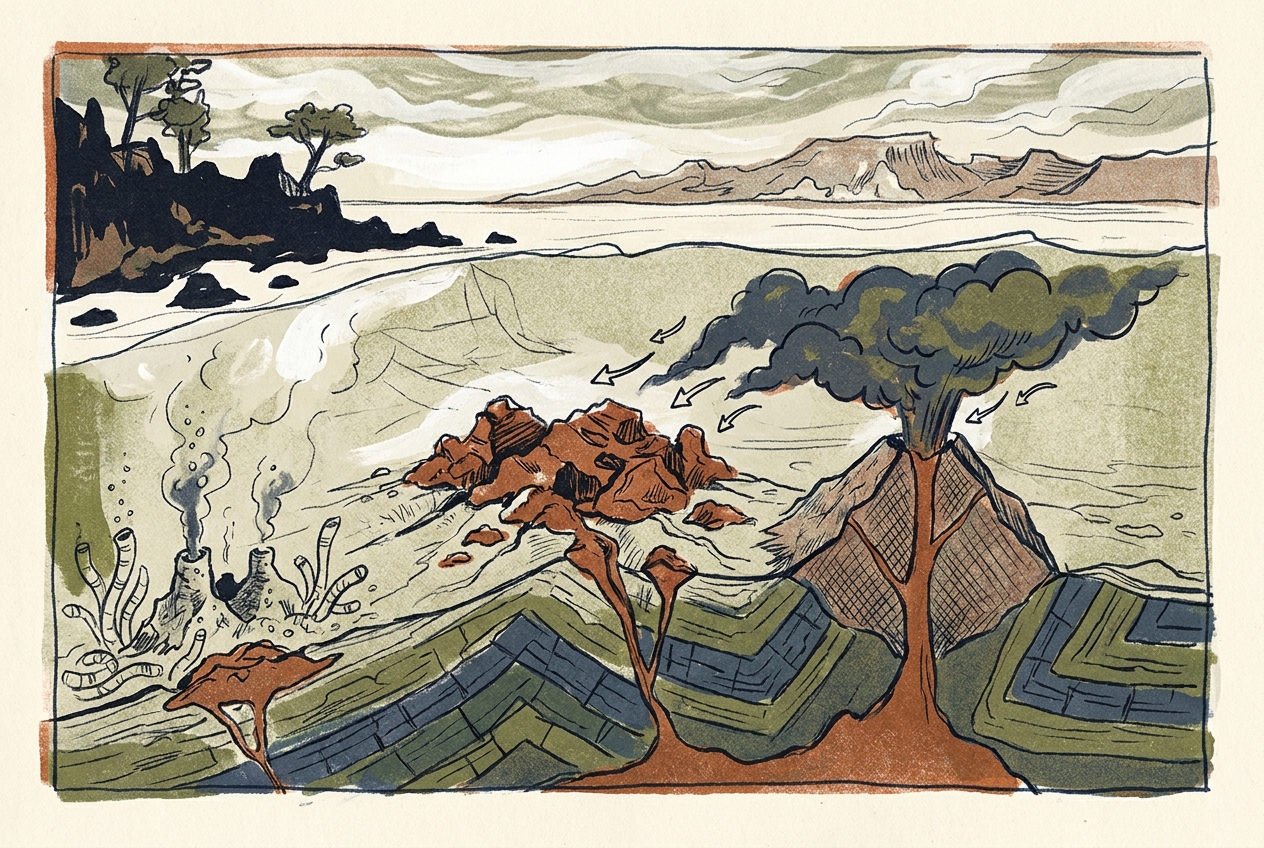
640 million years ago, the piece of crust that would become Tasmania was not a quiet island. It was a chain of volcanic arcs, like modern-day Indonesia—a string of submarine volcanoes spewing lava and hot fluids into a dark ocean. The rocks that formed there, now called the Mount Read Volcanics, stretch for over 200 kilometres through western Tasmania.
At the seafloor, vents called black smokers belched superheated water loaded with copper, gold, and iron. When that hot brine hit cold seawater, the metals precipitated out, building chimneys and mounds of sulfide minerals. These are volcanogenic massive sulfide deposits—the same kind that form at mid-ocean ridges today.
What makes Mount Lyell unusual is not just its size. It is one of the few places where such a deposit was buried, metamorphosed, and then exhumed by erosion, exposing the original seafloor architecture in cross-section.
The Deep Grind
Then came the assembly of Gondwana. Around 500 million years ago, the volcanic arc collided with the edge of the Australian continent. The rocks of Mount Lyell were shoved deep underground—to depths of perhaps 10 to 15 kilometres—where heat and pressure remade them.
The copper sulfide minerals didn't just sit there. Under high-grade metamorphism, they softened and flowed. Bornite and chalcopyrite—copper-iron sulfides—were squeezed into veins and fracture networks, like toothpaste forced through a crack. This secondary enrichment is why Mount Lyell ore could be worked with nineteenth-century technology: the metamorphism concentrated the metal into rich, accessible shoots.
The copper that miners dug from Mount Lyell had been melted, squeezed, and recrystallised by forces that only deep time can supply.
The Surface That Revealed It
The final act was erosion. Over the past 100 million years, the Tasmanian landscape has been steadily planed down. The softer rocks above Mount Lyell weathered away; the resistant quartz-rich ore body stood out. Lyell's distinctive red and green cliffs—stained by copper oxides and chlorite—became a landmark that prospectors could see from kilometres away.
When the Mount Lyell Mining and Railway Company began operations in 1893, they found a deposit that had already been prepared by half a billion years of Earth's labor. The mountain yielded over 1.5 million tonnes of copper metal and significant gold before the mine closed in 1994.
What the Mountain Still Holds
The Mount Lyell story is not finished. Modern geophysical surveys suggest that the known ore body extends deeper than anyone has drilled. The same volcanic sequence that produced the original deposit may host additional lenses of copper-gold mineralization, still buried beneath the folded strata.
More than that, Mount Lyell is a window into how copper moves through Earth's crust—from seafloor vent to metamorphic vein to weathered outcrop. Understanding that journey helps geologists find the next deposit, wherever young mountains and old seas have conspired to concentrate metal.
Western Tasmania's temperate rainforest now grows over the old workings. But beneath the myrtle beech and horizontal scrub, the bones of a 640-million-year-old seafloor still hold their copper promise.
More like this
- The 5,000-Year-Old Volcanoes That Still Smoke in the SouthIn Victoria's Newer Volcanics Province, 400 volcanic vents erupted as recently as 5,000 years ago—the youngest volcanic field in mainland Australia, where craters still hold blue lakes and scoria cone
- The 300-Million-Year-Old Forest That Died Standing UpIn New South Wales, a 300-million-year-old fossil forest preserves dozens of trees buried upright by a Permian volcanic eruption—an entire ecosystem frozen in ash.
- The 1.85-Billion-Year-Old Caldera That Still Feeds the FurnaceIn South Australia's Middleback Ranges, a 1.85-billion-year-old volcanic caldera collapsed and later became one of the world's richest iron ore deposits.