26 June 2026 · 2 min read
The 580-Million-Year-Old Ice That Dropped a Stone
Dropstones in South Australia's Elatina Formation record the rapid melt of Snowball Earth's Marinoan glaciation 580 million years ago.
About 20 kilometres south of Adelaide, a 580-million-year-old seafloor turned into a cliff of fossilised icebergs. The Elatina Formation at Hallett Cove is one of the world's best records of Snowball Earth—a time when glaciers reached the equator and the planet nearly froze solid. What remains is a story written in dropped stones.
The Dropstone Evidence
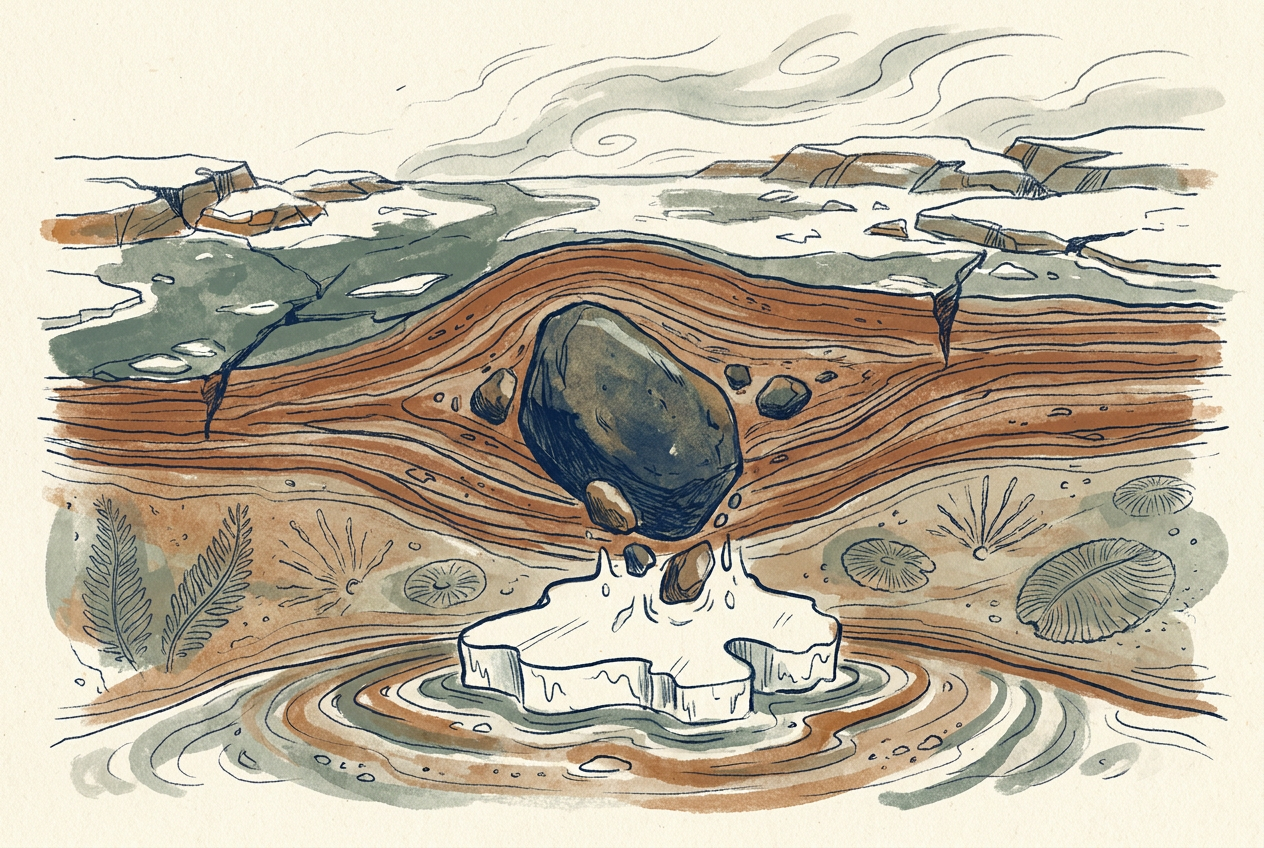
The cliffs at Hallett Cove expose a sequence of laminated siltstone and fine sandstone. Scattered through these layers are lonestones—pebbles and cobbles of granite, quartzite, and gneiss that have no business being in fine-grained marine sediment. These are dropstones: rocks that were carried by icebergs, then dropped to the seafloor when the ice melted.
Each dropstone punctured the soft sediment on impact, bending the underlying layers downward and draping them over the top. The pattern is unmistakable. No river could deliver granite boulders into still, deep water. Only ice could carry them.
The Elatina Formation dates to the Marinoan glaciation, roughly 640 to 580 million years ago. This was the second of two Neoproterozoic snowball episodes. Ice sheets covered most continents, and the oceans were sealed under a kilometre-thick lid of sea ice. Life survived in refugia—perhaps in hydrothermal vents or thin-water oases near the equator.
A Landscape Carved by Melt
When the Marinoan ice finally retreated, it did so rapidly. The dropstones at Hallett Cove are not evenly distributed. They cluster in horizons, suggesting episodic calving of icebergs during a warming climate. The sequence records the transition from full glaciation to open ocean.
Above the glacial diamictite—a chaotic mix of boulders, sand, and mud—sits the Nuccaleena Formation, a cap carbonate that drapes the glacial deposits across much of South Australia. This thin layer of dolomite represents the chemical aftermath of Snowball Earth: when the ice melted, carbon dioxide that had built up in the atmosphere over millions of years dissolved into the ocean, triggering massive carbonate precipitation.
The cap carbonate is the planet's receipt for a billion-year gas bill.
What the Stones Tell Us
The dropstones at Hallett Cove are not just geological curiosities. They are climate archives with annual resolution. The siltstone laminae that host them are varves—annual layers of sediment deposited in a glacial lake or sea. Each light-dark couplet represents one year: coarse sediment from spring melt, fine clay settling in winter.
Researchers have counted these varves and found that the Marinoan deglaciation—the melting of a global ice sheet—took only a few thousand years. In geological terms, that is nearly instantaneous. The same process that dropped a granite cobble onto a South Australian seafloor 580 million years ago is accelerating in Greenland and Antarctica today.
The Elatina Formation is protected as part of Hallett Cove Conservation Park, an urban geological reserve. Schoolchildren walk the same cliffs where, in the 19th century, geologists first recognised glacial striations on the pavements of Adelaide.
More like this
- The 110-Million-Year-Old River That Runs Backwards UndergroundWestern Australia's 110-million-year-old dune system has been slowly dissolving into a labyrinth of caves where an ancient river still flows, carrying the taste of a Cretaceous desert.
- The 5,000-Year-Old Volcanoes That Still Smoke in the SouthIn Victoria's Newer Volcanics Province, 400 volcanic vents erupted as recently as 5,000 years ago—the youngest volcanic field in mainland Australia, where craters still hold blue lakes and scoria cone
- The 560-Million-Year-Old Garden That Never Saw a PredatorIn South Australia's Flinders Ranges, 560-million-year-old Ediacara surfaces preserve entire seafloor communities of fronds, discs, and quilts — a garden of soft-bodied life that flourished before pre