26 June 2026 · 3 min read
The 500-Million-Year-Old Mudflat That Froze a Massacre
How 500-million-year-old mudstone in South Australia's Flinders Ranges preserves the earliest known evidence of a mass death event—trilobites killed by a sudden toxic algal bloom
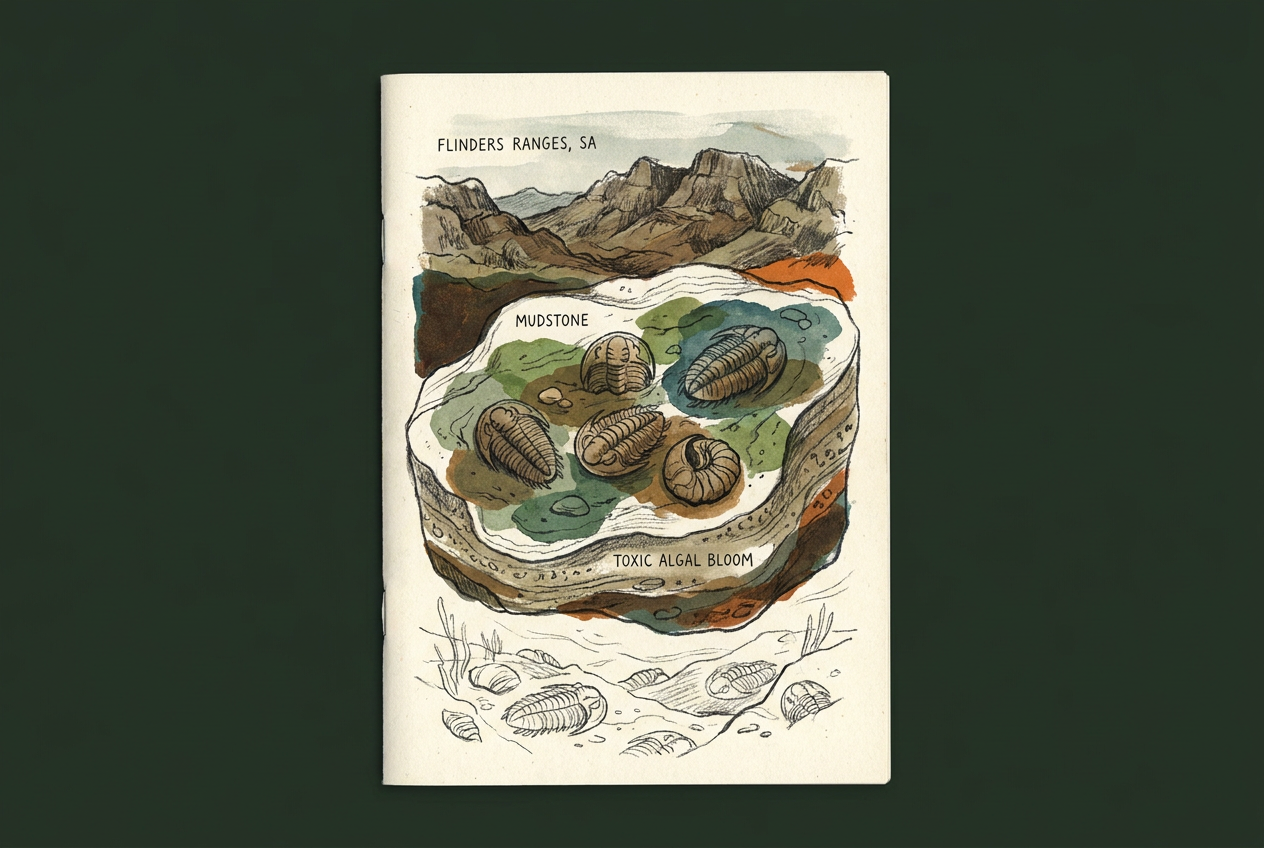
In the Flinders Ranges of South Australia, a slab of grey mudstone holds hundreds of trilobites frozen in contorted postures—backs arched, tails curled under, legs splayed as if seized by a cramp. They died together, in a single catastrophic event, 500 million years ago.
A Death Assemblage Written in Stone
The Emu Bay Shale, exposed on the coast of Kangaroo Island and in scattered outcrops across the Flinders Ranges, is one of the few places on Earth that preserves soft tissues from the early Cambrian. Most Cambrian fossils are shells and carapaces—the durable bits. Here, the mud was so fine, and burial so swift, that gut contents, antennae, and even muscle fibres survive.
But one particular bed tells a different story. The trilobites are not scattered by currents or scavenged. They lie in dense clusters, all of a single species, Redlichia takooensis, and all showing the same death pose: the "opisthotonic posture" that occurs when an animal dies in extremis, muscles contracting in a final spasm.
Five hundred million years ago, something poisoned the water, and a whole generation of trilobites died in hours.
The Silty Smoking Gun
Geologists from the University of Adelaide and the South Australian Museum examined the chemistry of the mudstone. They found elevated levels of organic carbon and pyrite, consistent with a sudden algal bloom that sucked oxygen from the water. The trilobites didn't suffocate slowly—they were overwhelmed by a rapid pulse of anoxia, perhaps triggered by nutrients washed in from the ancient continent's weathered crust.
The bed is no more than a few centimetres thick. Above and below it, the shale is full of healthy fossils, animals that lived and died in ordinary ways. This single layer is a snapshot of catastrophe: a mass mortality event from the very dawn of complex animal life.
The Oldest Known Mass Death
Comparable events are rare in the fossil record. The famous "death assemblages" of the Burgess Shale are thought to be accumulations over time, not single moments. The Emu Bay Shale's mass death bed is different. It is the oldest known example of a monospecific death assemblage—a whole population killed by a single environmental shock.
Redlichia takooensis was a large trilobite, up to 15 centimetres long, with a spiny carapace and large compound eyes. It was a predator of the early Cambrian seafloor, hunting smaller arthropods among the archaeocyathid sponge reefs that dotted the shallow waters of the Gondwana margin. That it died en masse suggests that even the top predators of the Cambrian were vulnerable to the whims of ocean chemistry.
The mudstone that entombed them is now part of the Billy Creek Formation, deposited in a shallow marine basin that once covered much of what is now South Australia. The basin was periodically starved of oxygen, and the trilobite death bed records one of those anoxic pulses—a brief, lethal event in a sea that otherwise teemed with life.
What the Posture Tells Us
The opisthotonic posture is familiar to palaeontologists. It is seen in dinosaur fossils, in ichthyosaurs, in mammals—any animal with a central nervous system that undergoes a prolonged death. The arched back, the tucked tail, the splayed limbs: these are not artefacts of decay or burial. They are the signature of a stressed nervous system, a body fighting to the last.
That Cambrian trilobites show the same posture as a dinosaur in a Jurassic lakebed tells us something fundamental. The neural pathways that control muscle contraction in response to extreme stress—the final, involuntary convulsion before death—were already in place half a billion years ago. The hardware is ancient.
The Emu Bay Shale's mass death bed is a small thing: a few centimetres of dark mud, a few hundred trilobites. But it is a window into a moment when the Cambrian sea turned poisonous, and the oldest complex animals on Earth died together, still thrashing, in water that had suddenly become unbreathable.
More like this
- The 560-Million-Year-Old Garden That Never Saw a PredatorIn South Australia's Flinders Ranges, 560-million-year-old Ediacara surfaces preserve entire seafloor communities of fronds, discs, and quilts — a garden of soft-bodied life that flourished before pre
- The 300-Million-Year-Old Forest That Died Standing UpIn New South Wales, a 300-million-year-old fossil forest preserves dozens of trees buried upright by a Permian volcanic eruption—an entire ecosystem frozen in ash.
- The 1.75-Billion-Year-Old Reef That Outranks the BarrierA 1.75-billion-year-old microbial reef in the Kimberley is the largest biological structure ever built by a single species, preserving a world without predators.