6 July 2026 · 4 min read
The 635-Million-Year-Old Snowball That Broke Open the Ediacaran
How 635-million-year-old glacial dropstones in South Australia's Flinders Ranges record the end of Snowball Earth and the beginning of the Ediacaran biota.
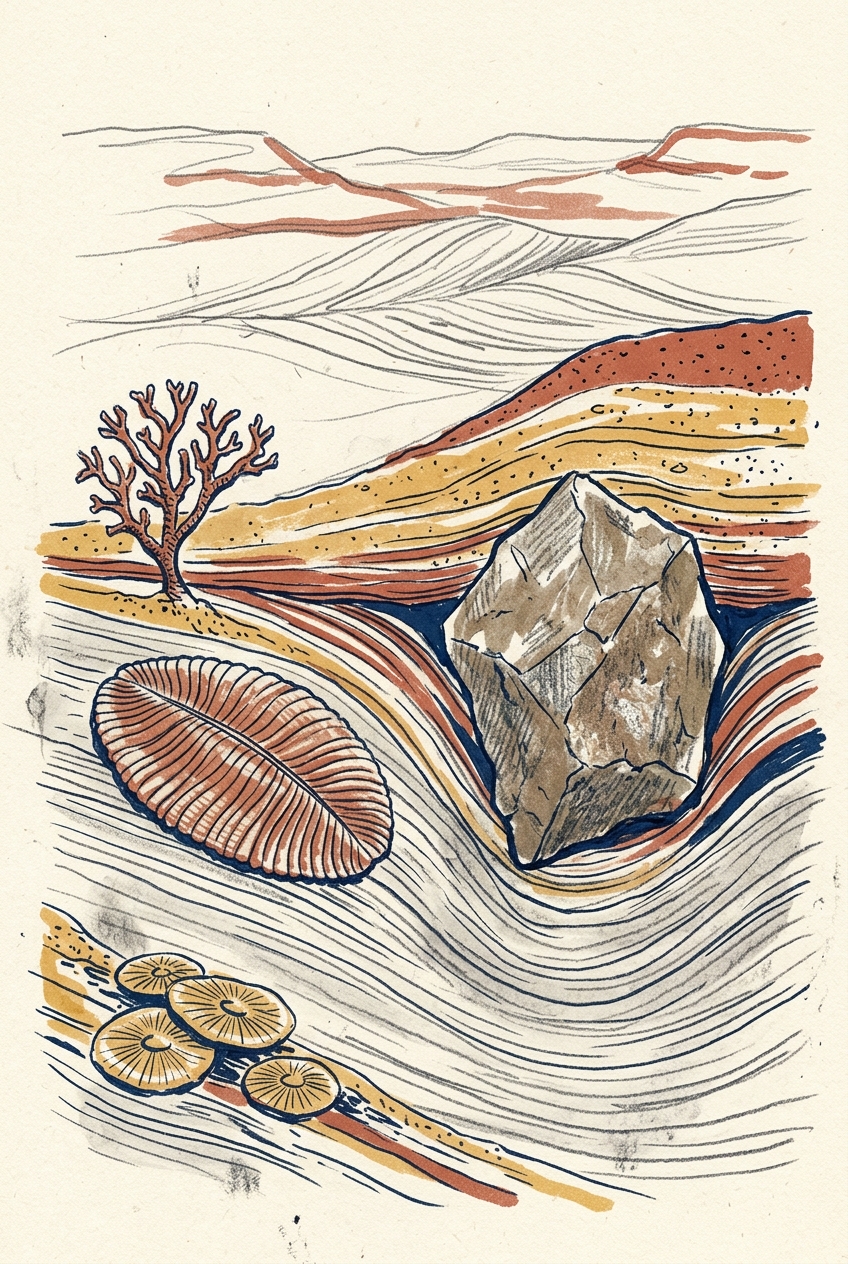
In the Flinders Ranges of South Australia, a cliff face near the old Brachina Gorge road holds a stone the size of a human skull, suspended in fine grey siltstone as though it fell from the sky and never landed. It did fall—but not from the sky. It fell from an iceberg.
The stone is a dropstone, a fragment of ancient bedrock that calved into a cold sea, drifted, melted, and dropped to the seafloor. Its presence in 635-million-year-old rock marks the end of the Sturtian glaciation, the most severe ice age Earth has ever known. For 60 million years, ice covered the planet from pole to equator—a Snowball Earth. Then it stopped. And when it did, the world changed.
The Ice That Held the World
The Sturtian glaciation began around 720 million years ago. Geochemical evidence from the Brachina Formation and the underlying glaciogenic sediments—tilites, striated pavements, and these very dropstones—suggests that continental ice sheets reached sea level at all latitudes. The planet's albedo trapped it in a frozen loop.
What broke the loop remains debated. The leading theory involves volcanic carbon dioxide. Subaerial volcanoes continued erupting through the ice, slowly pumping CO₂ into the atmosphere over millions of years. No plant life existed to draw it down. No silicate weathering operated on a frozen surface. The greenhouse gas accumulated until the atmosphere reached a tipping point—perhaps 350 times today's CO₂ levels—and the ice melted in a geological instant.
The dropstones in Brachina Gorge are the boundary markers. Below them: glacial diamictite, unsorted rubble ground from the continent by moving ice. Above them: finely laminated siltstone, deposited in a deep, quiet sea. The transition is abrupt. The ice vanished, and the ocean rose.
A Sea That Had Never Seen Light
The post-glacial ocean was unlike any that exists today. The meltwater pulse flooded continental shelves that had been buried under kilometres of ice for tens of millions of years. The seawater itself was chemically strange—rich in iron, low in oxygen, and saturated with carbonate from the long atmospheric buildup.
In the Flinders Ranges, the Trezona Formation records this world. It sits just above the glacial sequence and below the first Ediacaran fossils. The rock is a dolomitic limestone, deposited in shallow, warm seas that lapped against the newly exposed continent. Within it, microbial mats built wrinkled domes and layered crusts on the seafloor. No animals yet—but the water chemistry was changing, and so was the stage.
The ice did not kill life. It reset the planet's chemistry, and life answered with something new.
The carbon isotope record through these layers shows wild swings. Organic carbon burial rates surged. Oxygen began to accumulate in the deep ocean for the first time in hundreds of millions of years. Some geochemists call this the Shuram excursion—a 10-million-year wobble in the carbon cycle that may mark the oxygenation of the Ediacaran seas.
The First Animals Arrive
Above the Trezona Formation lies the Rawnsley Quartzite, a sandstone unit that crops out in the hills around Nilpena and Ediacara stations. This is where, in 1946, geologist Reg Sprigg found the first impressions of soft-bodied organisms in rocks that had been mapped as Cambrian. They were older. They were Ediacaran.
The Rawnsley Quartzite was deposited in a shallow marine basin, possibly a delta front, where periodic storms buried the seafloor communities in sand. That rapid burial preserved the outlines of organisms that had no shells, no skeletons, no hard parts at all. Dickinsonia, a ribbed oval that grew to a metre across, fed by absorbing nutrients through its sole. Spriggina, segmented and vaguely trilobite-like, moved across the microbial mats. Rangea, a frond-like filter feeder, stood anchored to the seafloor in the current.
These are the oldest complex multicellular animals in the fossil record. They appear roughly 570 million years ago, about 65 million years after the ice retreated. The connection is not coincidental. The Sturtian glaciation and its aftermath—the chemical weathering of fresh rock, the flooding of continental shelves, the rise of oxygen—created the conditions that complex life required.
The Cliff That Holds the Boundary
Standing in Brachina Gorge today, the dropstone layer is easy to miss. The rock is grey-green, fractured, and unremarkable to the untrained eye. But the boundary it marks is one of the most important in Earth history: the contact between a frozen planet and a habitable one.
Below that line: a world of ice, sterile continents, and oceans cut off from sunlight. Above it: the slow bloom of life that would culminate, 35 million years later, in the Cambrian explosion.
The stone that fell from an iceberg in a 635-million-year-old sea now rests in a dry creek bed in the South Australian outback. It carries no fossil, no visible structure, no hint of its significance. It is just a rock that fell, melted, and waited.
More like this
- The 560-Million-Year-Old Garden That Never Saw a PredatorIn South Australia's Flinders Ranges, 560-million-year-old Ediacara surfaces preserve entire seafloor communities of fronds, discs, and quilts — a garden of soft-bodied life that flourished before pre
- The 300-Million-Year-Old Forest That Died Standing UpIn New South Wales, a 300-million-year-old fossil forest preserves dozens of trees buried upright by a Permian volcanic eruption—an entire ecosystem frozen in ash.
- The 1.75-Billion-Year-Old Reef That Outranks the BarrierA 1.75-billion-year-old microbial reef in the Kimberley is the largest biological structure ever built by a single species, preserving a world without predators.