6 July 2026 · 3 min read
The 3-Million-Year-Old Salt Flat That Still Holds a Pulse
Australia's largest salt lake, Lake Torrens, spends most of its life bone-dry—yet its salt crust records 3 million years of the continent's climatic heartbeat.
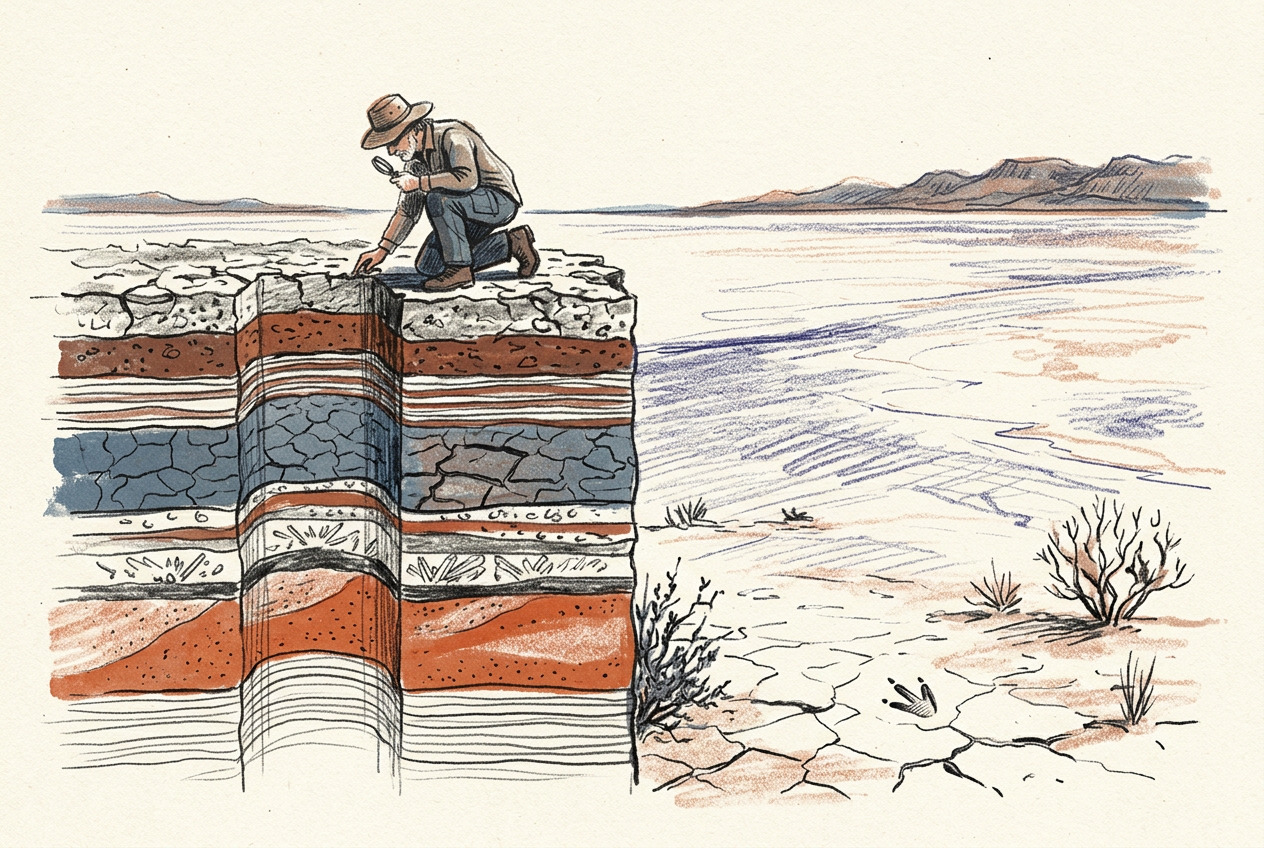
On the shores of Lake Torrens in South Australia, the ground is not ground. It is a salt crust, hundreds of kilometres across, that crackles underfoot like thin ice. This is not a lake in any familiar sense—it is the dry bed of an inland sea that has evaporated and re-formed more than thirty times in the last 3 million years.
The Lake That Refuses to Stay Dead
Lake Torrens is Australia's largest salt lake by area, stretching roughly 240 kilometres north of Port Augusta. Yet for most of a given decade it contains no water at all. Its bed is a flat, blinding-white pan of halite and gypsum, baked hard by the sun. Then, once every five or ten years, a flood from the northern catchment pours in and the lake becomes, for a few months, a shallow inland sea.
The transformation is violent. The salt crust dissolves, releasing brines that kill freshwater fish instantly. Birds arrive by the thousands. The water turns pink with algae. Then the flood recedes, the salt reforms, and the lake returns to its default state: a mirage.
This is not a lake that has forgotten how to hold water. It is a lake that remembers the Ice Age.
A Pulse Written in Salt
During the last glacial maximum, 20,000 years ago, the climate across central Australia was far wetter. Lake Torrens was a true lake, fed by permanent rivers. Its shoreline sat 30 metres higher than today's salt flat. As the continent dried out over the past 15,000 years, the lake shrank and the salt concentrated.
But the lake did not die. It entered a new rhythm. The salt crust that now covers the bed is not a tombstone—it is a seal. Below it, saturated brine still moves through the sediment, responding to shifts in pressure and temperature. Geologists have found that the crust itself breathes: it expands and contracts with seasonal humidity changes, cracking audibly at night as the desert cools.
The Living Salt
What looks like a dead landscape is, in fact, chemically alive. The halite crust is not a single flat sheet but a mosaic of polygonal plates, each a few metres across, that buckle and lift at their edges. Between the plates, brine wells up and crystallises into new salt, pushing the old crust upward. The whole surface is slowly turning over, like a glacier made of salt.
Microbial communities live inside the brine pockets, sealed in darkness for years between floods. They are halophilic archaea, organisms that thrive at salt concentrations that would desiccate most life. When a flood dissolves the crust, they bloom and turn the water pink. When the water evaporates, they dry into spores and wait.
What the Salt Records
Lake Torrens is not a geological oddity. It is a record of the continent's climatic heartbeat. Each layer of salt and sediment preserves a pulse of wet and dry, stretching back to the Pliocene. Drill cores through the crust have revealed cycles of flooding and desiccation that match the Earth's orbital wobbles—the same Milankovitch cycles that drive ice ages.
There is no water visible at Lake Torrens on most days. But the salt remembers every flood. The crust carries the chemistry of each inundation: the trace metals from distant ranges, the isotopes of rainfall from different ocean basins. The lake is a slow-motion archive, writing its history in crystals rather than pages.
For a continent that is mostly desert, Australia's driest lake may be its most eloquent witness. It does not hold water, but it holds time.
More like this
- The 110-Million-Year-Old River That Runs Backwards UndergroundWestern Australia's 110-million-year-old dune system has been slowly dissolving into a labyrinth of caves where an ancient river still flows, carrying the taste of a Cretaceous desert.
- The 5,000-Year-Old Volcanoes That Still Smoke in the SouthIn Victoria's Newer Volcanics Province, 400 volcanic vents erupted as recently as 5,000 years ago—the youngest volcanic field in mainland Australia, where craters still hold blue lakes and scoria cone
- The 560-Million-Year-Old Garden That Never Saw a PredatorIn South Australia's Flinders Ranges, 560-million-year-old Ediacara surfaces preserve entire seafloor communities of fronds, discs, and quilts — a garden of soft-bodied life that flourished before pre