6 July 2026 · 3 min read
The 1.8-Billion-Year-Old Desert That Still Wears Its Living Crust
The Bungle Bungle Range in Western Australia is a 1.8-billion-year-old sandstone landscape whose striped beehive domes are shaped by living cyanobacterial mats—a landscape built by the oldest form of
In the remote Kimberley of Western Australia, a 1.8-billion-year-old reef rises from the desert—but no coral built it. The Bungle Bungle Range is a fossilised landscape of microbial origin, a vast dome-and-karst system that predates animals by more than a billion years.
The Dome That Life Built
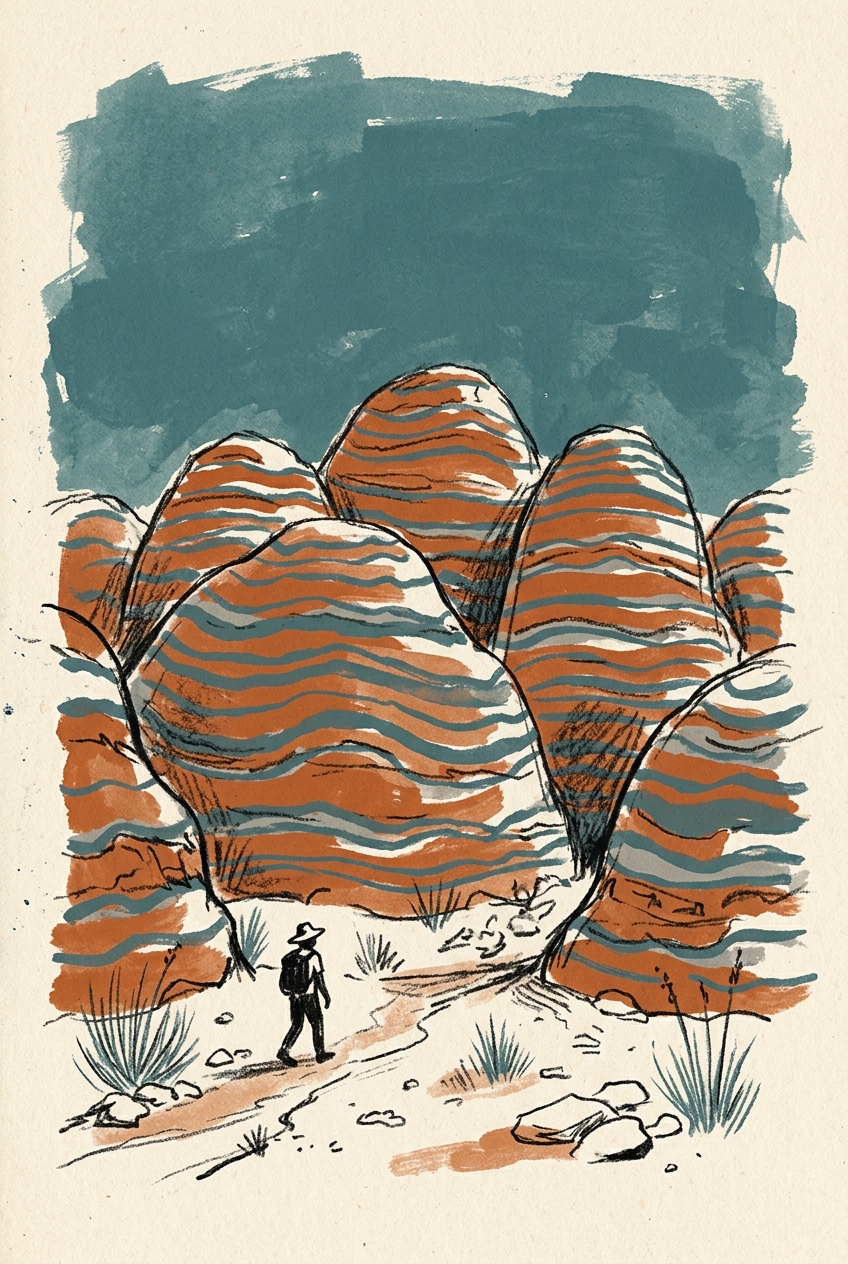
The Bungle Bungle Range, core of Purnululu National Park, is made of 1.8-billion-year-old sandstone and conglomerate deposited by ancient rivers in the Proterozoic. What makes it extraordinary is not the rock itself but the pattern it wears. The range is a field of striped beehive-shaped domes, each banded in alternating orange and grey-black layers. The orange bands are desert varnish—a thin coating of iron and manganese oxides laid down by microbes over tens of thousands of years. The grey-black bands are cyanobacterial crusts, living films that cling to the rock where moisture lingers. The domes are not a product of tectonic uplift or volcanic eruption. They are the result of differential weathering along ancient joint systems, guided by the same microbial communities that gave Earth its first oxygen.
A Billion-Year-Old River System
The quartz sandstone of the Bungle Bungle was laid down by a vast braided river system that once drained the Kimberley region. The sediment was buried, compacted, and cemented into rock by silica-rich groundwater. Later, the entire pile was gently tilted by the same tectonic forces that shaped the nearby Osmond Range. The joints and fractures that now control the dome pattern formed when the crust stretched and cracked during the breakup of the supercontinent Rodinia, around 750 million years ago. The Bungle Bungle Range is thus a rare thing: a landscape whose architecture was set in the Proterozoic and whose surface expression is still controlled by structures a billion years old.
The Bungle Bungle Range is not a fossil—it is a living landscape shaped by the same kind of life that invented photosynthesis.
The Stripes That Breathe
The grey-black bands on the Bungle Bungle domes are not paint or mineral stain. They are living cyanobacterial mats, descendants of the same microbial communities that built the first stromatolites 3.5 billion years ago. During the brief wet season, these mats become active, photosynthesising and fixing nitrogen. The orange bands below them are the chemical legacy of older mats—iron and manganese oxides precipitated by microbial activity over millennia. The entire landscape is thus a living palimpsest: the present surface is shaped by life, and the underlying rock was deposited in a world before complex life existed.
The Reef That Never Was
Early geologists mistook the Bungle Bungle for an ancient coral reef. The domes do resemble giant stromatolites, and the banding recalls the growth rings of a living organism. But the Bungle Bungle is not a reef. It is a sandstone plateau carved by erosion into a labyrinth of chasms and towers, then painted by the slow work of microbes. The closest analogue is not any reef on Earth but the karst landscapes of Vietnam or China, where limestone towers rise from the jungle—except here the rock is quartzite, not limestone, and the sculptor is not acid rain but the patient action of cyanobacteria.
The Oldest Living Landscape
The Bungle Bungle Range remained unknown to the outside world until 1983, when a film crew documenting the Kimberley's wildlife flew over it and recognised its uniqueness. The local Gadjerong people had known it for millennia, calling it Purnululu—"sandstone country." Its isolation preserved it. The domes are fragile: the microbial crust that holds them together can be destroyed by a single footprint, and regeneration takes decades. The Bungle Bungle is not a relic of a dead past but a living system, still being built by the same slow forces that shaped it. It is the oldest continuously inhabited landscape on Earth—inhabited not by humans, but by the microbes that first taught rock how to breathe.
More like this
- The 110-Million-Year-Old River That Runs Backwards UndergroundWestern Australia's 110-million-year-old dune system has been slowly dissolving into a labyrinth of caves where an ancient river still flows, carrying the taste of a Cretaceous desert.
- The 5,000-Year-Old Volcanoes That Still Smoke in the SouthIn Victoria's Newer Volcanics Province, 400 volcanic vents erupted as recently as 5,000 years ago—the youngest volcanic field in mainland Australia, where craters still hold blue lakes and scoria cone
- The 560-Million-Year-Old Garden That Never Saw a PredatorIn South Australia's Flinders Ranges, 560-million-year-old Ediacara surfaces preserve entire seafloor communities of fronds, discs, and quilts — a garden of soft-bodied life that flourished before pre