7 July 2026 · 2 min read
The 635-Million-Year-Old Carbon Cliff That Foretold a Frozen Earth
In the Flinders Ranges, 635-million-year-old carbon isotopes in the Trezona Formation record the collapse of life that preceded Earth's deepest ice age.
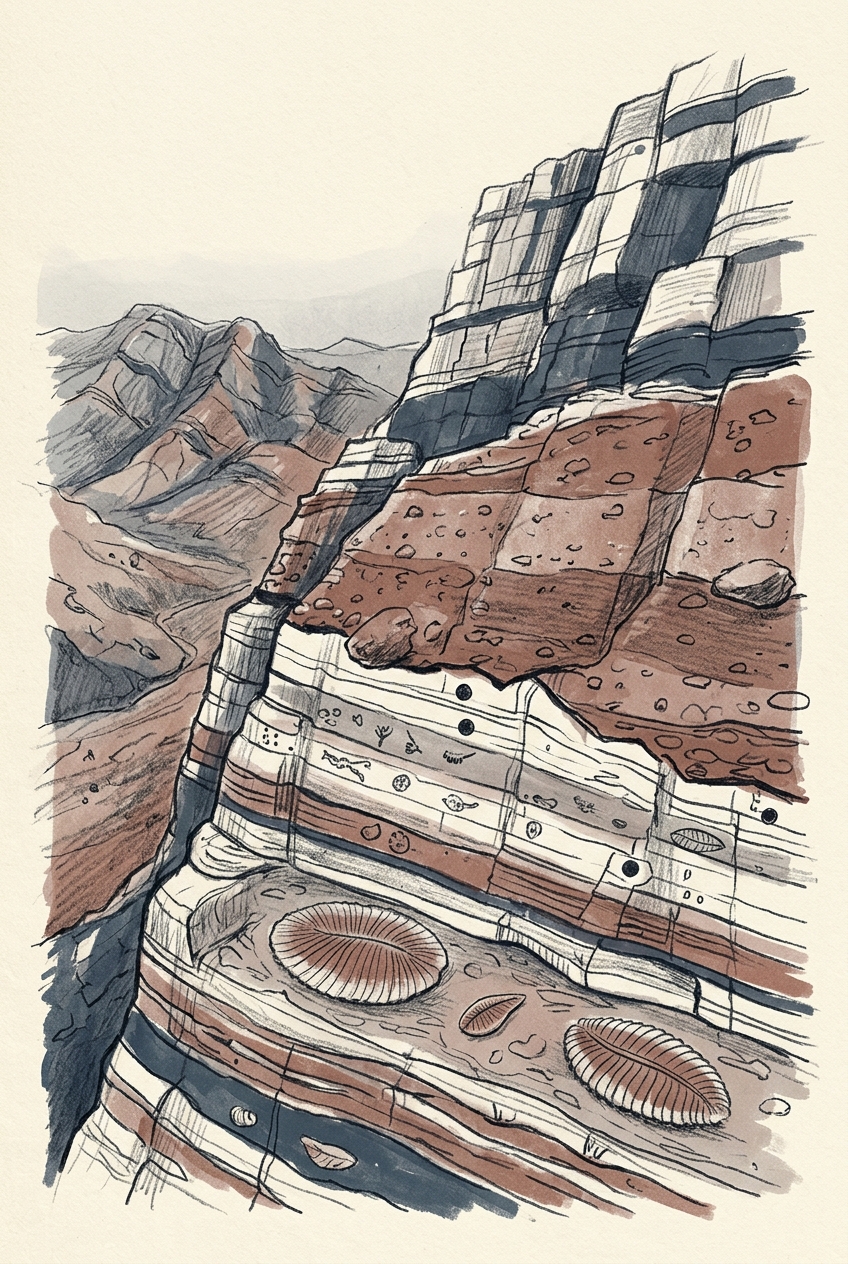
In the Flinders Ranges, a crisis sits frozen in stone. At a place called Trezona Bore, 635-million-year-old limestone carries a clear chemical warning — a steep drop in the carbon-13 isotope that records the moment Earth's biological pump collapsed, and the planet slid into its deepest ice age.
The Chemical Cliff
Limestone is built by life. Marine organisms pull carbon from seawater and build shells, preferentially taking up the lighter carbon-12 isotope. The heavier carbon-13 stays behind. For hundreds of millions of years, the ratio between them stayed stable.
Then, at the end of the Cryogenian period, something broke. Carbon-13 plummeted — a signal that biological productivity had crashed. The Trezona Formation preserves this event with remarkable clarity. Its limestones record a negative carbon-isotope excursion that geologists have traced across every continent, but nowhere more clearly than in these South Australian ranges.
The cause remains debated. Some researchers point to a massive release of methane hydrates from the seafloor. Others invoke a breakdown in ocean circulation. What is certain is that the biological crash preceded the glaciation — not the other way around.
The Frozen Sea
What followed was a global ice age unlike any since. The so-called Sturtian glaciation lasted 60 million years — the longest sustained freeze in Earth's history. In the Flinders Ranges, its deposits lie directly above the Trezona limestone.
Tillites — cemented glacial debris — blanket the landscape. Striated boulders carried by ice sit embedded in fine-grained mud. Dropstones, solitary rocks that fell from melting icebergs, puncture the sedimentary layers below. These are the calling cards of a world where ice reached the equator.
Some models suggest the oceans froze to a depth of a kilometre. With sunlight blocked by ice, photosynthesis slowed to near zero. The biological pump, already weakened, stopped entirely. The planet had become a white marble, silent and cold.
The Escape
What ended the Sturtian deep freeze is as controversial as what began it. The leading hypothesis points to volcanoes. In a Snowball Earth, plate tectonics continues below the ice. Subduction zones keep producing carbon dioxide, which vents into the atmosphere. With no rainfall to draw it down, CO₂ builds up over millions of years.
At the peak of the ice, atmospheric CO₂ may have reached 350 times pre-industrial levels — enough to trigger a runaway greenhouse that melted the ice in a geological instant.
The Trezona Formation sits at the hinge of this story. Its carbon isotopes preserve the silence before the storm — the moment the living world faltered, and the ice began to build. It is a chemical cliff that records the closest Earth has ever come to dying.
The Flinders Ranges hold many chapters of life's early history. This one is about its near end.
More like this
- The 560-Million-Year-Old Garden That Never Saw a PredatorIn South Australia's Flinders Ranges, 560-million-year-old Ediacara surfaces preserve entire seafloor communities of fronds, discs, and quilts — a garden of soft-bodied life that flourished before pre
- The 300-Million-Year-Old Forest That Died Standing UpIn New South Wales, a 300-million-year-old fossil forest preserves dozens of trees buried upright by a Permian volcanic eruption—an entire ecosystem frozen in ash.
- The 1.75-Billion-Year-Old Reef That Outranks the BarrierA 1.75-billion-year-old microbial reef in the Kimberley is the largest biological structure ever built by a single species, preserving a world without predators.