7 July 2026 · 3 min read
The 1.78-Billion-Year-Old Seasons That Still Read Like Tree Rings
In Queensland's McArthur Basin, 1.78-billion-year-old banded rhyolites preserve a seasonal climate record—annual wet-dry cycles frozen in volcanic rock.
A hundred kilometres north-west of Mount Isa, the Leichhardt River cuts through a slab of 1.78-billion-year-old volcanic rock that still holds the shape of the sky. The flow-banded rhyolite of the Eastern Creek Volcanics preserves a climate so precise that geologists can read the season—wet or dry, summer or winter—in the thickness of its microscopic growth rings.
The Rock That Grew in Water
The Eastern Creek Volcanics are not ordinary lava. They erupted not as molten rock but as steaming, silica-rich ash flows that poured into shallow lakes and ephemeral rivers across the McArthur Basin. Each flow cooled quickly, trapping the water chemistry of the moment in bands of fine-grained quartz and feldspar. The result is a rock called a banded rhyolite—a volcanic archive that records not just an eruption, but the weather.
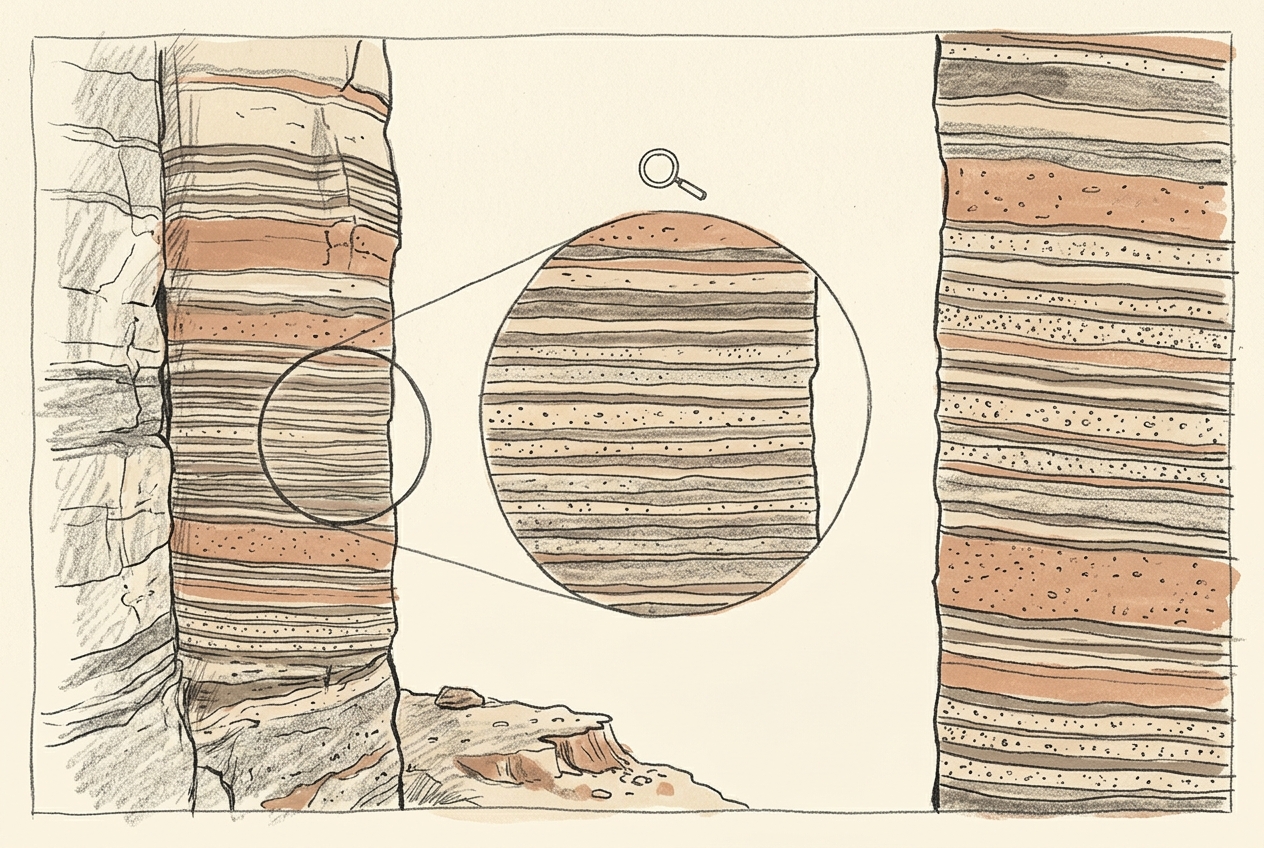
Geologists from the University of Queensland and the Geological Survey of Queensland have measured these bands layer by layer. They found that each couplet—a pale band and a dark band—represents a single year of deposition. The pale bands formed during the wet season, when runoff diluted the lake water and altered the chemistry of the precipitating silica. The dark bands formed in the dry season, when evaporation concentrated the dissolved minerals. The thickness of each band reflects the intensity of that season's rainfall or drought.
The rock remembers what the rain forgot.
A Billion-Year Weather Diary
The banded rhyolites of the Eastern Creek Volcanics span about 200,000 years of continuous deposition. This makes them one of the oldest annually layered climate records on Earth—a billion-year-old varve sequence preserved not in shale or limestone, but in volcanic glass.
Varves are sedimentary layers that form in lakes, one per year. But these are not sedimentary. They are volcanic rocks that mimic the rhythm of sediment because the lava itself was chemically sensitive to seasonal change. The silica-rich ash flows that entered the lakes were so hot that they boiled the water around them, but cooled fast enough to freeze the seasonal signal into the rock. The result is a hybrid: a volcanic rock that behaves like a tree ring.
The layers are visible to the naked eye. A hand sample cut perpendicular to the banding shows alternating light and dark stripes, each about 0.1 to 1 millimetre thick. Under a microscope, the bands reveal even finer detail: sub-millimetre laminations that might record individual storms or floods.
What the Bands Tell Us
The climate of the McArthur Basin 1.78 billion years ago was not the hellscape often imagined for the Proterozoic. The banding suggests a regime of strong seasonal rainfall, with wet summers and dry winters—similar to the modern monsoon climate of northern Australia. The thickness of the bands varies cyclically, hinting at longer-term climate oscillations that may correspond to changes in Earth's orbit.
But the most striking finding is the stability. The bands show no evidence of catastrophic drought or flood over the 200,000-year record. The climate was remarkably consistent, season after season, century after century. This is surprising, because 1.78 billion years ago the Sun was about 10 percent dimmer than today. The Earth should have been frozen. The fact that the McArthur Basin had a vigorous seasonal cycle suggests that greenhouse gases—probably methane and carbon dioxide from volcanic outgassing—kept the planet warm.
The Eastern Creek Volcanics are a rare window into a climate that no longer exists. They record a world where the Sun was weaker, the atmosphere was thicker, and the seasons were written in stone.
More like this
- The 110-Million-Year-Old River That Runs Backwards UndergroundWestern Australia's 110-million-year-old dune system has been slowly dissolving into a labyrinth of caves where an ancient river still flows, carrying the taste of a Cretaceous desert.
- The 5,000-Year-Old Volcanoes That Still Smoke in the SouthIn Victoria's Newer Volcanics Province, 400 volcanic vents erupted as recently as 5,000 years ago—the youngest volcanic field in mainland Australia, where craters still hold blue lakes and scoria cone
- The 560-Million-Year-Old Garden That Never Saw a PredatorIn South Australia's Flinders Ranges, 560-million-year-old Ediacara surfaces preserve entire seafloor communities of fronds, discs, and quilts — a garden of soft-bodied life that flourished before pre