26 June 2026 · 2 min read
The 590-Million-Year-Old Ice That Scratched a Continent
How 590-million-year-old glacial deposits in South Australia's Flinders Ranges record the Snowball Earth episode that melted into the Ediacaran dawn.
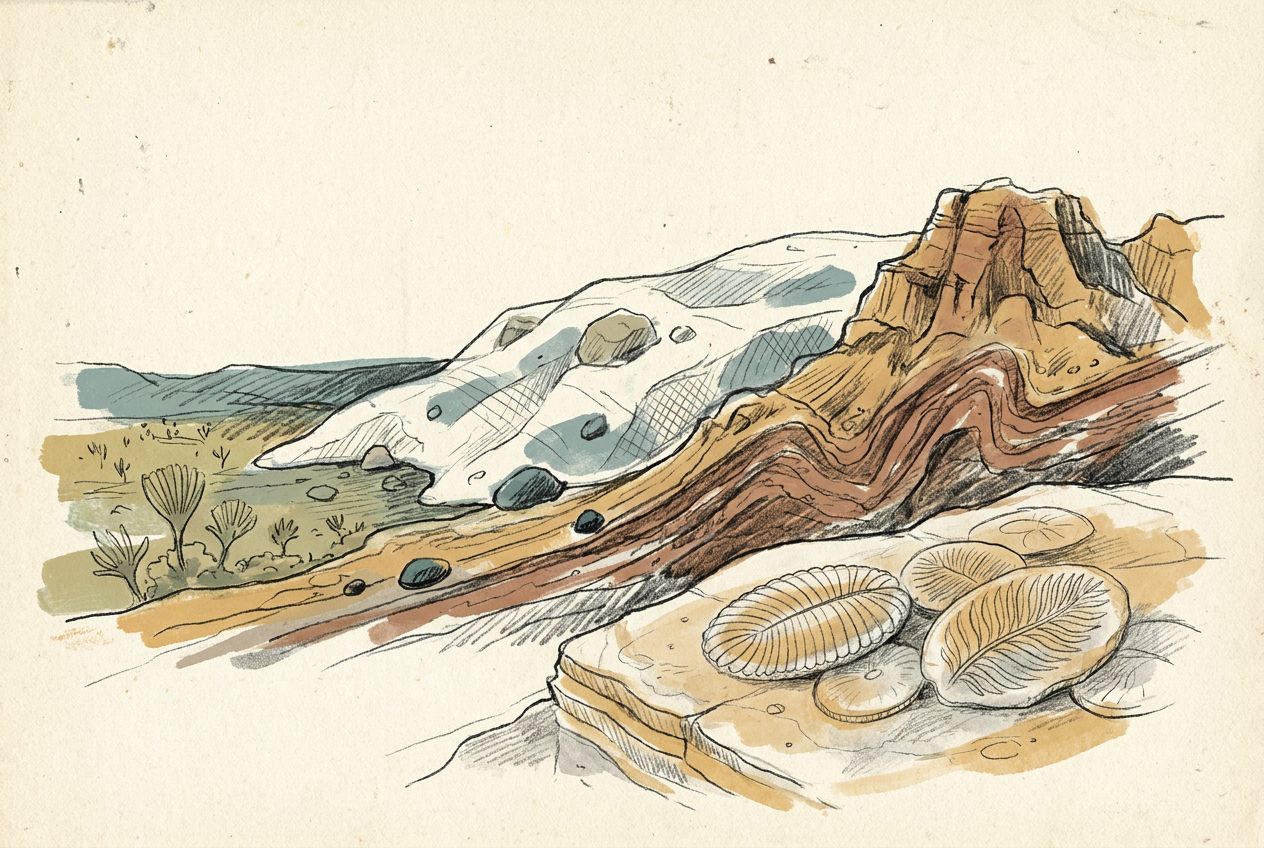
The rocks of the Flinders Ranges hold a contradiction: a seafloor that was once a glacier. Near the town of Brachina, outcrops of the Elatina Formation preserve the only known record of a low-latitude ice age that gripped the planet 590 million years ago. The same formation later cradled the first soft-bodied animals.
The Dropstone Evidence
Dropstones are the smoking gun of ancient ice. These are pebbles and boulders that calved from the base of a floating glacier, fell through the water column, and punched into soft seafloor mud. In the Elatina Formation, they sit in finely laminated siltstone like stones thrown into wet cement. Some are still faceted and striated—scratched by the grinding of ice against rock before they fell.
These dropstones occur within 10 degrees of the inferred equator. That is the key fact. For ice to reach sea level in the tropics, the entire planet must have frozen over. Geologists call this the Sturtian glaciation, the first and most severe of the Snowball Earth episodes. It lasted 60 million years.
The ice did not retreat. It collapsed.
The Cap Carbonate
Above the glacial sediments lies a thin band of pink dolomite, no more than a few metres thick. This is the cap carbonate—a chemical precipitate that formed when the frozen ocean suddenly warmed. Greenhouse gases from volcanic outgassing had built up during the long ice age. When the ice finally broke, the ocean acidified and calcium carbonate rained out in a geological instant.
The cap carbonate is the same rock, at the same horizon, found on every continent. It is the chemical signature of a planet emerging from deep freeze. In the Flinders Ranges, it sits directly on striated glacial pavement, the contact as sharp as a knife cut.
The Ediacaran Garden
Above the cap carbonate, the siltstones of the Rawnsley Quartzite preserve something stranger still. Here, 555 million years ago, the first complex multicellular organisms spread across the seafloor. Dickinsonia, Spriggina, and the frond-like Rangea lie flattened in the same basin that once held glacial till.
The connection is not coincidental. The Sturtian glaciation scoured continents, flushed nutrients into the oceans, and raised oxygen levels. When the ice melted, the seas were primed for life. The Ediacaran biota appear within a few million years of the cap carbonate.
The Landscape Today
The Flinders Ranges are an arid landscape of red ridges and dry creek beds. But the evidence is visible from the roadside. The Brachina Gorge geological trail passes through the full sequence: glacial diamictite, cap carbonate, fossil beds. A walk of a few hours crosses 30 million years of planetary crisis.
The striated pavements are still exposed, the grooves aligned north-south, showing the direction ice flowed across a continent that sat at the equator. No trees grow there now. The only sound is wind over stone.
More like this
- The 110-Million-Year-Old River That Runs Backwards UndergroundWestern Australia's 110-million-year-old dune system has been slowly dissolving into a labyrinth of caves where an ancient river still flows, carrying the taste of a Cretaceous desert.
- The 5,000-Year-Old Volcanoes That Still Smoke in the SouthIn Victoria's Newer Volcanics Province, 400 volcanic vents erupted as recently as 5,000 years ago—the youngest volcanic field in mainland Australia, where craters still hold blue lakes and scoria cone
- The 560-Million-Year-Old Garden That Never Saw a PredatorIn South Australia's Flinders Ranges, 560-million-year-old Ediacara surfaces preserve entire seafloor communities of fronds, discs, and quilts — a garden of soft-bodied life that flourished before pre