26 June 2026 · 3 min read
The 550-Million-Year-Old Seafloor That Turned to Diamond
How a 550-million-year-old meteorite impact in South Australia created Australia's only known diamond-bearing impact rock—shocked graphite from the Ediacaran seafloor
Fifty kilometres west of Coober Pedy, a low rise of rust-coloured gravel barely interrupts the flat horizon. Nothing about it suggests violence. But beneath that rise lies evidence of a collision so sudden that it turned seabed graphite into diamond—not the gem variety, but microscopic crystals that still carry the memory of impact.
The 550-Million-Year-Old Target
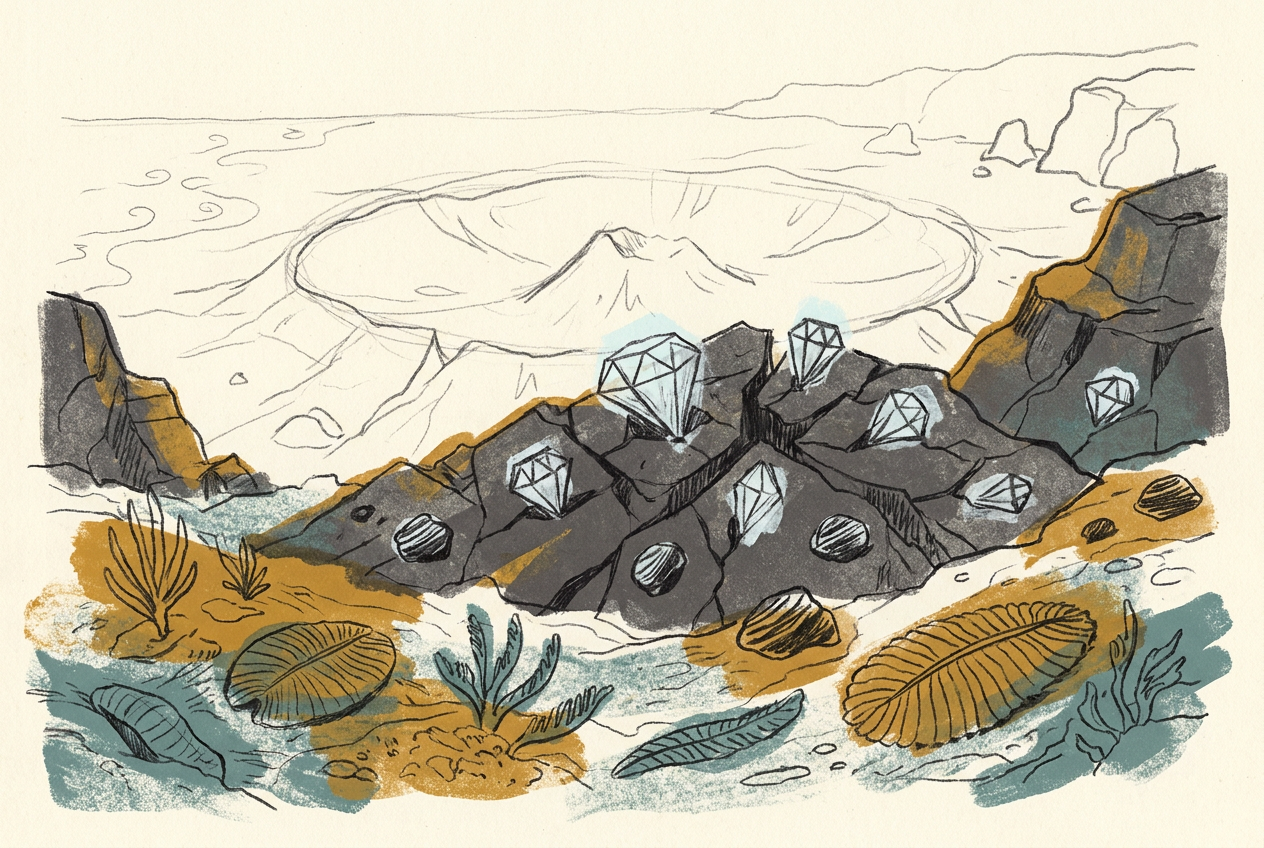
When the meteorite struck, this part of South Australia was seafloor. The Ediacaran ocean, shallow and cold, was layering down fine mud and silt that would become the Stuart Shelf sediments. The impact hit a sequence of rocks that had themselves only recently been deposited.
Among those sediments were thin beds of graphite—the compressed remains of organic matter from the Ediacaran seas. This graphite would become the raw material for the diamonds.
The crater, now called the Shoemaker Impact Structure, was originally about 30 kilometres across. Erosion has stripped away the upper layers, leaving a central uplift of shattered rock that rises barely 30 metres above the plain.
The Shock That Made Diamonds
Impact diamonds form differently from the volcanic diamonds we mine at Argyle or Kimberley. Those crystallise deep in the mantle, brought up by rare eruptions of kimberlite or lamproite. Impact diamonds form in seconds.
When the Shoemaker meteorite hit, the shockwave passed through the target rock at several kilometres per second. The pressure—estimated at over 300,000 atmospheres—transformed the graphite directly into diamond, preserving the original crystal shapes.
The process requires no mantle heat, no volcanic pipe. It needs only a rock travelling fast enough to turn a mineral into a denser version of itself.
The diamonds at Shoemaker are the only known impact diamonds in Australia, and among the oldest on Earth.
What the Diamonds Reveal
The Shoemaker diamonds are small—typically less than 50 micrometres across—and dark with inclusions. They are not jewellery. But they carry information no volcanic diamond can match.
Because they formed from the target rock itself, their carbon isotopes record the composition of the Ediacaran seafloor. The graphite that became diamond was biological in origin, meaning the carbon atoms in these crystals were once part of living organisms 550 million years ago.
Dating the impact has been difficult. The crater crosscuts rocks of the Stuart Shelf, which are about 550 million years old, and is overlain by younger sediments. Current estimates place the impact at roughly 550 million years ago—strikingly close to the end of the Ediacaran Period.
A Crater That Nearly Wasn't Found
The Shoemaker Impact Structure was recognised only in the 1960s, when aerial surveys revealed a circular magnetic anomaly. Earlier geologists had mapped the central uplift as a salt dome or a buried volcanic vent. It took the discovery of shocked quartz—quartz with microscopic fracture planes caused only by impact—to confirm what had happened.
Today, the crater is almost invisible from the ground. The 30-metre rise of the central uplift is the only topographic clue. Drill cores from the 1980s and 1990s revealed the full extent of the shattered rock and the diamond-bearing horizons.
It remains Australia's most completely preserved impact structure from the Ediacaran, and the only place on the continent where you can hold a piece of seafloor that briefly became diamond.
The Edge of Two Worlds
The Shoemaker impact happened at a pivotal moment in Earth history. The Ediacaran biota—those strange, soft-bodied organisms that preceded the Cambrian explosion—were still alive in the oceans. Within a few million years, most would be gone.
Whether the impact contributed to their decline is unknown. The crater's age is not yet precise enough to test the connection. But the coincidence is suggestive: the largest impact known from the Ediacaran, striking the seafloor where the first complex animals lived.
What remains is a quiet gravel rise in the South Australian desert, holding microscopic diamonds that were once Ediacaran slime, then graphite, then crystal—each transformation a record of a world in transition.
More like this
- The 560-Million-Year-Old Garden That Never Saw a PredatorIn South Australia's Flinders Ranges, 560-million-year-old Ediacara surfaces preserve entire seafloor communities of fronds, discs, and quilts — a garden of soft-bodied life that flourished before pre
- The 550-Million-Year-Old Frond That Died on PurposeA 550-million-year-old frond in the Flinders Ranges preserves the oldest known evidence of programmed cell death, recorded in the symmetrical decay pattern of Dickinsonia.
- The 825-Million-Year-Old Rift That Failed But Built a WorldA failed 825-million-year-old rift left a 650-kilometre volcanic chain and sedimentary basin in South Australia that preserved the Ediacaran fossils and still shapes the landscape today.