26 June 2026 · 3 min read
The 1.7-Billion-Year-Old Microbe That Nearly Ate a Continent
How 1.7-billion-year-old stromatolites in the Northern Territory's McArthur Basin created the world's oldest zinc-lead deposit—a metal reef built entirely by microbes.
On the southern edge of the Gulf of Carpentaria, a low ridge of black dolomite rises from the floodplains of the McArthur River. From a distance it looks unremarkable—another rust-brown outcrop in a landscape of termite mounds and spinifex. But this rock, the 1.7-billion-year-old Barney Creek Formation, holds the world's oldest known sedimentary zinc-lead deposit, and it was built entirely by microbes.
The McArthur River mine, which began production in 1995, extracts ore that averages 9 percent zinc and 4 percent lead—extraordinary grades for a deposit that never saw a single drop of hot volcanic fluid. The metals were concentrated not by magma or hydrothermal circulation, but by the slow, patient work of microbial mats living on an ancient seafloor.
The Sea That Smelled of Sulfur
In the Paleoproterozoic, northern Australia lay beneath a shallow, restricted basin stretching across what is now the McArthur Basin. Seawater in that basin was rich in dissolved zinc and lead, leached from the surrounding 1.8-billion-year-old volcanic rocks of the Tawallah Group. But the metals stayed dissolved—until the microbes got to work.
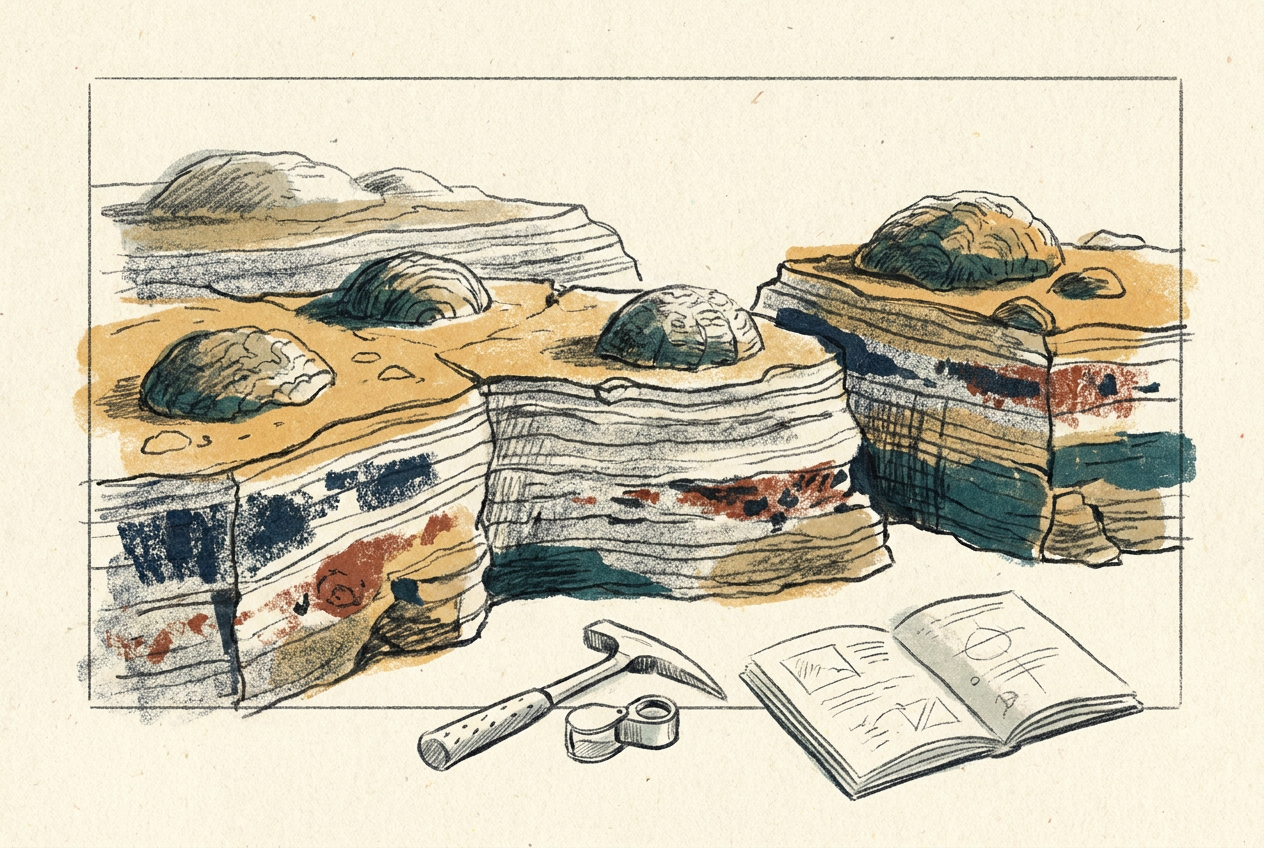
On the seafloor, layered communities of cyanobacteria and sulfate-reducing bacteria formed thick mats, much like the stromatolites still growing today in Shark Bay. These microbes photosynthesised and respired, creating a chemical trap. The sulfate-reducing bacteria consumed organic matter and produced hydrogen sulfide, which reacted with the dissolved zinc and lead in the seawater to precipitate tiny grains of sphalerite and galena—zinc sulfide and lead sulfide.
The ore did not arrive as a hydrothermal rush. It accumulated grain by grain, year by year, for tens of thousands of years.
The metal sulfides settled into the microbial mats, which were periodically buried by fine carbonate mud. Over 1.7 billion years of burial and gentle heating, those scattered grains recrystallised into the massive ore bodies that miners now follow underground.
A Reef of Metal
The deposit is what geologists call a SEDEX—sedimentary exhalative—ore body, but the term undersells what made it special. Most SEDEX deposits form around seafloor vents where hot, metal-rich brines mix with cold seawater. At McArthur River, no vent has ever been found. The metals came from the water itself, concentrated by biology.
The ore occurs in seven stacked lenses within a 30-metre-thick interval of dolomitic shale. Each lens corresponds to a period when the basin was starved of sediment input and microbial mats had time to flourish. The richest ore, with zinc grades above 15 percent, lies in the HYC Pyritic Shale Member—a name that hints at the sulfidic conditions that preserved the organic matter and the metals it trapped.
Drill core from the deposit shows delicate lamination at the millimetre scale: alternating dark bands of organic-rich sediment and pale bands of carbonate, with tiny crystals of sphalerite aligned along the bedding planes. The texture is unmistakably sedimentary, not hydrothermal. This ore was laid down like varves in a lake, but the lake was a basin hundreds of kilometres wide and the sediment was metal.
The Quietest Ore Body on Earth
The McArthur River deposit contains more than 30 million tonnes of combined zinc and lead—enough metal to supply the world for years. Yet the rock that hosts it never reached 150 degrees Celsius, never fractured, never saw a vein. It is one of the few major ore deposits on Earth that formed entirely at the temperature of the seafloor, without volcanic heat or tectonic squeezing.
That makes it a puzzle for exploration geologists. Most zinc mines are found near volcanic arcs or ancient fault zones where hot fluids circulated. McArthur River sits in a flat, quiet basin that has not been deformed since the Mesoproterozoic. The only clue that ore might be present is the black colour of the dolomite—a signature of the organic carbon left behind by the microbial mats.
The mine itself is invisible from the surface. The ore body lies 400 metres underground, beneath the black soil plains of the Barkly Tableland. Above ground, cattle graze and brolgas dance in the seasonal wetlands. Below, the ghosts of 1.7-billion-year-old microbes still hold their metal.
More like this
- The 560-Million-Year-Old Garden That Never Saw a PredatorIn South Australia's Flinders Ranges, 560-million-year-old Ediacara surfaces preserve entire seafloor communities of fronds, discs, and quilts — a garden of soft-bodied life that flourished before pre
- The 1.75-Billion-Year-Old Reef That Outranks the BarrierA 1.75-billion-year-old microbial reef in the Kimberley is the largest biological structure ever built by a single species, preserving a world without predators.
- The 3.5-Billion-Year-Old Cones That Still Catch LightIn the Pilbara's Dresser Formation, 3.5-billion-year-old stromatolites preserve the oldest direct evidence of life on Earth—microbial mats that built layered domes in a volcanic caldera.