7 July 2026 · 3 min read
The 580-Million-Year-Old Scar That Reset Evolution
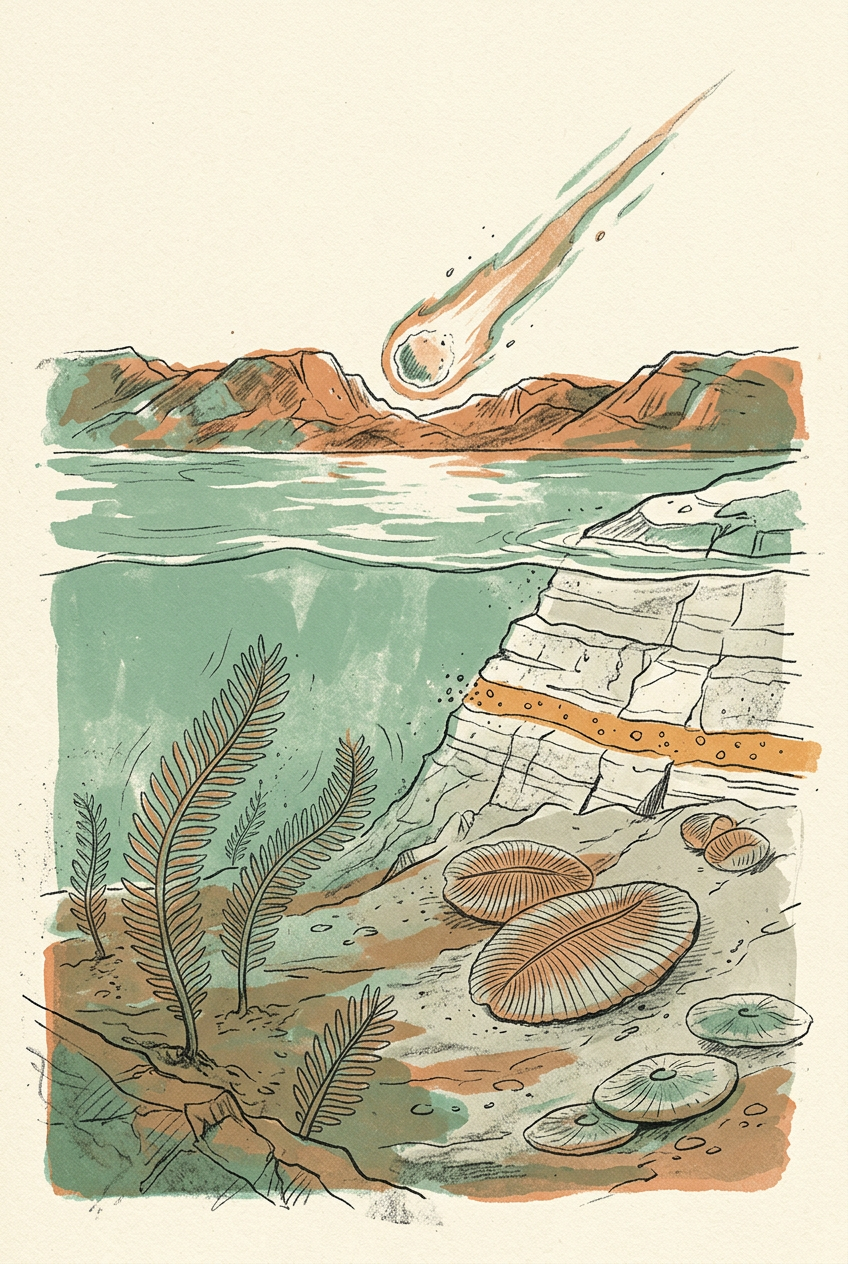
A 580-million-year-old impact crater in South Australia's Gawler Ranges may have reset the course of Ediacaran evolution, its ejecta layer preserved in Flinders Ranges sediments.
In the Gawler Ranges of South Australia, a 580-million-year-old scar stretches ninety kilometres across—the remains of an asteroid impact that struck when the first complex animals were just beginning to move. The Acraman impact structure is so eroded that from the ground it looks like little more than a shallow depression dotted with salt lakes. But the evidence of what happened here is preserved three hundred kilometres away, in the sedimentary rocks of the Flinders Ranges, where a thin layer of shattered debris records the moment an ancient ecosystem was interrupted.
The Impact
The asteroid that hit Acraman was probably about five kilometres wide. It struck volcanic bedrock that had been laid down more than a billion years earlier, excavating a transient crater perhaps forty kilometres across. The impact melted and fractured the target rock, throwing debris high into the atmosphere. Pieces of shocked Gawler Range volcanic rock—fragments with microscopic planes of glass where the crystal structure was deformed by the shockwave—rained down across a vast area of shallow sea that covered what is now the Flinders Ranges.
Geologists have traced this ejecta layer across more than 30,000 square kilometres. In the Bunyeroo Gorge of the Flinders Ranges, the layer sits within the Bunyeroo Formation, a sequence of 580-million-year-old marine sediments. The debris is unmistakable: angular fragments of dacite and andesite, minerals with multiple sets of shock lamellae, and the distinctive geochemical signature of an extraterrestrial impact. The layer is thin—often less than a centimetre—but it is consistent across hundreds of kilometres.
The ejecta blanket of a single impact connects two distant landscapes, like a fingerprint left on the seafloor.
Dating the impact relies on the Ediacaran sediments that bracket the ejecta layer. Uranium-lead dating of zircons from the Gawler Range volcanics gives a maximum age of about 590 million years, while the overlying Ediacaran fossils suggest a minimum age around 560 million years. The best estimate places the impact at roughly 580 million years ago—right in the middle of the Ediacaran Period, when the first soft-bodied animals were diversifying in shallow seas.
The Fossil Turnover
The ejecta layer in the Flinders Ranges does not appear in isolation. Directly above and below it, the fossil record changes. Below the layer, the Ediacaran assemblages are dominated by the discoidal form Ediacaria and other simple, centimetre-scale organisms. Above the layer, the assemblages shift: more complex, frond-like forms such as Dickinsonia and Rangea become common, while the earlier forms diminish.
This turnover has led some palaeontologists to suggest that the Acraman impact caused a local extinction event that cleared ecological space for new body plans to emerge. The evidence is not conclusive—the fossil record of the Ediacaran is sparse and the apparent turnover could reflect changing environmental conditions rather than a sudden catastrophe. But the coincidence in timing is striking. A major impact, followed by a shift in the dominant forms of life, preserved in the same sedimentary sequence.
What the Scar Still Tells Us
The Acraman impact structure is one of only a handful of known craters from the Ediacaran Period anywhere on Earth. Most impact craters from that era have been erased by erosion or subduction. Acraman survives because it struck the ancient, stable crust of the Gawler Craton, a piece of continental lithosphere that has remained largely undisturbed for half a billion years.
Today, the crater is invisible to the untrained eye. The central uplift, a region of fractured and uplifted rock typical of large impacts, is now a low rise surrounded by salt pans. Lake Acraman and Lake Gairdner occupy parts of the depressed crater floor. The surrounding landscape is dry, flat, and sparsely vegetated—an unlikely archive of a catastrophe that may have reshaped the course of early animal evolution.
The thin layer of debris in Bunyeroo Gorge remains the most tangible link. It connects a specific moment of violence—an asteroid striking the Australian continent—to a biological transition preserved in stone. Whether the impact caused a mass extinction or merely coincided with one, the ejecta layer is a time marker of rare precision, tying together two distant places and two different scales of geological time in a single, centimetre-thick seam of broken rock.
More like this
- The 560-Million-Year-Old Garden That Never Saw a PredatorIn South Australia's Flinders Ranges, 560-million-year-old Ediacara surfaces preserve entire seafloor communities of fronds, discs, and quilts — a garden of soft-bodied life that flourished before pre
- The 550-Million-Year-Old Frond That Died on PurposeA 550-million-year-old frond in the Flinders Ranges preserves the oldest known evidence of programmed cell death, recorded in the symmetrical decay pattern of Dickinsonia.
- The 825-Million-Year-Old Rift That Failed But Built a WorldA failed 825-million-year-old rift left a 650-kilometre volcanic chain and sedimentary basin in South Australia that preserved the Ediacaran fossils and still shapes the landscape today.