6 July 2026 · 2 min read
The 560-Million-Year-Old Trail That Changed Everything
In the Flinders Ranges, 560-million-year-old trackways preserve the moment the first animals learned to move — furrows pressed into microbial slime by Dickinsonia, the oldest known mobile organism.
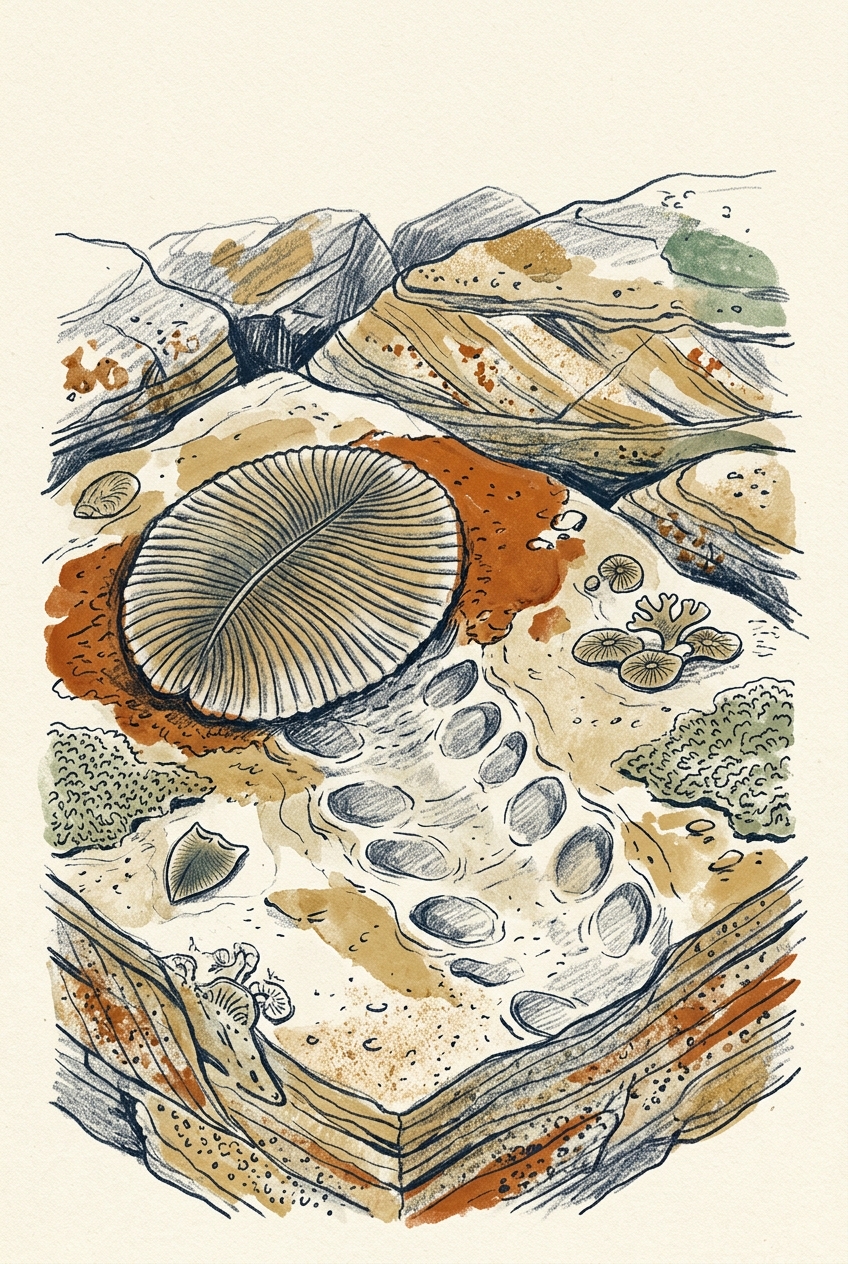
On the floor of a shallow sea 560 million years ago, something moved. The marks it left — long furrows pressed into microbial slime — are now preserved in sandstone slabs in the Flinders Ranges. They are the oldest known evidence of an animal with muscles, a creature that pulled itself across the Ediacaran seabed one contraction at a time.
The Slime That Held a Footprint
The fossils are called Dickinsonia, and they look like ribbed oval mats, nothing like modern animals. For decades, paleontologists argued whether they were animals, fungi, or something else entirely. Then, in 2018, a team found chemical traces of cholesterol in a Dickinsonia fossil from the Flinders Ranges — a biomarker unique to animals. The debate was settled. These were the first large, mobile organisms on Earth.
But Dickinsonia did not walk or swim. It crept across the seafloor by contracting its body, inchworm-style, leaving behind a trail of distorted sediment. The tracks, known as Epibaion, show the imprint of the animal's body and the direction of its movement. Some trails stop abruptly at the edge of a fossil, as if the animal simply settled down and died where it stopped crawling.
The Garden That Learned to Move
Before Dickinsonia, the Ediacaran biota were mostly stationary — frond-like organisms that stood upright in the water or mats that lay flat on the sediment. Mobility was a breakthrough. It required a gut, a hydrostatic skeleton, and coordinated muscle contractions. These were not simple bags of cells; they were bilaterians, the lineage that would eventually produce everything from earthworms to humans.
The Flinders Ranges preserve this transition in exquisite detail. At Nilpena Ediacara National Park, a single bedding plane can contain dozens of Dickinsonia individuals, some with adjacent trackways, frozen in the act of grazing across the microbial mat that once carpeted the seafloor. The mat acted like a soft conveyor belt, preserving the finest details of the animal's underside as it passed.
A 560-million-year-old trail of footprints, pressed into slime that turned to stone.
The Rock That Remembers
The fossils are preserved in quartz-rich sandstone, deposited by storm events that buried the seafloor in a sudden layer of sand. This quick burial was key: it prevented scavengers and decay from destroying the soft tissues. The result is a three-dimensional mold of the animal's body, cast in the sand that killed it.
Today, the same rocks are exposed along the western edge of the Flinders Ranges, tilted by the same tectonic forces that later raised the range itself. The fossils lie within the Rawnsley Quartzite, a unit that formed in a shallow marine basin at the edge of the ancient continent of Rodinia. By the time these animals crawled across the mud, Rodinia had already begun to break apart.
The First Footsteps
Dickinsonia died out at the end of the Ediacaran Period, 538 million years ago, as the Cambrian explosion began. But its tracks remain — the oldest known trace of an animal choosing a direction and moving toward it. No bones, no shells, no teeth. Just a furrow in the sand, 560 million years old, that tells us when life first learned to walk.
More like this
- The 560-Million-Year-Old Garden That Never Saw a PredatorIn South Australia's Flinders Ranges, 560-million-year-old Ediacara surfaces preserve entire seafloor communities of fronds, discs, and quilts — a garden of soft-bodied life that flourished before pre
- The 300-Million-Year-Old Forest That Died Standing UpIn New South Wales, a 300-million-year-old fossil forest preserves dozens of trees buried upright by a Permian volcanic eruption—an entire ecosystem frozen in ash.
- The 1.75-Billion-Year-Old Reef That Outranks the BarrierA 1.75-billion-year-old microbial reef in the Kimberley is the largest biological structure ever built by a single species, preserving a world without predators.