7 July 2026 · 3 min read
The 375-Million-Year-Old Reef That a River Found
Western Australia's Geikie Gorge is a 375-million-year-old Devonian reef, exposed by a river that cut straight down through a sandstone cap rather than wandering sideways.
In the Kimberley region of Western Australia, a 340-metre-deep canyon has been carved through a 1.8-billion-year-old sandstone plateau by forces that have barely moved in half a billion years. Geikie Gorge is not a canyon in the conventional sense. It was not cut by a river that has since departed. It was cut by a river that is still there, flowing through the same channel it occupied when the Devonian fish were swimming above what would become its walls.
The Reef That Became a Wall
The rock that forms Geikie Gorge was once a living reef. During the Devonian period, roughly 375 million years ago, this part of northern Australia lay beneath a shallow tropical sea. Sponges, corals, and stromatoporoids built a barrier reef along the margin of the Kimberley Basin, not unlike the Great Barrier Reef today. When the sea withdrew, the reef was buried under sediment and eventually lithified into massive limestone and dolomite. What makes Geikie Gorge unusual is that this limestone was then covered by a thick cap of sandstone — the 1.8-billion-year-old quartzites of the King Leopold Range. The reef sat hidden beneath that ancient lid for hundreds of millions of years.
The River That Refused to Move
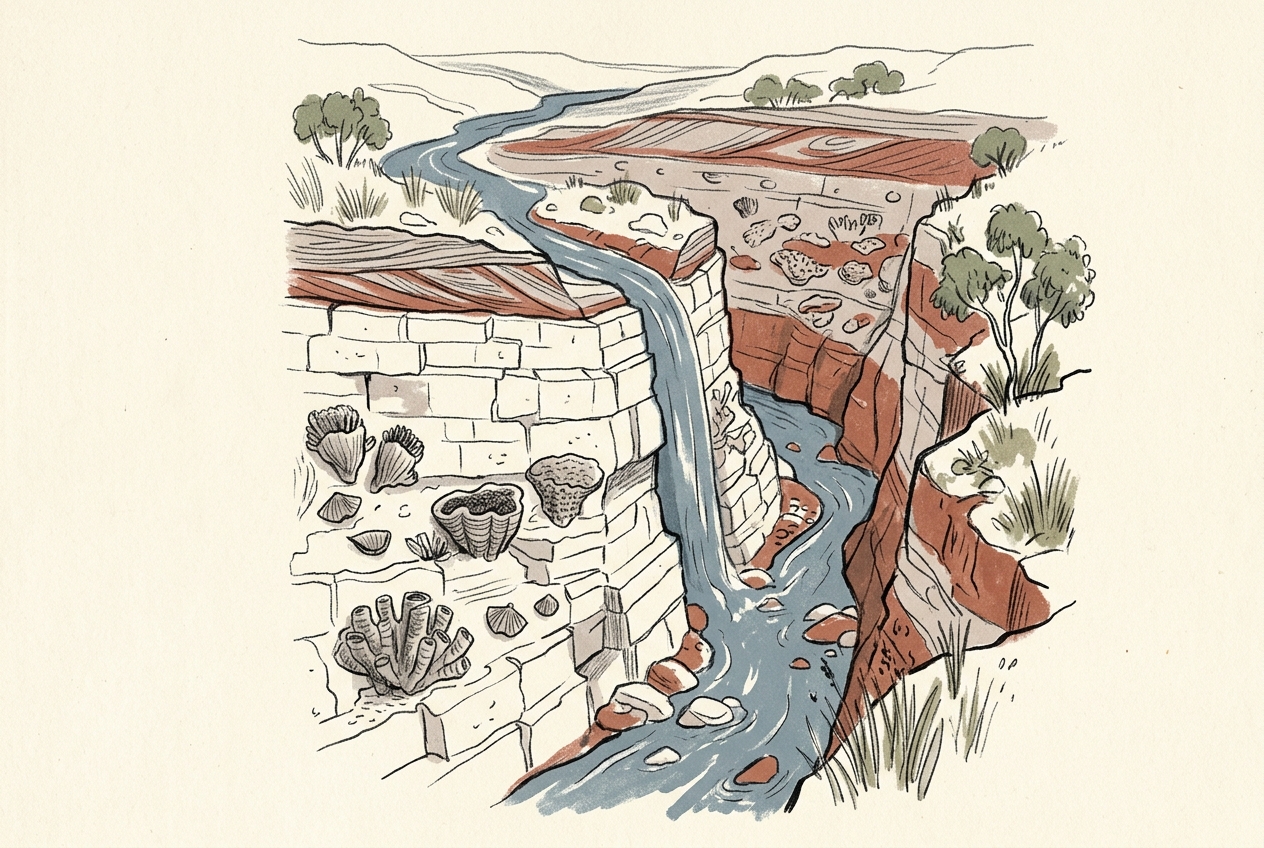
Most rivers wander. They shift course, cut new channels, abandon old ones. The Fitzroy River did something different. As the Kimberley region was uplifted over the past 20 million years, the river simply cut downward, straight through the sandstone cap and into the limestone reef beneath. It followed a joint — a vertical fracture in the rock — and never deviated. The result is a gorge whose walls are sharply banded: the upper third is pale buff sandstone, then a sharp contact line, and below that the dark grey limestone with its fossilised reef structures still visible. The river did not carve a winding valley. It cut a slot, as if following a blueprint drawn in the rock.
The reef died 375 million years ago, and yet the river found it, as though the old sea had left a seam in the earth that water could still follow.
The Freshwater Staircase
Inside the gorge, the Fitzroy River behaves like a staircase. During the dry season, the water pools in deep, clear holes separated by exposed limestone ledges. Walking along the riverbed — which is permitted only under guided tours — reveals the Devonian reef in cross-section. Stony corals, the size of dinner plates, sit frozen in the cliff face. Stromatoporoids — layered structures built by lime-secreting algae — form bulbous mounds along the walls. The gorge is a museum of the Devonian, its exhibits still in place, still arranged as they were when the reef was alive. Freshwater crocodiles sun themselves on the same ledges where ancient fish once swam.
The Flood Pulse
For most of the year, Geikie Gorge is a placid waterway. Then the wet season arrives. The Fitzroy River catchment is enormous — roughly 90,000 square kilometres — and when the monsoonal rains come, the river rises as much as 16 metres in a matter of days. The gorge, which can be waded in June, becomes a churning torrent in January. This annual flood pulse scours the riverbed clean of sediment, keeping the fossil exposures sharp. It also carves the limestone into intricate honeycomb textures and potholes, features that geologists call solutional sculpting. The same water that reveals the ancient reef is also slowly dissolving it.
Why It Matters
Geikie Gorge preserves something rare: a Devonian barrier reef in its original position, unburied by a river that chose to cut straight down rather than sideways. It is a reminder that landscapes are not merely shaped by erosion, but by the decisions that water makes about where to erode. The Fitzroy River found a fracture and followed it for millions of years, through a sandstone cap, into a limestone reef, and down to the present day. The gorge is not a curiosity. It is a lesson in patience.
More like this
- The 110-Million-Year-Old River That Runs Backwards UndergroundWestern Australia's 110-million-year-old dune system has been slowly dissolving into a labyrinth of caves where an ancient river still flows, carrying the taste of a Cretaceous desert.
- The 5,000-Year-Old Volcanoes That Still Smoke in the SouthIn Victoria's Newer Volcanics Province, 400 volcanic vents erupted as recently as 5,000 years ago—the youngest volcanic field in mainland Australia, where craters still hold blue lakes and scoria cone
- The 560-Million-Year-Old Garden That Never Saw a PredatorIn South Australia's Flinders Ranges, 560-million-year-old Ediacara surfaces preserve entire seafloor communities of fronds, discs, and quilts — a garden of soft-bodied life that flourished before pre