26 June 2026 · 3 min read
The 2.5-Billion-Year-Old Lava That Still Holds a Climate Record
How 2.5-billion-year-old pillow lavas in Western Australia's Pilbara Craton preserve the only known evidence of Archaean seawater chemistry—bubbles of ancient ocean trapped in stone.
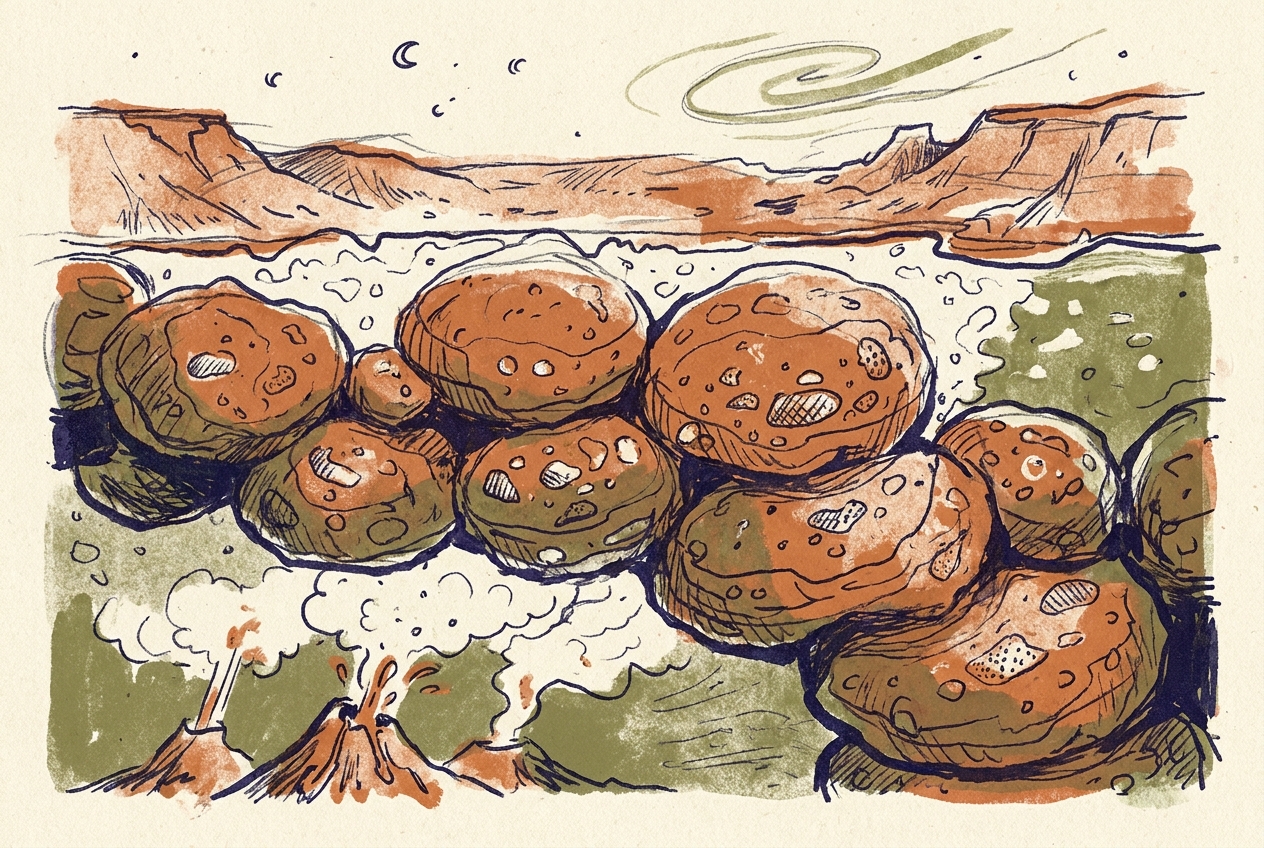
In the Pilbara region of Western Australia, outcrops of dark volcanic rock still hold the shape of the pillows they formed 2.5 billion years ago—rounded lobes of lava that quenched instantly when they met seawater. But what makes these particular pillows extraordinary is not their shape. It is what they trapped inside them.
The Quenched Edge
When basaltic lava erupts underwater, its outer skin cools so fast that it forms a glassy rind. In the Pilbara's 2.5-billion-year-old pillow basalts of the Fortescue Group, that rind is still visible as a dark, fine-grained margin around each lobe. As the lava chilled, it fractured along radial cracks, creating pathways for seawater to penetrate the cooling rock.
Those cracks then filled with minerals precipitated from the hot fluids circulating through the young oceanic crust—quartz, carbonate, and other vein minerals. But within those veins, geologists have found something unexpected: tiny primary fluid inclusions, each no wider than a human hair, that contain droplets of the Archaean ocean itself.
"These are not secondary fluids that seeped in later," one researcher noted. "They are the original seawater, sealed in the rock 2.5 billion years ago."
A Window into Ancient Seas
The inclusions are minute—typically less than 50 micrometres across—but they can be analysed using techniques that measure their chemical composition and salinity. The results have been surprising. The Archaean ocean was not the salty brine many had assumed. It was significantly less saline than modern seawater, with a different balance of dissolved ions.
These trapped droplets suggest that the early Earth's oceans were dominated by sodium bicarbonate rather than the sodium chloride that characterises today's seas. That chemistry would have affected everything from the formation of banded iron formations to the emergence of the first microbial metabolisms.
The pillows of the Fortescue Group are not the only place such inclusions occur, but they are the oldest and best preserved. Most Archaean seafloor has been recycled into the mantle by subduction. The Pilbara Craton survived because it was part of a continent that never fully re-entered the deep Earth.
The Weathering Signal
There is a second story in these same rocks. The pillow basalts also record the earliest known evidence of subaerial weathering—rain and atmosphere acting on fresh volcanic rock. Above the pillow lavas lie ancient soil horizons, or palaeosols, where the basalt was weathered into clay minerals 2.5 billion years ago.
Those palaeosols tell a parallel story. They contain chemical signatures that suggest the Archaean atmosphere was rich in carbon dioxide and largely free of oxygen. The weathering profiles show how the Pilbara landscape was slowly etched by acid rain—rain made acidic not by pollution but by the volcanic gases that dominated the early atmosphere.
Together, the fluid inclusions and the palaeosols offer two windows into the same vanished world: one from below, one from above. The pillows preserve the chemistry of the ocean; the soils preserve the chemistry of the air.
The Slow Archive
What makes the Pilbara pillow lavas remarkable is not drama but patience. They have sat on the surface, or just beneath it, for half the age of the Earth. They have survived continental collisions, erosion through multiple ice ages, and the slow uplift of the Australian continent.
In the gorges of the Pilbara, where streams have cut through the ancient basalt, the pillow structures are exposed in cross-section—each lobe a lens into the moment it formed. The rock is dark grey to black, weathered brown on the outside, and still sharply fractured along those original cooling cracks.
There is no other place on Earth where the Archaean ocean can be sampled directly. The Pilbara pillows are not a proxy or a model. They are the thing itself: 2.5-billion-year-old seawater, still wet inside the stone.
More like this
- The 110-Million-Year-Old River That Runs Backwards UndergroundWestern Australia's 110-million-year-old dune system has been slowly dissolving into a labyrinth of caves where an ancient river still flows, carrying the taste of a Cretaceous desert.
- The 5,000-Year-Old Volcanoes That Still Smoke in the SouthIn Victoria's Newer Volcanics Province, 400 volcanic vents erupted as recently as 5,000 years ago—the youngest volcanic field in mainland Australia, where craters still hold blue lakes and scoria cone
- The 560-Million-Year-Old Garden That Never Saw a PredatorIn South Australia's Flinders Ranges, 560-million-year-old Ediacara surfaces preserve entire seafloor communities of fronds, discs, and quilts — a garden of soft-bodied life that flourished before pre