6 July 2026 · 3 min read
The 565-Million-Year-Old Sea That Painted the Desert Red
How Ediacaran iron-rich seas and ancient bacteria stained the Flinders Ranges red, leaving a 565-million-year-old chemical signature visible from space.
From a distance of four hundred kilometres, the Flinders Ranges look like a wound. A long, rust-coloured gash across the pale interior of South Australia, visible to astronauts aboard the International Space Station. The red is not iron oxide from a recent age. It is a 565-million-year-old stain, fixed into rock before the first animal crawled onto land.
The Iron Sea
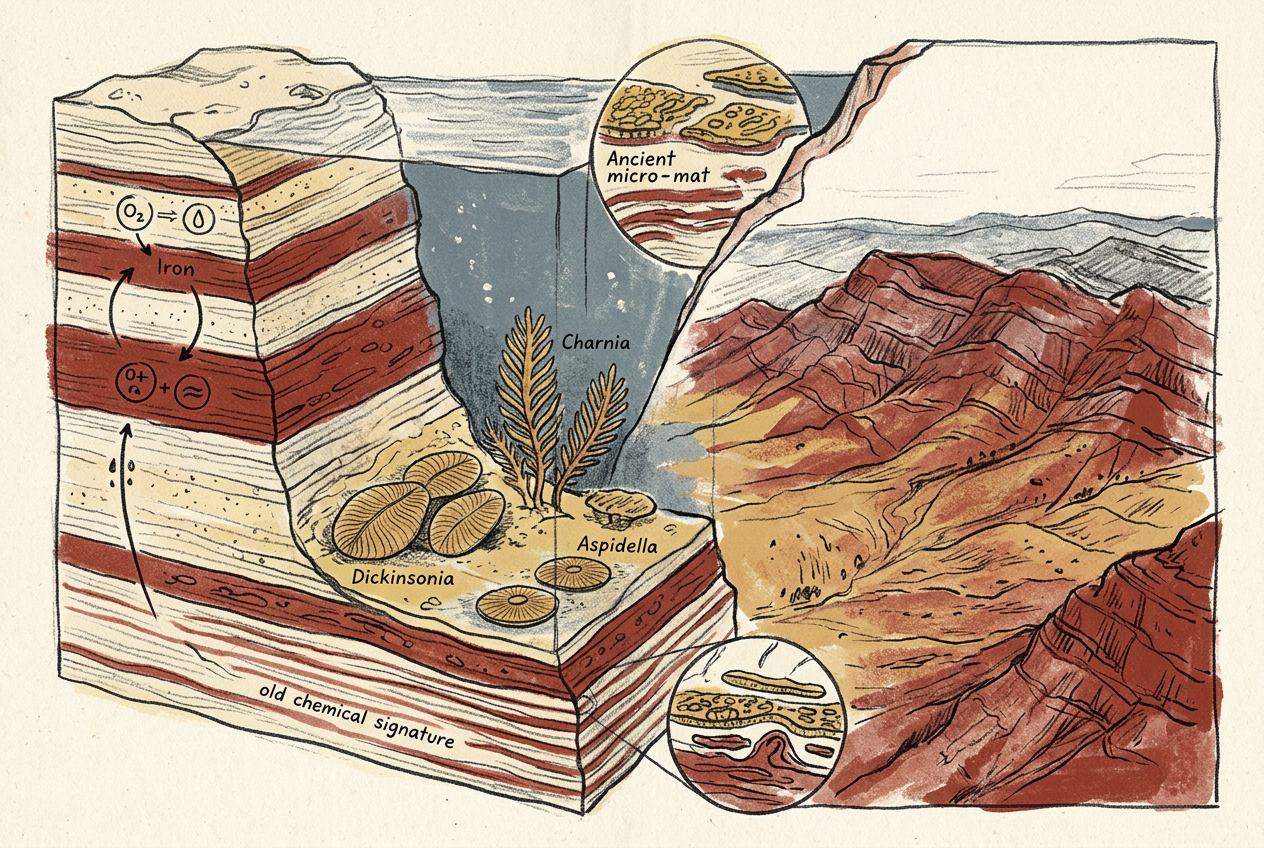
Late in the Ediacaran Period, the basin that would become the Flinders Ranges was a shallow, stratified sea. The water column behaved like a layered cake: oxygen near the surface, nothing but dissolved iron and hydrogen sulphide below. This was not an unusual condition for Earth at the time. The planet's oceans had spent billions of years rich in reduced iron, waiting for enough free oxygen to force it out of solution.
Then something changed. Perhaps a pulse of oxygen from photosynthesising microbes. Perhaps a shift in ocean circulation. Whatever the trigger, the iron began to fall.
It precipitated as iron hydroxide, settling grain by grain onto the seafloor mud. Each layer of sediment recorded the chemistry of the water column above it. The process was slow, intermittent, and utterly chemical. No living organism directed it. The iron simply obeyed the oxygen.
A Garden of Ghosts
While the iron accumulated, the same seafloor hosted the Ediacaran biota—soft-bodied organisms that represent the first complex life on Earth. These frond-like creatures, preserved as impressions in the sandstone, lived in quiet water below the wave base. They fed by filtering particles or absorbing nutrients directly through their skin.
The iron-rich mud that buried them acted as a preservative. When the organisms died and sank, the chemical conditions that stained the sediment red also discouraged scavengers and decay. Some of the world's most exquisite Ediacaran fossils, including the iconic Dickinsonia and Spriggina, come from the Brachina and Bunyeroo Gorges in the central Flinders Ranges. The fossils are ghosts in red rock.
The same chemical event that painted the landscape also locked the oldest animal forms into stone.
The Uplift That Revealed the Colour
For half a billion years, the red sediments lay buried under younger layers. Then, during the Mesozoic, the Australian plate began to stretch. A series of faults raised the entire sequence, tilting the beds and exposing them to the air.
Weathering did the rest. Rain and wind stripped away the grey cover of younger rock. The iron, already oxidised, remained stable. It did not rust further; it simply sat, exposed, as the less resistant minerals around it washed away.
The result is a landscape where the colour is not a surface coating but the rock itself. The red runs through the full thickness of the Brachina Formation, a unit that spans over two thousand metres of vertical section. Every cliff, every gully, every scree slope carries the same hue.
The Archive in the Stain
Geologists use the red beds of the Flinders Ranges as a chemical diary. The iron content, the ratio of different iron species, and the trace metals trapped alongside them all record the state of the Ediacaran ocean. The data show that oxygen levels fluctuated wildly during this period, rising and falling in pulses that may have driven the evolution of the first animals.
The same strata also contain evidence of the first mass extinction. Around 542 million years ago, the Ediacaran biota vanished, replaced by the hard-shelled organisms of the Cambrian explosion. The red beds continue across this boundary, unbroken. The iron did not care which creatures lived or died.
Today, tourists drive through the Flinders Ranges and photograph the red cliffs at sunset. They are looking at a sea that existed before the first trilobite, painted by a chemical reaction that lasted millions of years. The colour is not decoration. It is the preserved chemistry of an ancient ocean, still visible half a billion years later.
More like this
- The 110-Million-Year-Old River That Runs Backwards UndergroundWestern Australia's 110-million-year-old dune system has been slowly dissolving into a labyrinth of caves where an ancient river still flows, carrying the taste of a Cretaceous desert.
- The 560-Million-Year-Old Garden That Never Saw a PredatorIn South Australia's Flinders Ranges, 560-million-year-old Ediacara surfaces preserve entire seafloor communities of fronds, discs, and quilts — a garden of soft-bodied life that flourished before pre
- The 1.75-Billion-Year-Old Reef That Outranks the BarrierA 1.75-billion-year-old microbial reef in the Kimberley is the largest biological structure ever built by a single species, preserving a world without predators.