6 July 2026 · 3 min read
The 1.1-Billion-Year-Old Magma Chamber That Became a Mountain Range
How a 1.1-billion-year-old magma chamber in South Australia's Mount Painter Province cooked the surrounding rock into rare radioactive minerals, then rose from the earth as a mountain range that still
In the northern Flinders Ranges, a mountain range leaks radiation into its own creeks. The water is safe to drink, but the rocks—gneisses and granites shot through with veins of uraninite—still carry the heat of an event that happened 1.1 billion years ago, when a plume of magma rose from the mantle and stalled beneath the crust, cooking the continent from below for ten million years.
The Chamber That Never Erupted
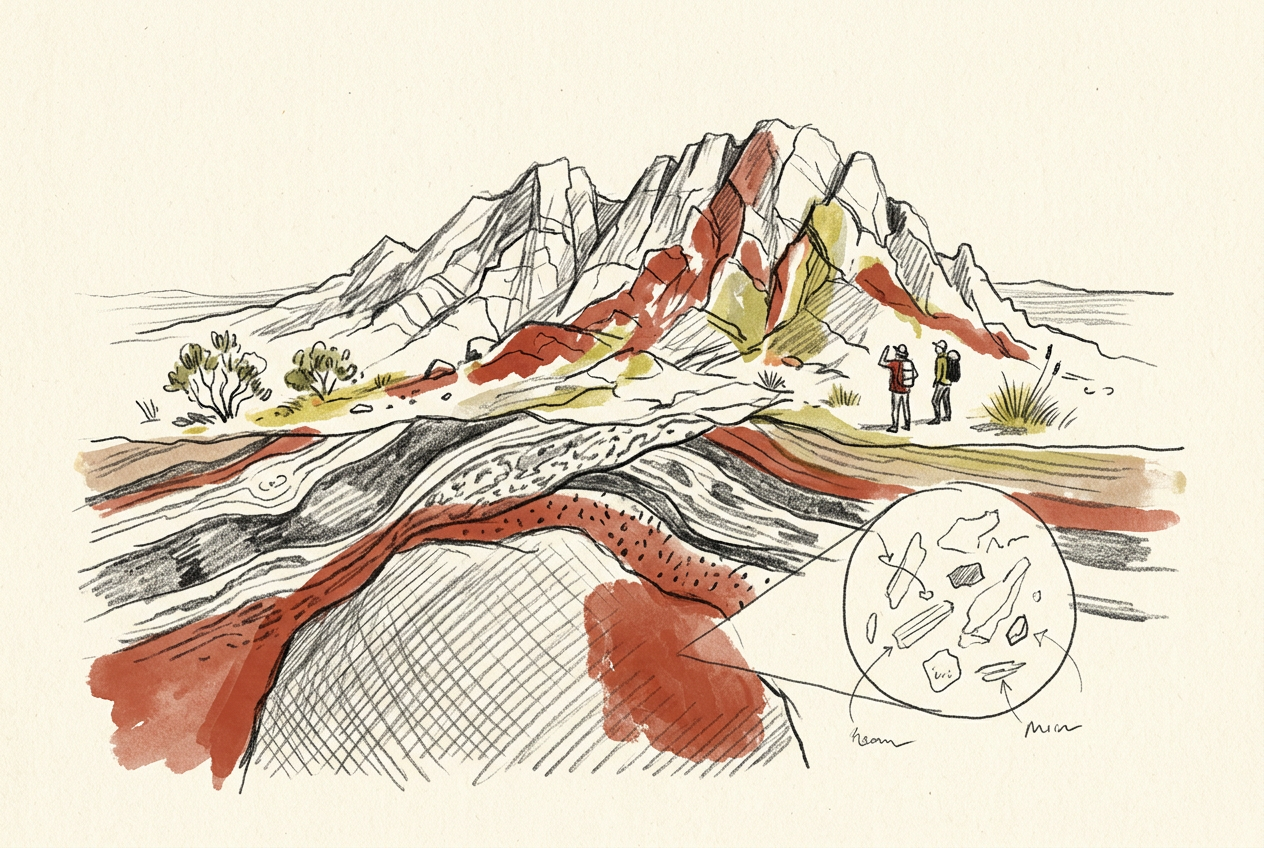
The Mount Painter Province is not a volcano. It is what a volcano leaves behind when the magma never reaches the surface: a batholith, a subterranean blister of molten rock the size of a small country. Between 1.1 and 1.0 billion years ago, during the breakup of the supercontinent Rodinia, a mantle plume inflated the crust of what is now South Australia into a dome. The magma cooled slowly, kilometres underground, crystallising into a coarse-grained granite that is still radioactive enough to register on handheld scintillators.
What makes Mount Painter unusual is not the uranium itself but the way the heat moved. The batholith acted as a giant radiator, driving hydrothermal fluids through the surrounding sedimentary rocks for millions of years. Those fluids dissolved uranium, thorium, and rare-earth elements from the granite and redeposited them in veins and breccias—concentrating metals that had been diffuse into deposits rich enough to mine.
The mountain did not rise from the earth; it was left behind as the soft rock around it dissolved into the wind.
The Cooking of the Crust
The country rock surrounding the batholith—shales, sandstones, and limestones deposited in a shallow sea more than 1.5 billion years ago—was transformed by the heat. Contact metamorphism turned shale into hornfels, baked limestone into marble, and recrystallised sandstone into quartzite. In places, the temperature reached 700 degrees Celsius, hot enough to melt the rock entirely, creating migmatites—hybrid rocks that are part metamorphic, part igneous, part something in between.
The result is a geological palette that geologists still argue over. More than a dozen distinct rock types have been mapped in the province, some of them unique to this single location. The uranium mineralisation alone takes half a dozen forms: uraninite in veins, brannerite in breccias, coffinite in sandstone, and others that have no common names because they are found nowhere else on Earth.
The Mountain That Leaks
Erosion has done the rest. Over hundreds of millions of years, the granite batholith was unroofed. The softer sediments that once covered it washed away, and the tough, metamorphosed core of the heat-affected zone remained as high ground. Today, the Mount Painter Province forms a rugged block of peaks rising 600 metres above the surrounding plains—not because it was pushed up, but because it was harder to erode.
Radon gas seeps from fractures in the granite. Uranium levels in local creek sediments are high enough that the area was explored for mining in the 1950s and again in the 1970s. No commercial mine was ever developed—the deposits are too small, too dispersed, too difficult to extract—but the radioactive signature of the ancient magma chamber remains readable from the air, a ghost of heat that still glows 1.1 billion years later.
In the dry creek beds of the northern Flinders Ranges, you can hold a piece of the batholith in your hand: a grey granite speckled with black uraninite, warm from the sun, still quietly decaying. The mountain is the cooled skin of an old planet's fever.
More like this
- The 5,000-Year-Old Volcanoes That Still Smoke in the SouthIn Victoria's Newer Volcanics Province, 400 volcanic vents erupted as recently as 5,000 years ago—the youngest volcanic field in mainland Australia, where craters still hold blue lakes and scoria cone
- The 1.85-Billion-Year-Old Caldera That Still Feeds the FurnaceIn South Australia's Middleback Ranges, a 1.85-billion-year-old volcanic caldera collapsed and later became one of the world's richest iron ore deposits.
- The 190,000-Year-Old Lava Tube That Still Holds a River of StoneIn Queensland's Undara volcano, 190,000-year-old lava tubes preserve the longest known flow on Earth—a frozen river of basalt that still shelters bats, ferns, and the memory of Pleistocene fire.