6 July 2026 · 2 min read
The 5,000-Year-Old Volcano That Is Still Growing
Off the coast of Kangaroo Island, a young volcano is growing on the seafloor—proof that Australia is not geologically finished.
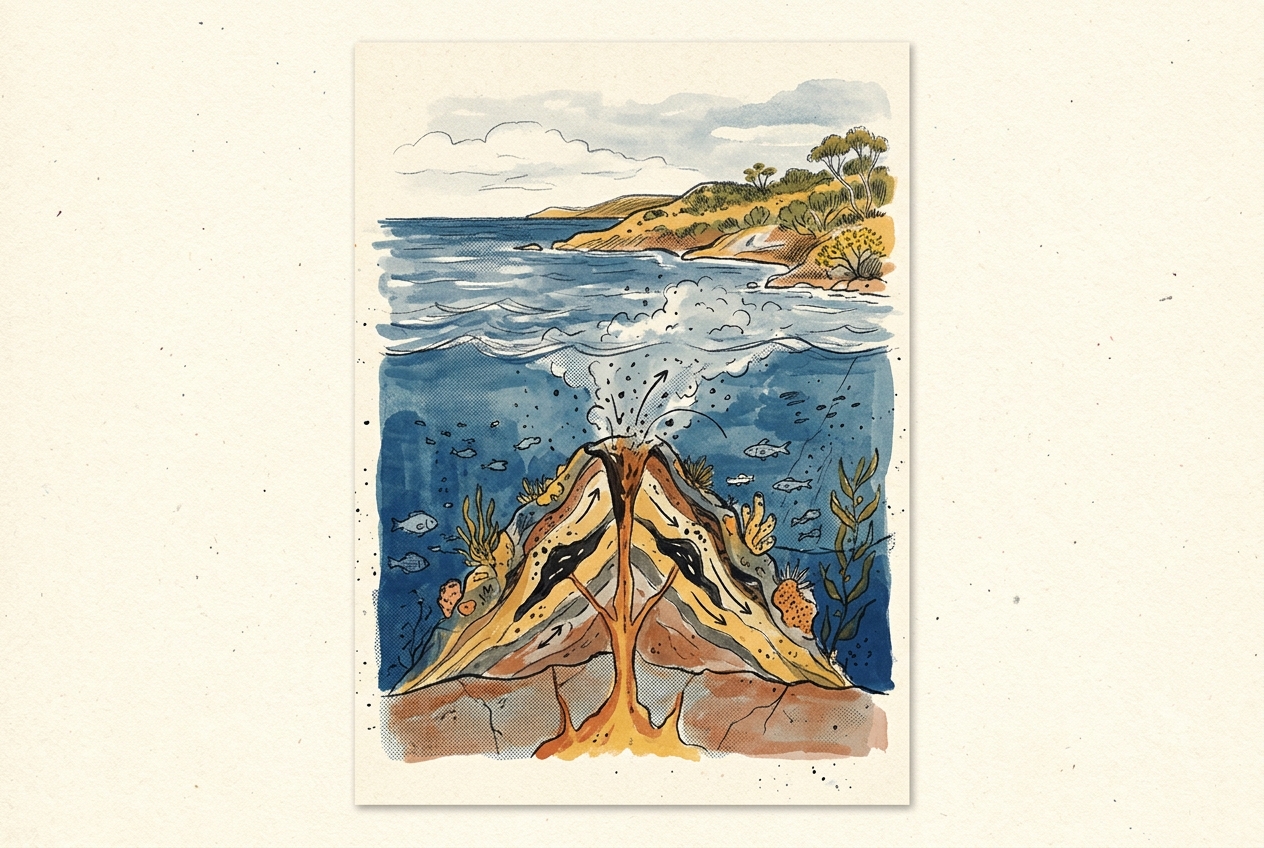
Just off the coast of South Australia, a volcano is growing right now. Not the explosive kind—a slow, oozing dome of basalt on the seafloor, 30 kilometres southwest of Kangaroo Island. It is the only place on the continent where magma is actively building new crust.
The Youngest Volcano
The Newer Volcanics Province stretches from Melbourne to the border of South Australia, a field of more than 400 eruption points. Most are Pleistocene—tens of thousands to a few million years old. But one site is different. The Schanck Volcano, named for a nearby cape, produced its last lava flow only 5,000 years ago, by Aboriginal reckoning. Geological dating puts the most recent eruption at roughly 4,000 to 5,000 years before present. That is young enough that oral traditions may recall it.
Offshore, the picture is even more immediate. Sonar surveys have mapped a fresh volcanic cone on the continental shelf, unweathered by sediment, with pillow lavas still glassy. It has not been dated directly, but its pristine shape suggests activity within the past few thousand years—perhaps within the last few centuries.
The continent that seems geologically asleep is, in one corner, still building itself from below.
What the Lava Tells Us
These are not the voluminous flood basalts that built the Deccan Traps or Siberia. The Newer Volcanics are small-volume eruptions, each one a brief pulse from the mantle. Magma rises along fractures in the crust, fed by a source that has been producing sporadic eruptions for four million years. The lava is alkaline basalt, rich in olivine, carrying xenoliths—pieces of the mantle ripped from depth and brought to the surface in hours.
At Mount Gambier and Mount Schanck, the xenoliths include spinel lherzolite and harzburgite, rocks that originated 60 to 80 kilometres down. For geologists, these are direct samples of the mantle beneath southeastern Australia, brought up fresh. No drilling required.
A Continent's Slow Pulse
Australia sits in the middle of the Indo-Australian Plate, far from any active subduction zone or mid-ocean ridge. The Newer Volcanics Province is an intraplate volcanic field, fed not by plate boundaries but by a mantle that is still warm from the passage of the continent over a hotspot tens of millions of years ago. As Australia drifted north, it moved away from that plume, but the thermal anomaly lingers.
The result is a geological paradox: a quiet continent with active volcanism. The last eruption was a blink of an eye ago, geologically speaking. There is no reason to think the province is finished. The next eruption could come tomorrow, or ten thousand years from now. Either way, the magma is still there.
More like this
- The 110-Million-Year-Old River That Runs Backwards UndergroundWestern Australia's 110-million-year-old dune system has been slowly dissolving into a labyrinth of caves where an ancient river still flows, carrying the taste of a Cretaceous desert.
- The 5,000-Year-Old Volcanoes That Still Smoke in the SouthIn Victoria's Newer Volcanics Province, 400 volcanic vents erupted as recently as 5,000 years ago—the youngest volcanic field in mainland Australia, where craters still hold blue lakes and scoria cone
- The 300-Million-Year-Old Forest That Died Standing UpIn New South Wales, a 300-million-year-old fossil forest preserves dozens of trees buried upright by a Permian volcanic eruption—an entire ecosystem frozen in ash.