6 July 2026 · 2 min read
The 180-Million-Year-Old Spine That Gondwana Left Behind
Tasmania's 180-million-year-old dolerite ridge is the frozen belly of a Jurassic volcano, exposed by erosion as hexagonal columns that record Gondwana's failed breakup.
On the island of Tasmania, a 270-kilometre-long dolerite ridge runs north-south like a spine. It is not a mountain range in the usual sense. It is the frozen belly of a Jurassic volcano, exposed by 180 million years of erosion.
The Flood That Came From Within
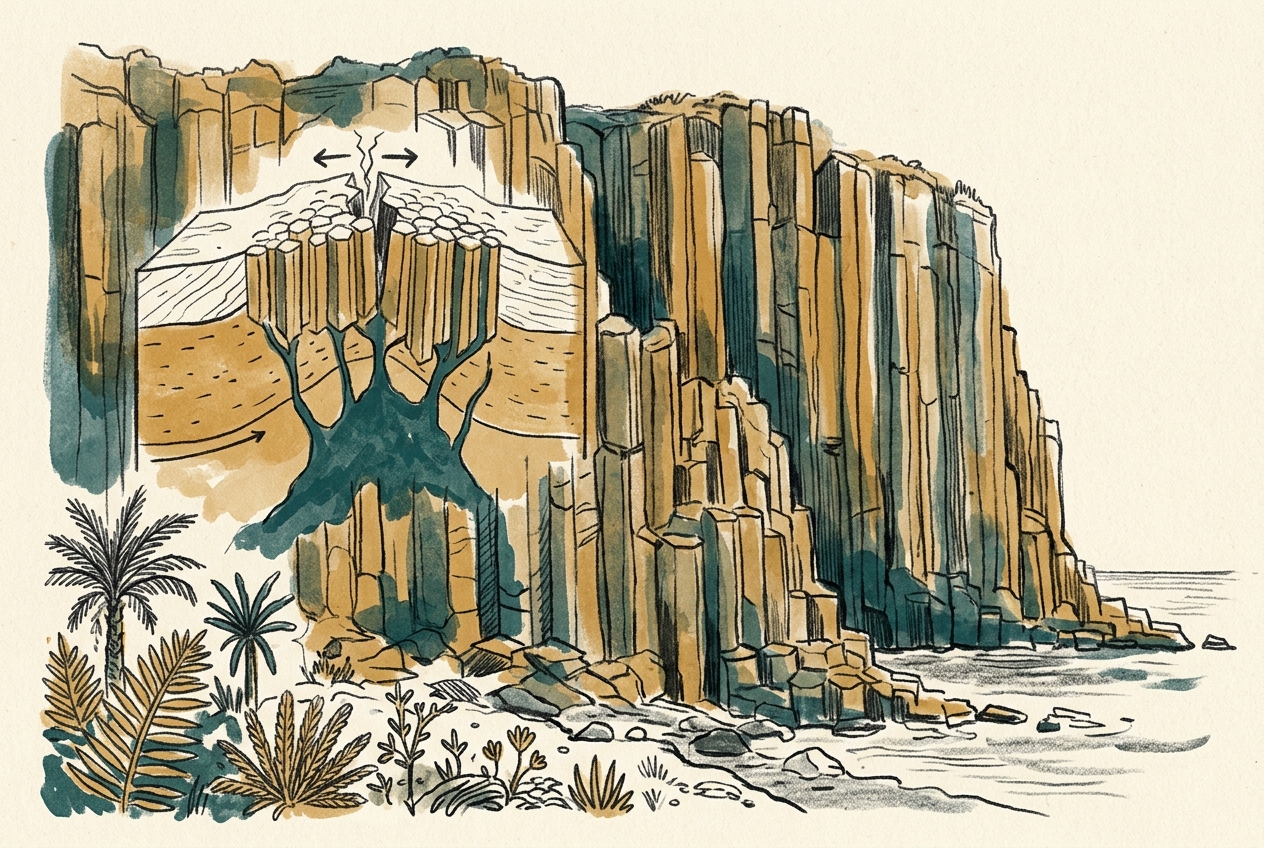
About 180 million years ago, in the Jurassic period, a vast province of magma began rising through the crust of eastern Australia. This was no single eruption. It was a flood of basalt that covered much of Tasmania and Antarctica—both still connected at the time. As the magma cooled deep underground, it crystallised into dolerite, a rock coarser than basalt because it took centuries to solidify.
The same event can be seen in South Africa, Antarctica, and South America. It marks the beginning of Gondwana's breakup. The magma rose along weaknesses in the crust, filling fractures and forming thick sills that never reached the surface.
The Mountain That Refused to Fall
Dolerite is tough. It resists chemical weathering far better than the softer sedimentary rocks that once surrounded it. Over tens of millions of years, rain, ice, and wind stripped away the sandstone and mudstone that buried the dolerite. What remained was a long, resistant ridge.
The mountain is not what rose; it is what was left behind.
This is why Tasmania's Central Plateau and the Organ Pipes of Mount Wellington exist. The columns are not carved by a sculptor. They are the natural fracture pattern of cooling rock—hexagonal columns formed as the magma shrank and cracked into geometric shapes, exactly like those at Giant's Causeway in Ireland.
The Columns That Geometry Built
When a thick body of molten rock cools evenly, it contracts. The contraction creates tension that is released as cracks. These cracks propagate perpendicular to the cooling surface and meet at 120-degree angles, producing hexagonal columns. Tasmania's dolerite columns are among the finest examples on Earth. At Cape Raoul, the columns rise 300 metres from the sea. At the Organ Pipes on Mount Wellington, they stand like a cathedral's facade.
The same process built the cliffs of the Tasman Peninsula and the sea stacks of the Totem Pole—a 65-metre-high dolerite spire that climbers regard as one of the world's most dangerous free-standing rock formations.
What the Columns Remember
The dolerite ridge is a record of a failed breakup. The magma that fed it was the first pulse of the rift that would eventually tear Tasmania away from Antarctica and South America. But in Tasmania, the rifting stopped. The magma never reached the surface. It stalled, cooled, and became a 180-million-year-old plug.
That plug now forms the backbone of Tasmania. It holds the island's highest peaks, its deepest gorges, and its most dramatic coastline. The columns are not merely geological curiosities. They are the exposed skeleton of a continent that tried to come apart and did not quite succeed.
More like this
- The 110-Million-Year-Old River That Runs Backwards UndergroundWestern Australia's 110-million-year-old dune system has been slowly dissolving into a labyrinth of caves where an ancient river still flows, carrying the taste of a Cretaceous desert.
- The 5,000-Year-Old Volcanoes That Still Smoke in the SouthIn Victoria's Newer Volcanics Province, 400 volcanic vents erupted as recently as 5,000 years ago—the youngest volcanic field in mainland Australia, where craters still hold blue lakes and scoria cone
- The 1.75-Billion-Year-Old Reef That Outranks the BarrierA 1.75-billion-year-old microbial reef in the Kimberley is the largest biological structure ever built by a single species, preserving a world without predators.