5 July 2026 · 3 min read
The 560-Million-Year-Old Garden That Left Its Ghost in Sand
The Flinders Ranges hold the world's oldest animal fossils—soft-bodied Ediacaran organisms preserved in sandstone, recording the dawn of complex life.
South Australia's Flinders Ranges hold a layer of rock less than a metre thick that preserves the moment multicellular life first learned to move.
The Slab That Changed Paleontology
In 1946, geologist Reg Sprigg was mapping the Ediacara Hills north of Adelaide when he flipped over a slab of quartzite and found something no one had seen before: a fossil of a soft-bodied organism, preserved in relief on the underside of a sandstone bed. The rock was late Precambrian—around 560 million years old—from a time before the Cambrian explosion, when most textbooks said complex life did not exist.
Sprigg's discovery was met with skepticism. The fossils looked like jellyfish or worms, but they were preserved in rocks that predated the "dawn of animal life." For decades, paleontologists argued over what they were: lichens, giant protists, a failed evolutionary experiment. It took half a century for the scientific consensus to settle on what Sprigg had actually found—a whole lost world.
A World Without Predators
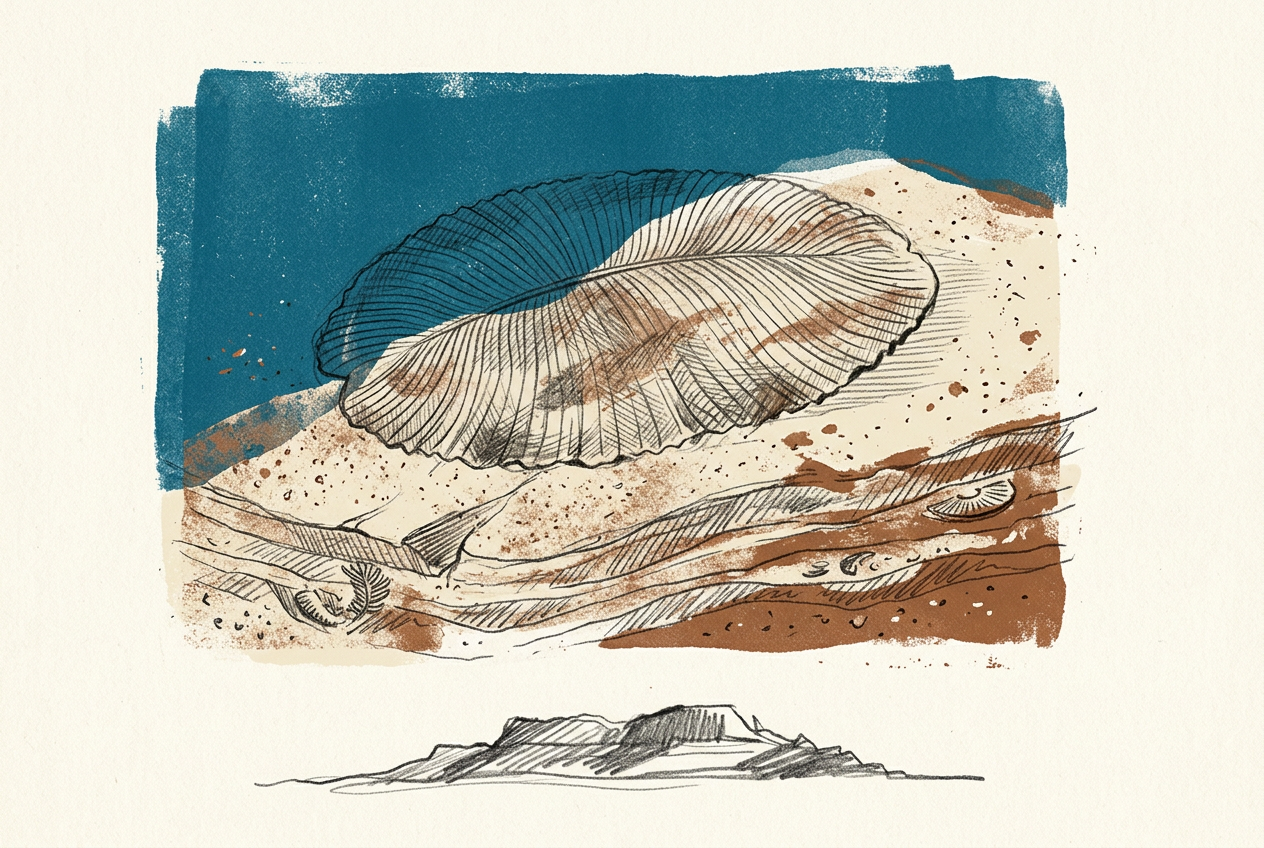
The Ediacaran organisms were unlike anything alive today. Many were frond-like or quilted, growing in place on the seafloor like living mats. Some reached a metre across but had no mouth, gut, or limbs. They absorbed nutrients directly from the water. The most famous, Dickinsonia, was an oval ribbed slab that grew by adding new segments—like a quilt being stitched larger.
The oldest complex creatures on Earth left no bones, no teeth, no shells—only their shapes pressed into the sand.
The Nilpena site, 500 kilometres north of Adelaide, has yielded the most complete picture. Bed after bed of fossil-covered sandstone has been excavated, revealing entire communities preserved where they lived. The fossils are not skeletons but casts—molds of soft bodies that were smothered by sand sheets during storms, then decayed away, leaving their shapes behind in the rock.
How the Ash Preserved the Garden
The key to the preservation lies in the sediment itself. The Ediacaran seafloor was covered in microbial mats—thin layers of bacteria that glued the sand together. When a storm dumped a fresh layer of sediment, the mat prevented the sand from mixing with the underlying mud. The organisms were buried alive, and the mat held their shapes long enough for the sediment to harden into rock.
South Australia's Flinders Ranges were repeatedly submerged and uplifted during the Delamerian Orogeny around 500 million years ago, tilting the ancient seafloor and exposing it to erosion. The same tectonic forces that built the mountains also revealed the fossils. Today, you can walk across beds that were once the floor of a shallow sea and see the impressions of creatures that lived half a billion years before the dinosaurs.
The First Footprints
The Ediacaran biota lasted for roughly 30 million years before vanishing at the start of the Cambrian. Their extinction coincided with the rise of burrowing animals and predators—creatures with guts and mouths that tore through the microbial mats and ate the stationary quilted organisms whole.
But the Ediacarans left a legacy. The Nilpena beds contain the oldest known trace fossils—marks left by moving organisms, preserved in the same microbial mats. These are not body fossils but footprints: the earliest evidence that an animal could crawl across the seafloor under its own power. The tracks are tiny, no wider than a fingernail, but they record the moment life began to move.
The Living Rock
Today, the Flinders Ranges are arid and red, scoured by wind and occasional flash floods. The same beds that held Sprigg's discovery are now a national park, and the South Australian Museum holds the world's largest collection of Ediacaran fossils. But the most remarkable thing about the site is not the fossils themselves—it is that they exist at all. Soft-bodied organisms from 560 million years ago should have decayed without a trace. That they did not is due to a perfect sequence of events: a microbial mat, a sudden burial, and 500 million years of tectonic patience.
More like this
- The 560-Million-Year-Old Garden That Never Saw a PredatorIn South Australia's Flinders Ranges, 560-million-year-old Ediacara surfaces preserve entire seafloor communities of fronds, discs, and quilts — a garden of soft-bodied life that flourished before pre
- The 300-Million-Year-Old Forest That Died Standing UpIn New South Wales, a 300-million-year-old fossil forest preserves dozens of trees buried upright by a Permian volcanic eruption—an entire ecosystem frozen in ash.
- The 1.75-Billion-Year-Old Reef That Outranks the BarrierA 1.75-billion-year-old microbial reef in the Kimberley is the largest biological structure ever built by a single species, preserving a world without predators.