5 July 2026 · 3 min read
The 510-Million-Year-Old Eye That Never Closed
How 510-million-year-old Cambrian limestone on Kangaroo Island preserves the world's oldest compound eye—a 3,000-lens eye of an extinct trilobite relative, frozen in time.
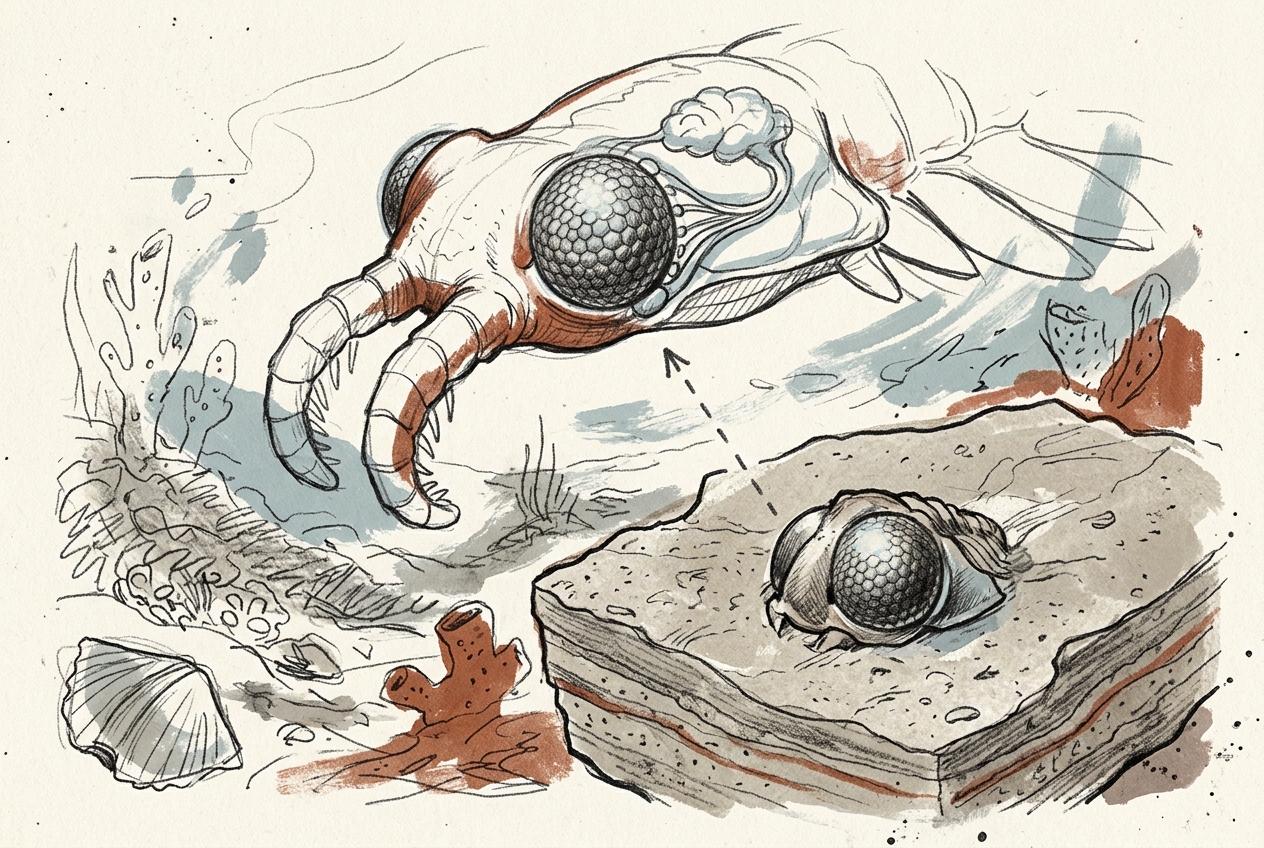
On the south coast of Kangaroo Island, a slab of grey limestone holds an eye that has not blinked for half a billion years. It is not a fossilised impression of an eye, but the eye itself—the calcite lenses still intact, still transparent, still arranged in the precise hexagonal grid that once captured light in a Cambrian sea. At 510 million years old, it is the oldest compound eye ever found.
The Lens That Became Stone
The eye belongs to an extinct arthropod called Anomalocaris, a metre-long predator that was the great white shark of its time. But the Kangaroo Island specimen is not the famous Anomalocaris—it is a close relative, Echidnacaris, named for the spiny echidna-like appearance of its frontal appendages. The creature died on a shallow seafloor that slowly turned to limestone, and its eye, made of calcite, simply refused to decay.
Compound eyes in modern insects and crustaceans are built from thousands of individual light-sensing units called ommatidia, each with its own lens. In Echidnacaris, those lenses were already pure calcite—the same mineral that forms the limestone around them. While soft tissue rotted and bones dissolved, the calcite lenses survived, locked into the rock like jewels in a bezel. When researchers split the limestone slab open in 2011, they found 3,000 lenses staring back.
The eye was not preserved in stone. It was already stone.
A Window Into Cambrian Vision
The Kangaroo Island specimen comes from the Emu Bay Shale, a fossil deposit that ranks among the world's great Cambrian Lagerstätten. Unlike the more famous Burgess Shale in Canada, which preserves soft bodies as carbon films, the Emu Bay Shale captures them in three dimensions, sealed inside calcium phosphate or calcite. The result is a level of detail that borders on the unsettling.
The eye's lenses are arranged in two distinct bands, separated by a ridge. This is not an artefact of preservation—it is the original structure, suggesting that Echidnacaris had acute vision in at least two directions at once. The largest lenses are over a millimetre across, big enough to gather light in dim water. This was an animal built for hunting, not drifting.
The Seafloor That Held Still
The Emu Bay Shale outcrops along the north coast of Kangaroo Island, near the town of Emu Bay. During the Cambrian, around 510 million years ago, this was a shallow marine shelf at the edge of the Gondwanan continent. Fine mud and occasional volcanic ash settled onto the seafloor, smothering anything that died and keeping scavengers away. The result is a snapshot of a Cambrian ecosystem, frozen in sediment.
The same deposit has yielded preserved guts, gills, and muscle tissue in other animals. But the eye is special. It is a direct record of how an animal saw the world, not just how it was built. The lenses are still optically functional—scientists have measured their refractive properties and confirmed that they would have worked as lenses, focusing light onto the retina below.
What the Eye Still Sees
The Echidnacaris eye tells us that compound vision evolved before the great Cambrian radiation was complete. Trilobites, the classic arthropods of the Palaeozoic, also had compound eyes, but their lenses were made of calcite too—a coincidence that suggests calcite was the default optical material for Cambrian arthropods. They had not yet evolved the flexible, organic lenses that insects and crustaceans use today.
Kangaroo Island today is better known for its eucalyptus forests, its sea lions, and its honey. But its limestone cliffs hold something older than any of that: the unblinking gaze of a predator that died before there were fish in the sea. The eye is now housed in the South Australian Museum, but its home is the rock. And it is still watching.
More like this
- The 560-Million-Year-Old Garden That Never Saw a PredatorIn South Australia's Flinders Ranges, 560-million-year-old Ediacara surfaces preserve entire seafloor communities of fronds, discs, and quilts — a garden of soft-bodied life that flourished before pre
- The 300-Million-Year-Old Forest That Died Standing UpIn New South Wales, a 300-million-year-old fossil forest preserves dozens of trees buried upright by a Permian volcanic eruption—an entire ecosystem frozen in ash.
- The 1.75-Billion-Year-Old Reef That Outranks the BarrierA 1.75-billion-year-old microbial reef in the Kimberley is the largest biological structure ever built by a single species, preserving a world without predators.