5 July 2026 · 3 min read
The 1.1-Billion-Year-Old Lake That Boiled the Crust
How a 1.1-billion-year-old mantle plume beneath central Australia melted the continent's crust into a 25,000-square-kilometre granite plain—the Musgrave Province—and left a record of failed rifting th
In the centre of Australia, where the Stuart Highway runs straight for two hundred kilometres past red dirt and spinifex, the ground changes without warning. The soil turns pale. Rounded domes of bare rock rise from the plain like the backs of buried animals. This is the Musgrave Province, and it was once a lake of magma twenty kilometres deep.
The Mantle That Rose
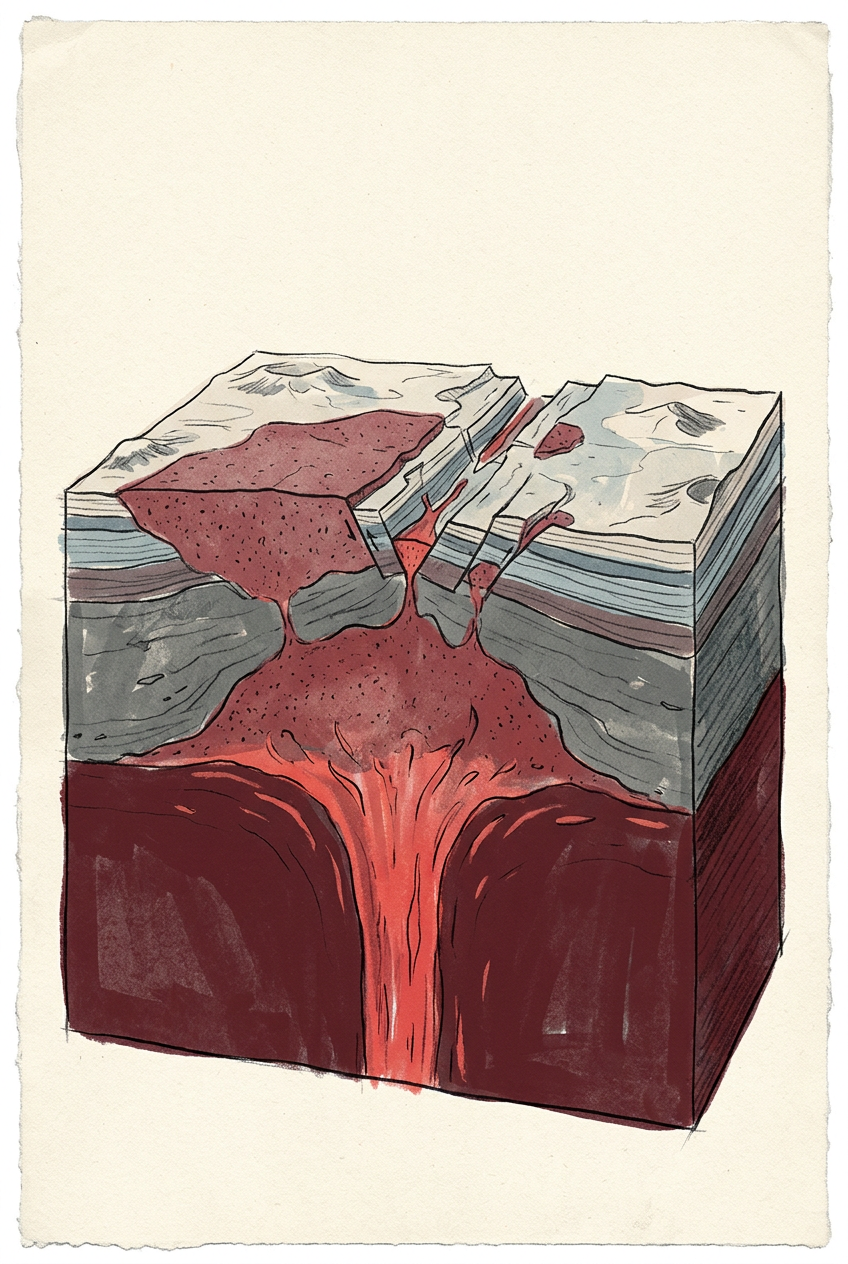
One point one billion years ago, a plume of superheated mantle rock rose from the deep Earth beneath what is now the border of South Australia, Western Australia, and the Northern Territory. It did not erupt. Instead, it stalled beneath the crust and began to cook it from below.
The heat was immense—temperatures above 1,000 degrees Celsius. The lower crust melted into a syrupy magma that slowly rose, pooling in enormous chambers. Over several million years, this molten body spread across 25,000 square kilometres, an area the size of Vermont. It never reached the surface, but it came close: the crystallised granite that now forms the Musgrave Ranges cooled at depths of only a few kilometres.
The plume never broke through. But it came close enough to leave the crust permanently changed.
What makes the Musgrave Province unusual is not its size but its composition. The magma was derived from mantle that had been chemically enriched by earlier subduction events, producing granites rich in potassium, rare earth elements, and—most tellingly—a distinctive ratio of neodymium isotopes that fingerprints the entire body as a single melting event.
The Failed Tear
The Musgrave Province sits at the junction of three ancient cratons: the Yilgarn, the Gawler, and the North Australian Craton. One point one billion years ago, this triple junction tried to tear apart.
The mantle plume that generated the magma was also driving continental rifting. Australia was then part of the supercontinent Rodinia, and the Musgrave region was a zone of extension where the crust was thinning and stretching. Had the rifting continued, a new ocean basin might have opened, splitting the continent.
It failed. For reasons still debated—perhaps a change in plate motions, perhaps the cooling of the plume—the rift stalled. The magma chambers crystallised into granite. The stretched crust cooled and stiffened. The ocean never came.
But the weakness remained. The Musgrave Province has been a zone of deformation ever since, repeatedly reactivated by later tectonic events. When central Australia was compressed during the Alice Springs Orogeny 450 million years ago, the old granite domes were thrust upward along faults that had first formed during the failed rift. The landscape we see today—the rounded hills, the pale granite outcrops—is the expression of a billion-year-old wound that never healed.
The Surface That Records the Deep
The most visible remnant of this ancient melting event is the town of Ernabella, or Pukatja, which sits on the southern flank of the Musgrave Ranges. The rock there is a coarse-grained granite called the Pitjantjatjara Granite, named for the people who have lived on this land for tens of thousands of years. It contains large crystals of feldspar, some the size of a fist, that grew slowly in the cooling magma chamber.
Walk across this granite and you are walking on the roof of a billion-year-old magma body. The domes are exfoliation features—curved sheets of rock that peel away as the overlying crust erodes, releasing the pressure that has held the granite together since the Proterozoic. The surface cracks in polygonal patterns. The feldspar crystals catch the afternoon light.
The same event produced something else: the Warburton Basin, a buried sedimentary basin to the northeast that formed as a sag above the cooling magma chamber. The basin later became a trap for natural gas, and today it is being explored for geothermal energy. The heat from the mantle plume has not entirely dissipated. One point one billion years later, the crust beneath central Australia is still warmer than the surrounding rock.
The Musgrave Province is not a dramatic landscape. There are no volcanic peaks, no black lava flows, no craters. It is a quiet place of low, rounded hills and pale stone. But it records a moment when the continent almost broke apart—and the magma that rose but never fell.
More like this
- The 110-Million-Year-Old River That Runs Backwards UndergroundWestern Australia's 110-million-year-old dune system has been slowly dissolving into a labyrinth of caves where an ancient river still flows, carrying the taste of a Cretaceous desert.
- The 5,000-Year-Old Volcanoes That Still Smoke in the SouthIn Victoria's Newer Volcanics Province, 400 volcanic vents erupted as recently as 5,000 years ago—the youngest volcanic field in mainland Australia, where craters still hold blue lakes and scoria cone
- The 300-Million-Year-Old Forest That Died Standing UpIn New South Wales, a 300-million-year-old fossil forest preserves dozens of trees buried upright by a Permian volcanic eruption—an entire ecosystem frozen in ash.