8 July 2026 · 2 min read
The 560-Million-Year-Old Fronds That Learned to Reproduce
In the Flinders Ranges, 560-million-year-old Funisia fossils preserve the oldest known evidence of sexual reproduction in the fossil record.
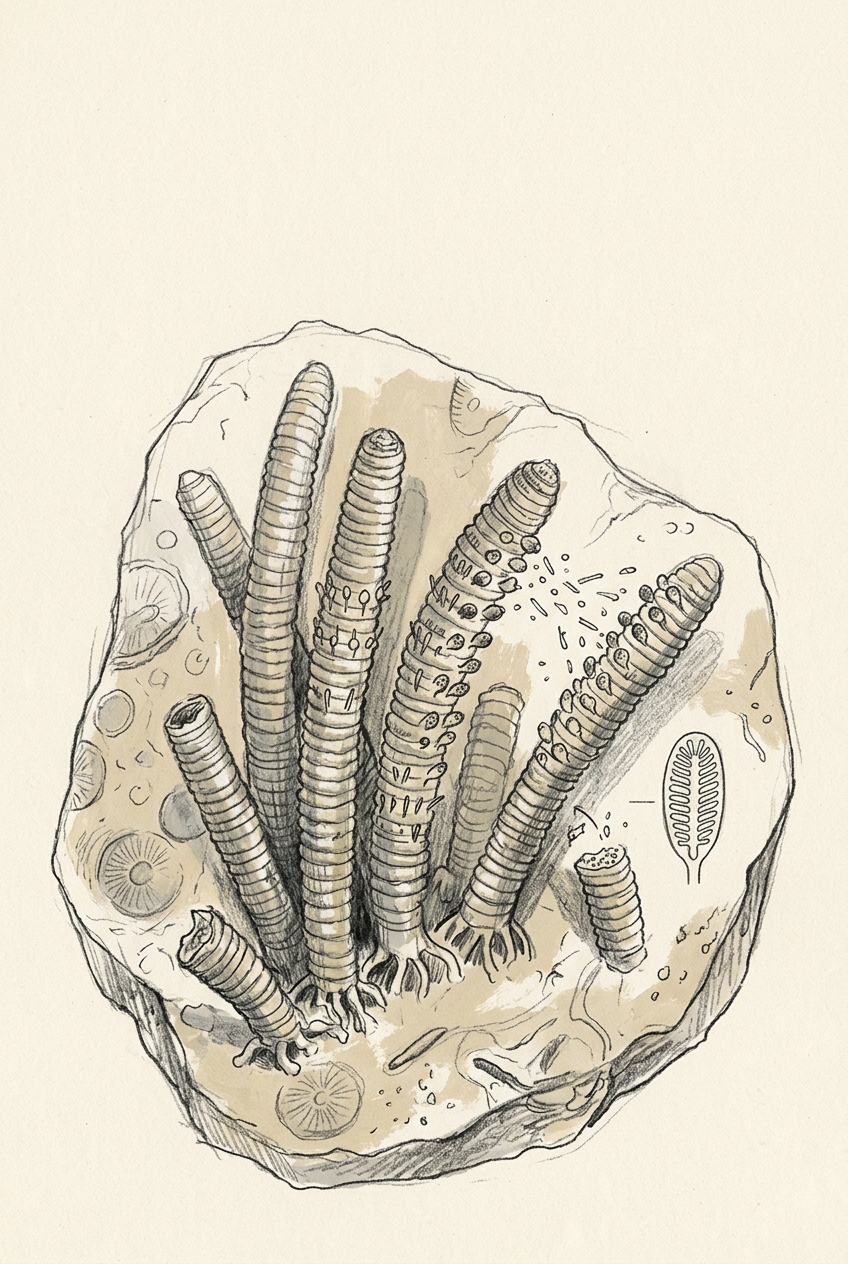
Some 560 million years ago, on a seafloor that is now the Flinders Ranges of South Australia, an organism pressed its body into the microbial mat and never moved again. That impression—a frond-like shape called Funisia—survived the entire Phanerozoic to become the oldest known fossil of sexual reproduction on Earth.
The Ediacaran Sex Life
The Ediacaran period (635–541 million years ago) was a biological experiment unlike any before or since. Soft-bodied organisms grew, fed, and died on a seafloor carpeted by microbial mats—but how they reproduced has long been a mystery. Most Ediacaran fossils are adults; juveniles are vanishingly rare.
In the Nilpena Ediacara National Park in South Australia, paleontologist Mary Droser and her team found something unexpected among the thousands of Funisia fossils preserved on sandstone slabs. The fronds appeared in two distinct size classes, not a continuous range. That bimodal distribution is a signature of sexual reproduction—offspring born at a consistent size from eggs or larvae, rather than the gradual fragmentation of asexual cloning.
A 560-million-year-old nursery, frozen in stone.
What the Fronds Tell Us
Funisia was a rangeomorph, a frond-shaped organism built from repeating branches. It stood upright on the seafloor, filtering nutrients from the water. The Nilpena slabs show clusters of small Funisia (1–4 cm) and larger adults (8–12 cm), with almost nothing in between. That gap means the young did not bud from the parents; they arrived as a cohort, likely from fertilized eggs.
This is the oldest evidence for sexual reproduction in the fossil record. It pushes the origin of complex life cycles back by tens of millions of years, before the Cambrian explosion, before skeletons, before predators. The Ediacaran seafloor was not a simple microbial world; it was already a place where organisms invested in sex.
A Seafloor Nursery
The fossil beds at Nilpena are not a death assemblage but a living landscape preserved in place. A series of storms buried the seafloor in thin layers of sand, capturing the mat, the fronds, and their spatial arrangement. The small Funisia are not scattered randomly; they cluster in patches, as if the larvae settled together in favorable spots.
The preservation is exquisite. Even the organic film of the microbial mat is visible as a wavy texture on the rock surface. The fronds show the fine branching of their rangeomorph bodies, each leaflet a few millimeters wide. It is as close as we will ever get to watching an Ediacaran nursery.
Why It Matters
Sexual reproduction requires more energy than cloning. It demands that an organism produce gametes, find a mate, and raise young that are genetically distinct. The fact that Funisia—a simple frond—had already evolved this strategy by 560 million years ago means that the Ediacaran biota was not a dead end. These were not failed experiments; they were ancestors.
When the Cambrian explosion began 20 million years later, the genetic toolkit for complex development was already in place. The fronds of Nilpena are not curiosities. They are the oldest family portraits we have.
More like this
- The 560-Million-Year-Old Garden That Never Saw a PredatorIn South Australia's Flinders Ranges, 560-million-year-old Ediacara surfaces preserve entire seafloor communities of fronds, discs, and quilts — a garden of soft-bodied life that flourished before pre
- The 300-Million-Year-Old Forest That Died Standing UpIn New South Wales, a 300-million-year-old fossil forest preserves dozens of trees buried upright by a Permian volcanic eruption—an entire ecosystem frozen in ash.
- The 1.75-Billion-Year-Old Reef That Outranks the BarrierA 1.75-billion-year-old microbial reef in the Kimberley is the largest biological structure ever built by a single species, preserving a world without predators.