8 July 2026 · 3 min read
The 250-Million-Year-Old Shark Teeth That Turned to Opal
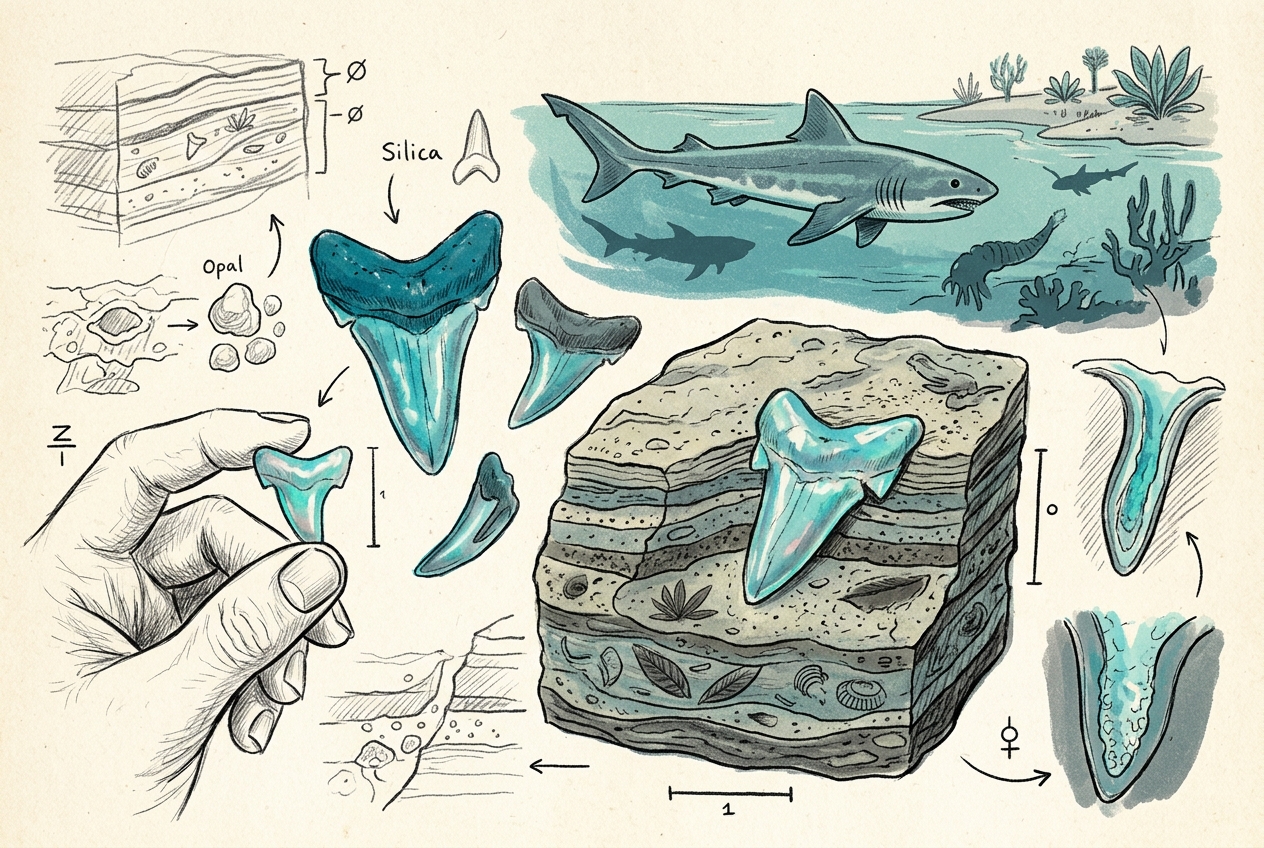
In the Gunnedah Basin, 250-million-year-old shark teeth have been replaced by precious opal—silica ghosts that preserve the shape of an ancient inland sea.
On the high plains of New South Wales, not far from the town of Gunnedah, the ground is littered with the teeth of sharks that swam in a sea that vanished 250 million years ago. But this is no ordinary fossil bed: the teeth are made not of bone or enamel, but of the same mineral that forms the blue-white fire of a diamond engagement ring.
The Great Artesian Basin's Secret
The Gunnedah Basin is part of the vast Great Artesian Basin, a 1.7-million-square-kilometre saucer of sedimentary rock that underlies a fifth of Australia. Between 300 and 250 million years ago, during the Permian and Triassic, this region was a shallow inland sea—warm, oxygen-poor, and rich in silica dissolved from volcanic ash.
Sharks swam those waters, and when they died, their teeth fell to the seafloor. Most were buried in fine muds and sandstones. But in a narrow band of rock known as the Narrabri Formation, something unusual happened. The silica-rich groundwater that percolated through the sediments began to replace the original calcium phosphate of the shark teeth, molecule by molecule, until nothing remained but microcrystalline quartz.
The result was opal.
How Opal Forms in a Tooth
Opal is not a mineral in the strict sense—it is a hydrated silica gel that hardens into a disordered, non-crystalline structure. Precious opal, the kind that flashes green, blue, and red, owes its colour to tiny spheres of silica arranged in a regular lattice that diffracts light like a diffraction grating.
In the Gunnedah Basin, the replacement happened slowly, in spaces where groundwater moved at a crawl. The shark teeth acted as chemical templates. The original collagen framework of the dentine was dissolved away, and silica precipitated in its place, preserving every microscopic canal and pulp cavity. The result is a fossil that is, in a literal sense, a gemstone in the shape of a tooth.
These are not the only opalised fossils in Australia—Lightning Ridge, 150 kilometres to the north, is famous for opalised dinosaur bones and shells. But the Gunnedah shark teeth are older, and they formed in a different way. At Lightning Ridge, opal filled cavities left by decaying organic matter. In Gunnedah, it replaced the original tissue itself.
The tooth is no longer a tooth; it is a ghost of silica that remembers the shape of a shark's mouth.
A Seafloor That Became a Desert
The inland sea that once covered eastern Australia was not permanent. It advanced and retreated dozens of times as the continent drifted northward out of polar latitudes. By the early Jurassic, the sea was gone entirely, replaced by river plains and then by the dry landscapes of today.
The sedimentary rocks that preserved the shark teeth were themselves buried under younger sediments, then slowly exhumed by erosion. Today, the opalised teeth weather out of the Narrabri Formation and are scattered across the surface, where farmers and fossickers find them after rain.
Most are small—a centimetre or two long—and unremarkable at first glance. But when wet, or cut and polished, they reveal the characteristic play-of-colour that makes opal precious. Some are blue-green, others fire-red. A few preserve the serrated edges of the original tooth, still sharp enough to draw blood.
What the Teeth Tell Us
These opalised teeth are not just curiosities. They are snapshots of a vanished ecosystem. The sharks that left them were small, probably bottom-feeders, related to the modern horn shark. Their teeth are broad and crushing, adapted for eating shellfish and crustaceans.
The presence of opal itself is a clue. For silica to precipitate and replace organic tissue, the groundwater must have been alkaline and rich in dissolved silica—conditions that point to volcanic activity in the surrounding highlands, weathering of silica-rich rocks, and a slow rate of sedimentation that allowed the chemical reactions to proceed.
In other words, the opalised shark teeth of Gunnedah record not only the existence of an ancient sea, but the chemistry of that sea, the volcanic landscape that fed it, and the slow, patient work of groundwater over millions of years.
They are, in their small way, as informative as any core sample or seismic image. And they are beautiful enough to wear on a ring.
More like this
- The 560-Million-Year-Old Garden That Never Saw a PredatorIn South Australia's Flinders Ranges, 560-million-year-old Ediacara surfaces preserve entire seafloor communities of fronds, discs, and quilts — a garden of soft-bodied life that flourished before pre
- The 300-Million-Year-Old Forest That Died Standing UpIn New South Wales, a 300-million-year-old fossil forest preserves dozens of trees buried upright by a Permian volcanic eruption—an entire ecosystem frozen in ash.
- The 1.75-Billion-Year-Old Reef That Outranks the BarrierA 1.75-billion-year-old microbial reef in the Kimberley is the largest biological structure ever built by a single species, preserving a world without predators.