8 July 2026 · 3 min read
The 1.6-Billion-Year-Old Volcano That Became a Mountain of Iron
The Middleback Ranges were built from 1.6-billion-year-old volcanic iron, folded by a continental collision, and mined for over a century.
On the Eyre Peninsula of South Australia, a 1.6-billion-year-old volcano has turned into a mountain of pure iron. The Middleback Ranges are not ranges in the usual sense—they are the folded, eroded guts of a Precambrian volcanic arc, and they have fed every blast furnace in Australia for a century.
The Volcano That Became Ore
Around 1.6 billion years ago, a chain of submarine volcanoes erupted along the edge of the Gawler Craton. They were not the explosive kind. These were hot, iron-rich hydrothermal systems—black smokers, vent fields, and seafloor springs—that pumped dissolved iron and silica into a shallow Proterozoic sea.
The iron came from deep within the Earth, carried by superheated water circulating through the volcanic crust. When that water hit cold seawater, the iron precipitated out as iron oxide and iron silicate minerals, settling in layers on the seafloor. Over tens of thousands of years, the process built thick bands of hematite and magnetite interleaved with chert and shale.
Geologists call these rocks banded iron formations, or BIFs. The Middleback Ranges preserve some of the thickest and purest examples on Earth.
The Fold That Made It Minable
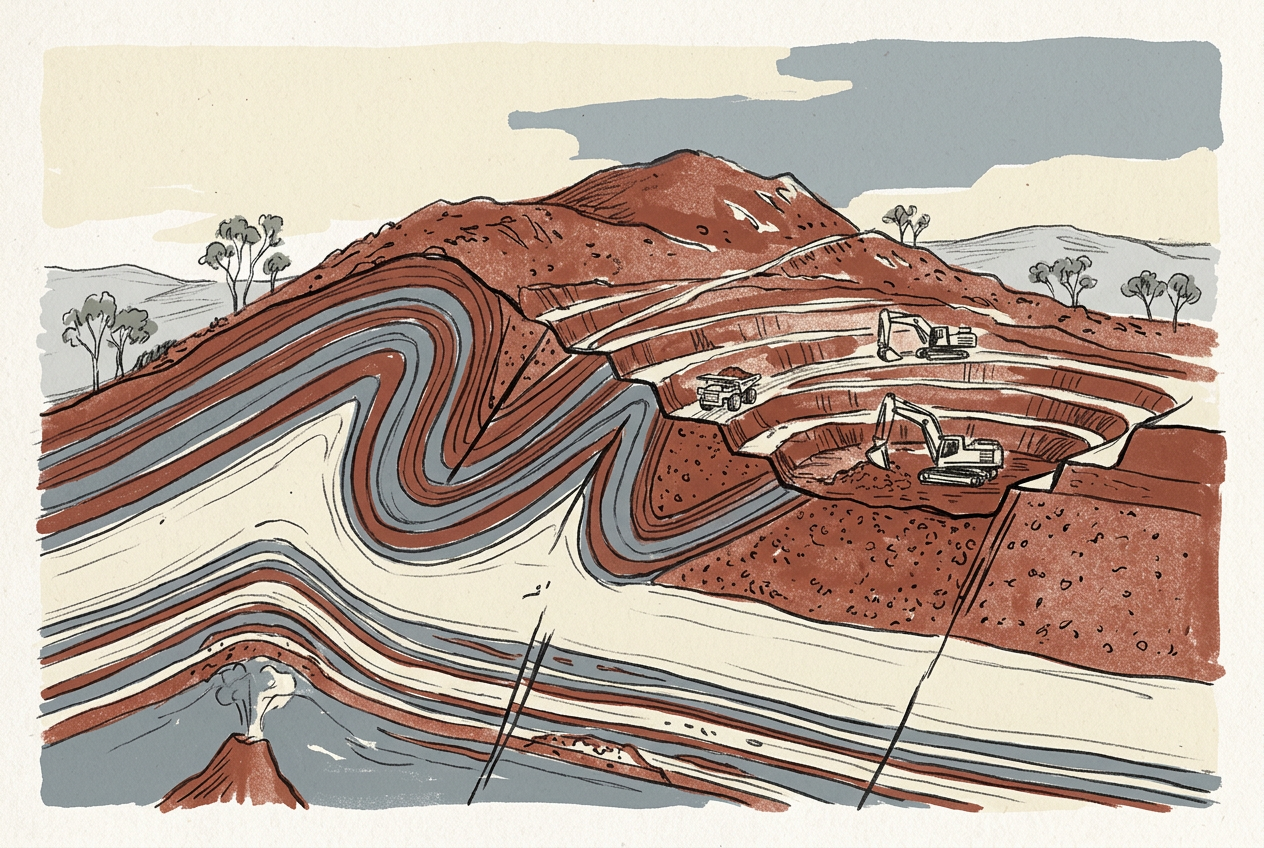
What made the Middleback Ranges valuable was not the iron itself—it was the deformation. Around 1.5 billion years ago, the Gawler Craton collided with another block of continental crust, compressing the ancient seafloor into tight folds. The banded iron formations were tilted upright, thickened in the hinges of the folds, and brought close to the surface.
Erosion did the rest. Over the next billion years, softer surrounding rocks were stripped away, leaving the iron-rich beds standing as ridges. The modern landscape is an inverted topography: what was once the bottom of a volcanic sea is now a series of parallel ridges rising 200–300 metres above the plain.
The deposits are not uniform. Some beds run 90 per cent iron—among the highest-grade natural iron ore in the world. Others contain enough silica that the ore must be beneficiated before smelting.
The Middleback Ranges are a billion-year-old accident of geology: a volcano, a sea, a collision, and a long, patient erosion.
The Mines Beneath the Ridges
Iron mining began in the Middleback Ranges in 1901, when the BHP company opened the Iron Knob quarry. That single deposit supplied the steel that built the Sydney Harbour Bridge, the Trans-Australian Railway, and the weapons of two world wars. By the 1930s, Iron Knob was the most productive iron mine in the British Empire.
Today, the mining operations have moved south to Iron Duke, Iron Baron, and the massive open pit at Peculiar Knob—a deposit so pure that the ore is simply crushed and shipped without processing. The town of Whyalla, built entirely to service the mines and their steelworks, still depends on the volcanic iron that erupted 1.6 billion years ago.
The Chemistry That Built a Nation
Australia's iron ore story is usually told through the Pilbara, where the Hamersley Ranges hold the world's largest BIF deposits. But the Middleback Ranges are older, more folded, and in some ways more instructive. They show that not all iron ore comes from the same kind of geology.
The Pilbara ores formed in a quiet, stable basin. The Middleback ores formed above an active volcanic arc, then were compressed by a mountain-building event, then exposed by deep erosion. Each step added purity. Each step made the ore easier to reach.
The Eyre Peninsula's iron mines are not as large as those in the northwest. But they have been running for longer, and they tell a different story about how the continent was assembled—one volcanic vent, one hydrothermal plume, one tectonic collision at a time.
More like this
- The 5,000-Year-Old Volcanoes That Still Smoke in the SouthIn Victoria's Newer Volcanics Province, 400 volcanic vents erupted as recently as 5,000 years ago—the youngest volcanic field in mainland Australia, where craters still hold blue lakes and scoria cone
- The 560-Million-Year-Old Garden That Never Saw a PredatorIn South Australia's Flinders Ranges, 560-million-year-old Ediacara surfaces preserve entire seafloor communities of fronds, discs, and quilts — a garden of soft-bodied life that flourished before pre
- The 300-Million-Year-Old Forest That Died Standing UpIn New South Wales, a 300-million-year-old fossil forest preserves dozens of trees buried upright by a Permian volcanic eruption—an entire ecosystem frozen in ash.