10 July 2026 · 2 min read
The 560-Million-Year-Old Fronds That Learned to Grow Tall
In the Flinders Ranges, 560-million-year-old fossils of the Ediacaran organism Rangea record the first known attempt at vertical growth—fronds that stood above the microbial mat, competing for food in
The first tall thing on Earth was not a tree. It was a frond.
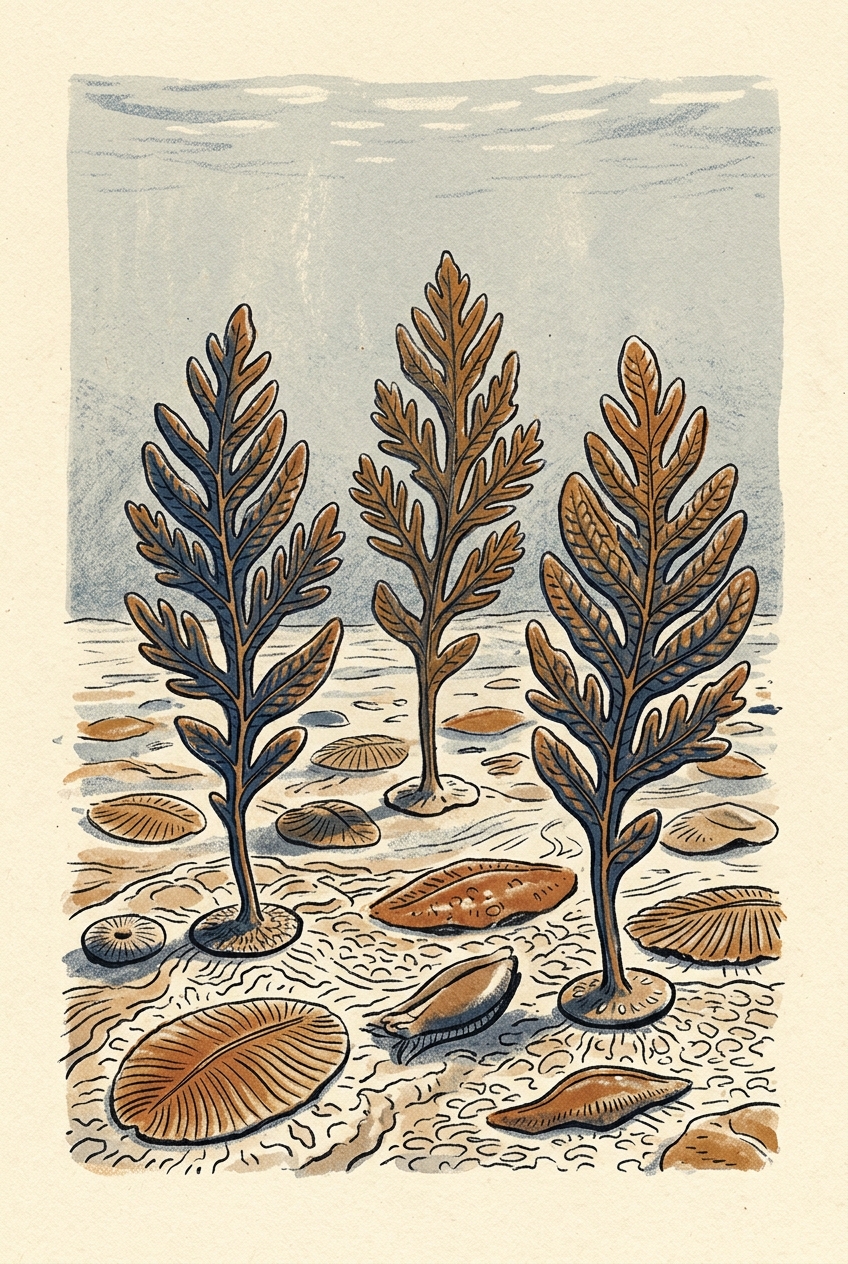
In the Flinders Ranges of South Australia, 560-million-year-old slabs of sandstone preserve the fossils of Rangea—a soft-bodied organism that looked like a fern, grew to half a metre, and stood upright in the current. Before Rangea, nearly all life lay flat. Microbial mats carpeted the seafloor. Dickinsonia crawled across them like creeping pancakes. But Rangea did something new: it reached up.
A Frond That Fed from the Flow
Rangea belonged to the rangeomorphs, a group of Ediacaran organisms whose fractal branching bodies baffled palaeontologists for decades. Each frond was built from repeating units that split into smaller copies of themselves, like a snowflake designed by a mathematician. There was no mouth, no gut, no organs. The entire surface absorbed nutrients directly from seawater.
The key innovation was height. By growing above the mat, Rangea accessed faster-moving water where dissolved organic matter was more abundant. It was the first organism to exploit the third dimension—to compete for food by growing taller than its neighbours, not wider. The frond was anchored by a holdfast, a bulbous base that gripped the sandy seafloor. When currents shifted, the flexible stem bent. When they strengthened, it stood rigid.
The frond was the first skyscraper, built not of steel but of fractal tissue in a world without predators.
A Garden in the Ediacaran
The fossils occur in the Rawnsley Quartzite, a formation of fine-grained sandstone that preserved these soft bodies as casts and moulds. The beds were deposited by storms that buried whole communities in moments, freezing the seafloor in place. At Nilpena Ediacara National Park, researchers have excavated dozens of bedding planes, each one a snapshot of an ancient garden.
Rangea did not grow alone. It shared the seafloor with Dickinsonia, Tribrachidium, and Funisia—a community of fronds, discs, and tubes that formed the first complex ecosystems on Earth. But Rangea was the tallest. In the densest patches, the fronds stood spaced apart like saplings in a forest, each one claiming its own column of current. The spacing suggests competition—a silent struggle for access to flow, played out over millennia.
The Limits of Soft Architecture
Rangea had no skeleton, no woody tissue, no rigid support. Its height came from turgor pressure—fluid held inside the branching chambers, stiffening the frond like an inflatable structure. This worked in the quiet Ediacaran seas, where the biggest threat was a storm, not a predator.
When the Cambrian explosion began, 40 million years later, animals evolved mouths, guts, and shells. The first predators arrived, and the soft fronds became vulnerable. Rangeomorphs vanished. But the principle they discovered—grow tall to catch more—did not. It reappeared in Cambrian sponges, in Ordovician corals, in Devonian trees. Every stalk, every stem, every trunk on Earth descends from the same solution to an ancient problem.
The fronds of the Flinders Ranges left no descendants. But they left the pattern. And the pattern still stands. In the fossil beds of Nilpena, the oldest tall things on Earth lie flattened on stone—but in life, they were the first to reach for something more. They learned to grow tall, and the world has never been flat since.
More like this
- The 560-Million-Year-Old Garden That Never Saw a PredatorIn South Australia's Flinders Ranges, 560-million-year-old Ediacara surfaces preserve entire seafloor communities of fronds, discs, and quilts — a garden of soft-bodied life that flourished before pre
- The 300-Million-Year-Old Forest That Died Standing UpIn New South Wales, a 300-million-year-old fossil forest preserves dozens of trees buried upright by a Permian volcanic eruption—an entire ecosystem frozen in ash.
- The 1.75-Billion-Year-Old Reef That Outranks the BarrierA 1.75-billion-year-old microbial reef in the Kimberley is the largest biological structure ever built by a single species, preserving a world without predators.