8 July 2026 · 3 min read
The 560-Million-Year-Old Burrow That Broke the World
560-million-year-old burrows in South Australia's Flinders Ranges record the moment animals first dug into the seafloor, collapsing the ancient microbial mat world and setting the stage for the Cambri
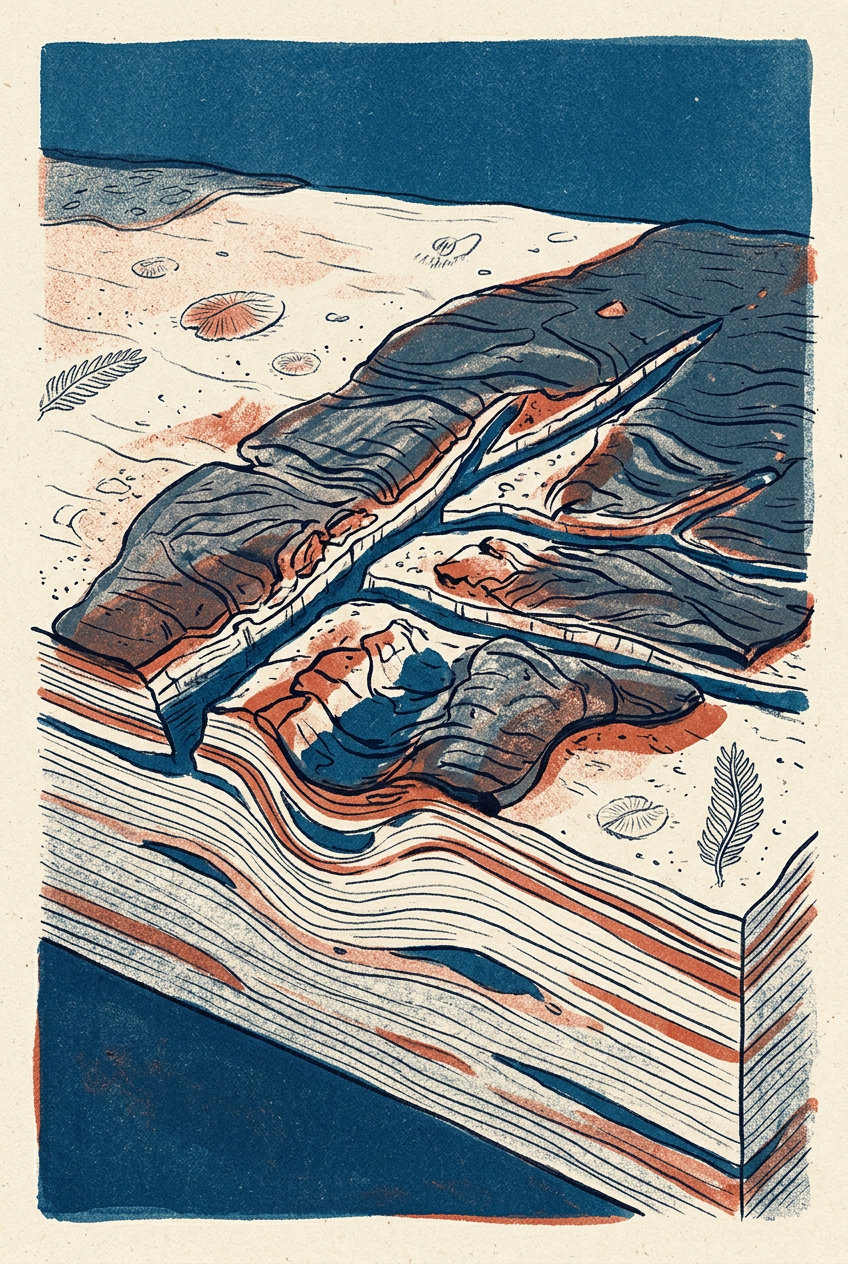
On the seafloor of South Australia, 560 million years ago, a creature no bigger than a rice grain punched a hole in the muddy bottom and pulled itself through. That burrow—a simple tube called Helminthoidichnites—is the oldest known evidence of an animal disturbing sediment in three dimensions. Before it, life lay flat on the seafloor like a living skin. After it, the planet's surface was never still again.
The Flat World
For most of the Ediacaran Period (635–541 million years ago), the seafloor was a quiet place. Microbial mats—sticky films of bacteria and algae—covered the sediment like a living carpet. The strange, quilted organisms of the Ediacaran biota (Dickinsonia, Spriggina, Tribrachidium) sat on top of these mats, absorbing nutrients directly through their bodies. They did not dig, burrow, or churn the seabed.
This world of flat surfaces and immobile life is preserved in the Flinders Ranges of South Australia, where the Nilpena Ediacara National Park exposes fossil beds that look like slabs of grey sandstone stamped with leaf-like impressions. For 30 million years, nothing moved below the surface.
The First Excavator
Then, around 560 million years ago, something changed. A small bilaterian worm—an animal with a left and right side, a front and back, and a gut—evolved the ability to push through sediment. The trace fossil it left behind is deceptively simple: a horizontal burrow, 1–5 millimetres wide, meandering through the mud. But it represents a revolution in animal behaviour.
These burrows appear in the Ediacara Member of the Rawnsley Quartzite, the same formation that preserves Dickinsonia and other soft-bodied fossils. The worms were small, but their impact was enormous. They were the first ecosystem engineers, turning over the seafloor in a way that oxygenated sediment, recycled nutrients, and created new habitats for other organisms.
The burrow that broke the microbial seal was the first step toward a world of roots, reefs, and earthworms.
The End of the Matground
Once burrowing began, the Ediacaran seafloor changed forever. The microbial mats that had dominated for hundreds of millions of years depended on an undisturbed surface. Burrowing tore them apart, exposing organic matter to decay and reducing the oxygen supply at the sediment-water interface. The matground ecosystem collapsed.
This is not speculation. In the Flinders Ranges, the fossil record shows a clear pattern: beds that contain abundant trace fossils have fewer body fossils of the classic Ediacaran biota. The burrowing worms were competitors—and they won. By the dawn of the Cambrian Period (541 million years ago), animals had evolved more sophisticated burrowing behaviours, including vertical shafts and U-shaped tunnels. The seafloor was no longer a flat, passive surface; it was a three-dimensional, dynamic environment.
The Legacy of a Worm
The appearance of bioturbation—the mixing of sediment by organisms—is one of the most important events in Earth history. It changed the chemistry of the seafloor, altered the global carbon cycle, and paved the way for the complex ecosystems of the Phanerozoic. Without that first worm, the Cambrian explosion might never have happened.
Today, the evidence is preserved in the red hills of the Flinders Ranges, where you can still walk on a 560-million-year-old seafloor and see the marks of the first animals that dug. They were small, soft, and ephemeral, but they left a permanent scar on the planet.
More like this
- The 560-Million-Year-Old Garden That Never Saw a PredatorIn South Australia's Flinders Ranges, 560-million-year-old Ediacara surfaces preserve entire seafloor communities of fronds, discs, and quilts — a garden of soft-bodied life that flourished before pre
- The 300-Million-Year-Old Forest That Died Standing UpIn New South Wales, a 300-million-year-old fossil forest preserves dozens of trees buried upright by a Permian volcanic eruption—an entire ecosystem frozen in ash.
- The 1.75-Billion-Year-Old Reef That Outranks the BarrierA 1.75-billion-year-old microbial reef in the Kimberley is the largest biological structure ever built by a single species, preserving a world without predators.